
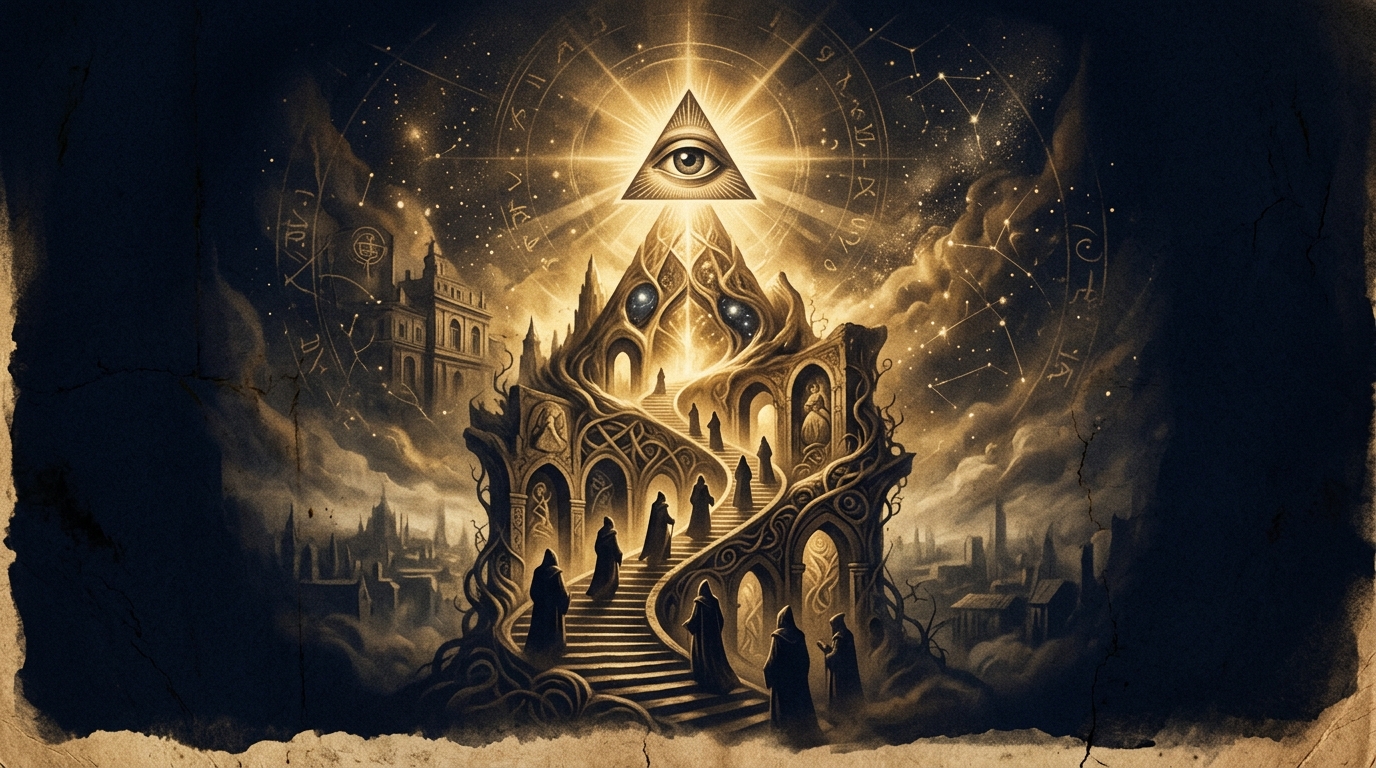
 Codex Illustration
Illuminati
Founded in 1776 by Bavarian professor Adam Weishaupt as a rational, anti-clerical secret society, the Illuminati was suppressed within a decade — yet its shadow has grown only longer in the centuries since, metastasizing into the most sprawling conspiracy mythology of the modern age.
Overview
On May 1, 1776, Adam Weishaupt — a professor of canon law at the University of Ingolstadt and a man deeply shaped by Enlightenment philosophy — founded the Order of the Illuminati, formally known as the Illuminatenorden, in Bavaria. The historical record on this point is unambiguous. Weishaupt's original aims were rationalist and anti-superstitious: he sought to oppose what he regarded as religious obscurantism and the political influence of the Jesuits, to cultivate philosophical free-thinking among an elite membership, and to promote a vision of secular moral improvement. The order attracted perhaps 2,000 members at its height — including, notably, the writer Johann Wolfgang von Goethe and Duke Ernst II of Saxe-Gotha-Altenburg — and operated through a hierarchical cell structure partly borrowed from Masonic practice. In 1784 and 1785, the Bavarian government of Elector Charles Theodore issued edicts banning the order, raided its archives, and published its internal documents. By 1787, the historical Illuminati had, by all credible scholarly accounts, ceased to function as an organized body.
The disproportion between the order's actual lifespan — roughly a decade — and its mythological afterlife is one of the most striking phenomena in the history of ideas. The first major wave of post-suppression Illuminati mythology emerged almost immediately: in 1797, the Scottish physicist John Robison published his influential and polemical work Proofs of a Conspiracy, arguing that the Illuminati had secretly survived, infiltrated Freemasonry, and orchestrated the French Revolution. The Abbé Augustin Barruel made similar arguments in his Memoirs Illustrating the History of Jacobinism. Historians of ideas note that these works were produced in a climate of genuine revolutionary upheaval, in which the search for hidden architects of disorder was understandable if ultimately unsupported. Modern scholarship — exemplified by Richard van Dülmen's meticulous 1975 German monograph on the order — confirms that no credible evidence exists for the survival of an organized Illuminati after 1787.
The modern mythology of the Illuminati bears little resemblance to the historical organization beyond the name. The pivotal cultural reinvention came in 1975 with Robert Shea and Robert Anton Wilson's satirical Illuminatus! trilogy, which blended genuine conspiracy lore, countercultural philosophy, and deliberate absurdism into a sprawling fictional universe. Wilson, a careful and witty thinker, intended his work partly as a meditation on the psychology of pattern-recognition and the seductive grammar of conspiracy thinking. The trilogy was hugely influential, inadvertently providing a template that subsequent popular culture — from Dan Brown's Angels and Demons to a vast ecosystem of internet forums — largely decontextualized from its satirical intent. Today, the word 'Illuminati' functions as a floating signifier: a catch-all label applied to bankers, politicians, entertainers, and international institutions, alleged to be coordinating a New World Order through control of media, finance, and government. No independently verified evidence supports this claim.
Why does the myth persist? Scholars of conspiracy culture — including Michael Barkun in A Culture of Conspiracy and Kathryn Olmsted in Real Enemies — point to several overlapping factors. First, elite networks genuinely exist: institutions like the Bilderberg Group, the Council on Foreign Relations, and the World Economic Forum hold private meetings that make decisions affecting millions of people, and the opacity of real power creates a legitimate substrate for suspicion. Second, human cognition is exceptionally well-adapted to detecting agency and pattern, sometimes at the cost of false positives — a phenomenon psychologists call 'apophenia.' Third, the symbol most commonly cited as 'Illuminati' — the Eye of Providence above an unfinished pyramid, as found on the reverse of the United States Great Seal — predates Weishaupt's order and carries a rich history in Christian and Masonic iconography unrelated to any putative Illuminati survival. Understanding why this particular mythology endures tells us something important not about secret cabals, but about human nature, the sociology of mistrust, and the grammar of explanation in a complex world.
Key Claims
Timeline
Evidence
Multiple Perspectives
Biblical Lens
Scripture Threads
Sources & Further Study
Questions to Explore
Go Deeper Path
Follow the Thread
Continue the Investigation
You’ve reached the Full Archive portion of this Case File.
Ask the Archivist
about this fileSign in to ask the Archivist
Create a free account to ask the Archivist 1 grounded question each day, cited straight from the CODEX case files.
Discussion
0Share findings, questions, and evidence with fellow Seekers. Be respectful and cite sources where you can.
No comments yet. Be the first to open this thread.