
 Codex Illustration
Indrid Cold
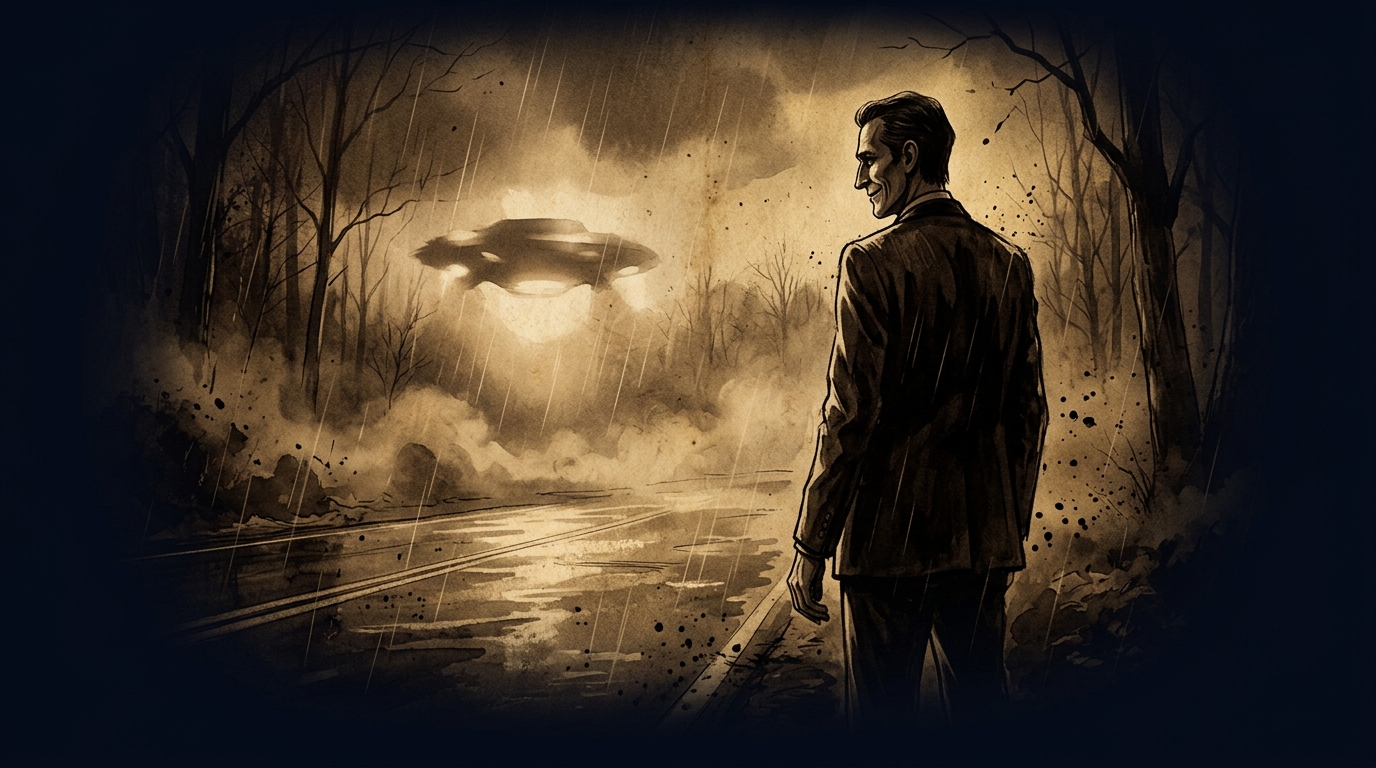
In the autumn of 1966, a West Virginia sewing machine salesman named Woodrow Derenberger reported being stopped on a rain-slicked highway by a craft of unknown origin, whose occupant — a grinning, dark-suited figure who called himself Indrid Cold — communicated with him wordlessly and claimed to come from a world called Lanulos. The encounter became one of the strangest footnotes in American paranormal history, woven permanently into the broader tapestry of the Mothman era and the enduring folklore of non-human contact.
Overview
On the evening of November 2, 1966, Woodrow Wilson Derenberger, a resident of Mineral Wells, West Virginia, reported that his truck was overtaken on Interstate 77 near Parkersburg by a gray, elongated craft he described as resembling an old-fashioned kerosene lamp shade. According to Derenberger's own account — which he gave freely and repeatedly to police, journalists, and investigators — a hatch opened and a man emerged: tall, broad-shouldered, with a deep tan complexion, slicked dark hair, and an expression of fixed, unbroken grinning. The figure did not speak aloud; Derenberger claimed the exchange was entirely telepathic. The being identified himself as Indrid Cold, stated that he was 'a searcher,' and indicated he meant no harm. He asked only a few simple questions about the town ahead before retreating to his craft and departing. Derenberger filed a report with Parkersburg police the same night, and his account was covered in local news within days. Whatever one makes of the content, the original report's timeline is documented: police records and newspaper coverage from November 1966 confirm that Derenberger did come forward promptly, which distinguishes the case from many purely retrospective UFO claims.
Derenberger's story did not stop at a single highway encounter. Over the months that followed — precisely the same period during which Point Pleasant, West Virginia, was gripped by the wave of sightings later dubbed 'the Mothman' — he claimed ongoing telepathic contact with Indrid Cold, eventual face-to-face visits, and ultimately an invitation to travel to Cold's home planet, which he described as a lush, pleasant world called Lanulos located somewhere in the Ganymede region of the galaxy. Derenberger eventually co-authored a book, 'Visitors from Lanulos' (1971), with co-author Harold Hubbard, in which he elaborated these experiences at length. Paranormal investigator John Keel, who was in West Virginia during this same period researching the Mothman phenomenon and would later publish 'The Mothman Prophecies' (1975), interviewed Derenberger and treated his account as part of a larger pattern of what Keel called 'ultraterrestrial' contact — entities that Keel believed were not extraterrestrial in origin but were instead something far stranger, possibly native to our own reality and operating on frequencies of perception humans rarely access.
The figure of Indrid Cold occupies an unusual position in the landscape of twentieth-century anomalous phenomena. Unlike the vast majority of alleged contactee figures — who typically describe benevolent Space Brothers resembling idealized Caucasian humans, offering uplift and warnings about nuclear war — Cold's defining feature is that grin: fixed, wide, and in the estimation of those who have studied the case, deeply unsettling rather than reassuring. This uncanny quality links him conceptually to a broader class of folkloric and reported entities characterized by expressions or behaviors that seem to mimic human affect without genuine inner correspondence. Researchers such as Loren Coleman and Patrick Huyghe have noted, in their survey work on humanoid entity reports, that the 'grinning man' type recurs across multiple independent cases in the same era, suggesting either a shared archetypal hallucination, a coordinated cultural narrative, or — if taken at face value — a non-human intelligence presenting a disturbingly imperfect simulation of human friendliness. The Derenberger case also parallels, in structure if not in detail, the broader contactee tradition documented by researchers such as Jacques Vallée, who argued in works such as 'Passport to Magonia' (1969) that UFO contact reports share deep structural DNA with centuries-old folklore concerning encounters with fairy beings, djinn, and similar liminal intelligences.
In the decades following the original events, Indrid Cold migrated from local West Virginia folklore into broader popular culture, most notably through John Keel's 'The Mothman Prophecies' and the 2002 film adaptation. The character has since become a recurring figure in internet-era creepypasta, horror fiction, and paranormal social media, which has made rigorous historical analysis increasingly difficult as the folkloric accretion compounds. Woodrow Derenberger himself continued to maintain his account until his death in 1990, reportedly experiencing social estrangement and personal difficulties he attributed to the aftermath of his contacts. Whether Derenberger was a sincere witness to something genuinely inexplicable, a man whose perception was shaped by psychological or environmental factors, or a storyteller whose account took on a life of its own, his place in the record of anomalous phenomena is secure — and Indrid Cold remains one of the most haunting, and most precisely named, figures in the literature of alleged non-human contact.
Key Claims
Timeline
Evidence
Multiple Perspectives
Biblical Lens
Scripture Threads
Sources & Further Study
Questions to Explore
Go Deeper Path
Follow the Thread
Continue the Investigation
You’ve reached the Full Archive portion of this Case File.
Ask the Archivist
about this fileSign in to ask the Archivist
Create a free account to ask the Archivist 1 grounded question each day, cited straight from the CODEX case files.
Discussion
0Share findings, questions, and evidence with fellow Seekers. Be respectful and cite sources where you can.
No comments yet. Be the first to open this thread.