
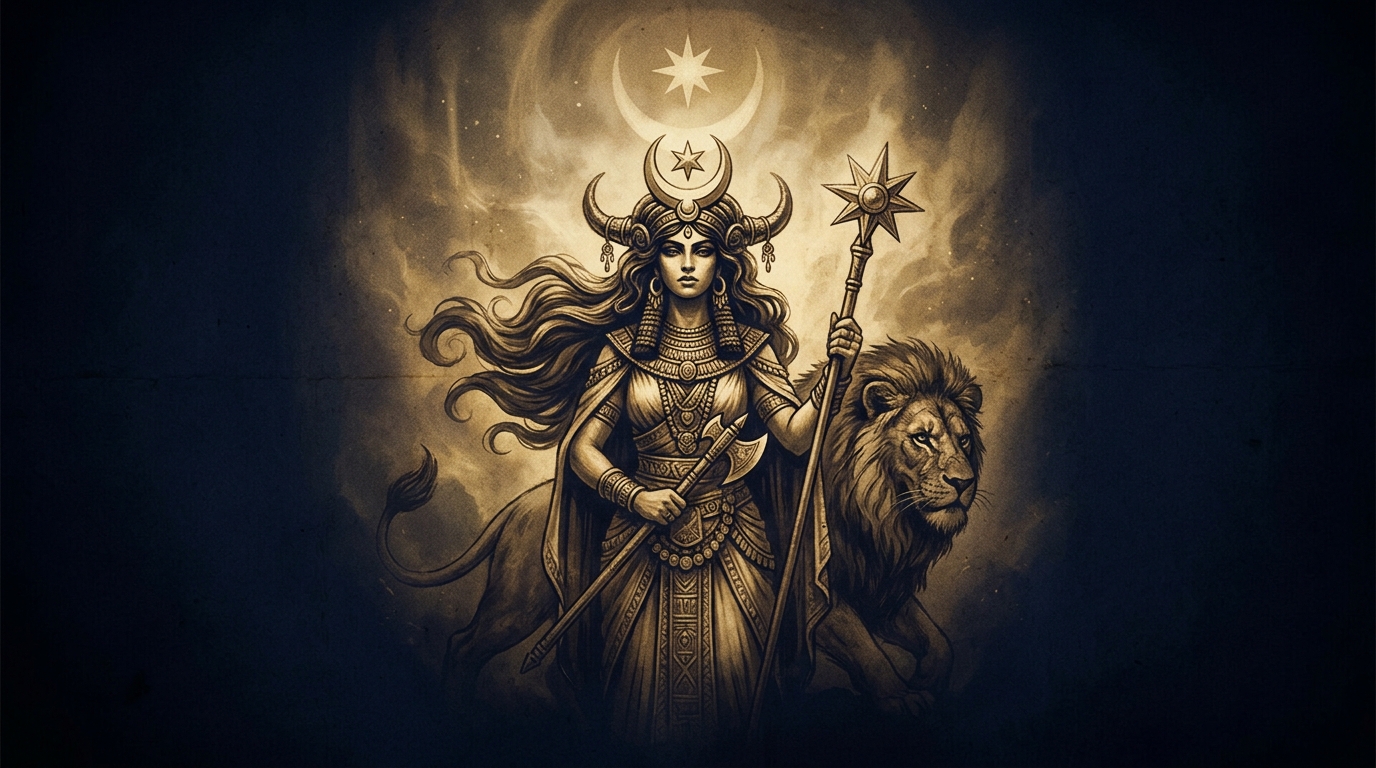
 Codex Illustration
Ishtar
Ishtar — known to the Sumerians as Inanna — was among the most widely venerated deities of the ancient world: goddess of love, war, and the morning star, whose myths of descent, resurrection, and divine fury echo across three thousand years of Mesopotamian religious life and cast long shadows into the biblical record.
Overview
From the earliest Sumerian city-temples of the fourth millennium BC to the grand processional avenues of Nebuchadnezzar's Babylon, Ishtar (Sumerian: Inanna) occupied a singular position in the divine hierarchy of the ancient Near East. She was simultaneously the goddess of erotic love and of martial devastation — a pairing that struck ancient worshippers not as contradictory but as a unified expression of overwhelming, boundary-dissolving power. Attested in thousands of cuneiform tablets, she appears as daughter of the moon-god Nanna (in one tradition) and as the planet Venus itself, visible at dawn and dusk, eternally liminal, never fully belonging to either the heavens or the earth. The grandeur of her cult is not in dispute: archaeologists have excavated her temples at Uruk (the Eanna precinct), Nippur, Nineveh, and Babylon, and the Ishtar Gate — reconstructed in the Pergamon Museum in Berlin — stands as one of the most visually commanding surviving monuments of the ancient world.
Her mythology is preserved in texts of extraordinary literary power. The 'Descent of Inanna' (or its Akkadian counterpart, the 'Descent of Ishtar to the Underworld') narrates her passage through seven gates, surrendering an emblem of power at each until she arrives stripped and vulnerable before her sister Ereshkigal, queen of the dead. The myth has attracted sustained scholarly attention because it appears to encode real cultic ritual, possibly connected to the disappearance of Venus from the night sky and its eventual reappearance. In the Epic of Gilgamesh, Ishtar's appearance is both magnificent and dangerous: she proposes marriage to Gilgamesh, is refused with stinging insults, and responds by releasing the Bull of Heaven — a divine weapon that lays waste to Uruk. These are not peripheral stories. They are canonical texts preserved by scribal schools across centuries, studied in their own time as authoritative literature.
The biblical connection to Ishtar is both historically serious and popularly mishandled. Two identifications deserve careful treatment. First, the 'Queen of Heaven' denounced by the prophet Jeremiah (7:18; 44:17–25) is widely regarded by mainstream scholars — including those working in the tradition of William Foxwell Albright, John Day, and Mark Smith — as a reference to the cult of Astarte or Ishtar, or possibly a Syro-Palestinian syncretistic figure drawing on both. Jeremiah's distress is directed at women who bake cakes bearing the goddess's image, a practice that finds close archaeological parallels in figurines and offering molds recovered from Iron Age Judahite sites. Second, the biblical Ashtoreth (plural: Ashtaroth) is linguistically related to the Phoenician Astarte, herself the western Semitic cognate of Ishtar — a connection affirmed across the field of comparative Semitics. The biblical editors appear to have deliberately vocalized 'Ashtoreth' with the vowel pointing of the Hebrew word for 'shame' (bosheth), a polemical scribal strategy that does not obscure the underlying identification.
Within a Heiser-style Divine Council framework — developed in Michael Heiser's 'The Unseen Realm' (2015) and grounded in texts such as Deuteronomy 32:8–9 and Psalm 82 — Ishtar/Astarte would represent precisely the kind of 'elohim' assigned governance over the nations following the Babel event: a supernatural being of genuine power, acknowledged as real by the biblical text itself, but whose worship is characterized as rebellion against the Most High. The polemic is not 'these are mere statues' but rather 'these powers are real, and their veneration is infidelity.' This framing takes the ancient Near Eastern context seriously without collapsing the biblical theological distinction. It also anchors Ishtar's cult within the broader landscape of territorial spirits attested in Deuteronomy 32, Daniel, and the intertestamental literature.
Key Claims
Timeline
Evidence
Multiple Perspectives
Biblical Lens
Scripture Threads
Sources & Further Study
Questions to Explore
Go Deeper Path
Follow the Thread
Continue the Investigation
You’ve reached the Full Archive portion of this Case File.
Ask the Archivist
about this fileSign in to ask the Archivist
Create a free account to ask the Archivist 1 grounded question each day, cited straight from the CODEX case files.
Discussion
0Share findings, questions, and evidence with fellow Seekers. Be respectful and cite sources where you can.
No comments yet. Be the first to open this thread.