
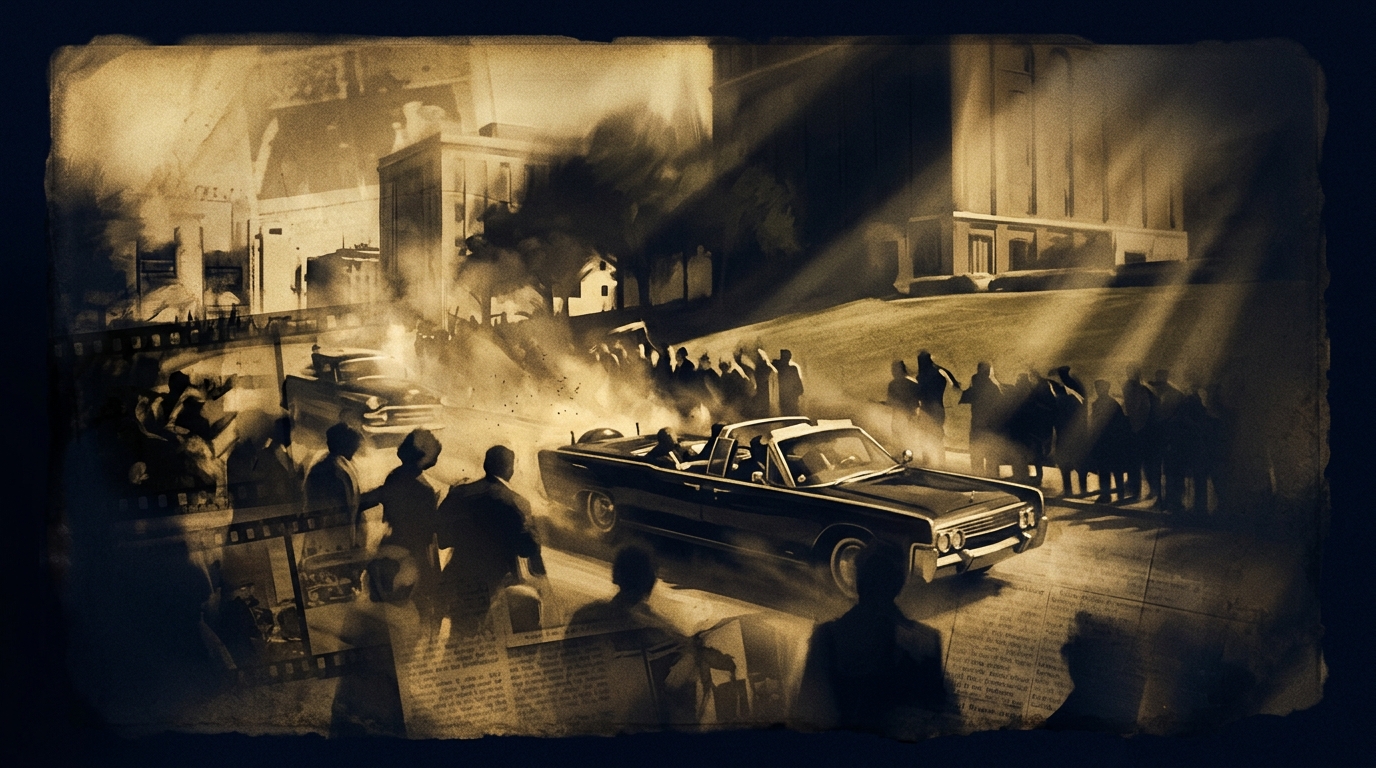
 Codex Illustration
JFK Assassination
On November 22, 1963, President John F. Kennedy was shot and killed in Dallas, Texas — an event whose core facts are thoroughly documented, yet whose full explanation has remained one of the most contested and consequential questions in modern American history.
Overview
At 12:30 p.m. on November 22, 1963, President John F. Kennedy was struck by rifle fire while riding in a presidential motorcade through Dealey Plaza in Dallas, Texas. He was pronounced dead at Parkland Memorial Hospital approximately thirty minutes later. Texas Governor John B. Connally, seated in the same limousine, was seriously wounded. Within hours, Dallas police arrested Lee Harvey Oswald, a former U.S. Marine who had defected to the Soviet Union in 1959 and later returned to the United States. Oswald denied all involvement and was himself shot and killed two days later in the basement of Dallas Police Headquarters by nightclub owner Jack Ruby — before he could be tried or testify before a court of law. These facts are thoroughly documented by contemporaneous records, physical evidence, photographic and film documentation, and institutional investigation.
The Warren Commission, established by President Lyndon B. Johnson and chaired by Chief Justice Earl Warren, concluded in its September 1964 report that Oswald acted alone, firing three shots from the sixth floor of the Texas School Book Depository. The commission's central findings — including the so-called Single Bullet Theory, developed by assistant counsel Arlen Specter — have been the subject of sustained professional and scholarly debate ever since. Critics, including some forensic scientists and medical professionals, have argued that the trajectory and behavior attributed to a single bullet strain physical plausibility, though defenders of the commission's methodology maintain that the analysis is sound when the geometry of the seated occupants is properly accounted for. The commission's work, while extensive, was also constrained by Cold War political pressures; internal documents later revealed that both the CIA and FBI withheld or delayed sharing relevant intelligence with investigators.
In 1979, the House Select Committee on Assassinations (HSCA) reached a substantially different conclusion: based primarily on acoustic evidence from a Dallas police dictabelt recording, the HSCA determined that a second gunman had probably fired from the grassy knoll north of Elm Street, and that Kennedy was 'probably assassinated as a result of a conspiracy.' However, this acoustic evidence was subsequently re-analyzed in 1982 by a National Academy of Sciences panel — the Ramsey Panel — which concluded that the sounds used by the HSCA to identify a second shot were recorded approximately one minute after the assassination and could not reliably be attributed to gunfire in Dealey Plaza. The HSCA's conspiracy conclusion thus rests on a foundation that mainstream acoustical science has largely — though not unanimously — rejected. Despite this, the HSCA's evidence of institutional information-withholding by the CIA remains a documented and troubling finding.
Decades of document releases under the President John F. Kennedy Assassination Records Collection Act of 1992 have produced millions of pages of government files, and successive partial releases in 2017, 2021, 2022, and 2023 have continued to draw public and scholarly attention. Many documents remain redacted or withheld on national security grounds. The released materials have confirmed extensive CIA surveillance of Oswald prior to the assassination, contacts between Oswald and Soviet and Cuban officials, and apparent failures of intelligence coordination — but no released document has, as of this writing, definitively established a broader conspiracy. The assassination stands as a case study in the limits of institutional investigation, the corrosive power of information withheld from the public, and the psychological dynamics by which uncertainty, when left unfilled by authoritative explanation, is inevitably populated by competing narratives — some carefully reasoned, others sensational, and most existing somewhere in between.
Key Claims
Timeline
Evidence
Multiple Perspectives
Biblical Lens
Scripture Threads
Sources & Further Study
Questions to Explore
Go Deeper Path
Follow the Thread
Continue the Investigation
You’ve reached the Full Archive portion of this Case File.
Ask the Archivist
about this fileSign in to ask the Archivist
Create a free account to ask the Archivist 1 grounded question each day, cited straight from the CODEX case files.
Discussion
0Share findings, questions, and evidence with fellow Seekers. Be respectful and cite sources where you can.
No comments yet. Be the first to open this thread.