 Codex Illustration
Kathryn Kuhlman
Kathryn Kuhlman (1907–1976) stands as one of the most documented and contested figures in modern Pentecostal and charismatic Christianity — a self-educated evangelist from rural Missouri whose healing services drew tens of thousands and whose reported miracles attracted both fervent devotees and rigorous skeptics in roughly equal measure.
Overview
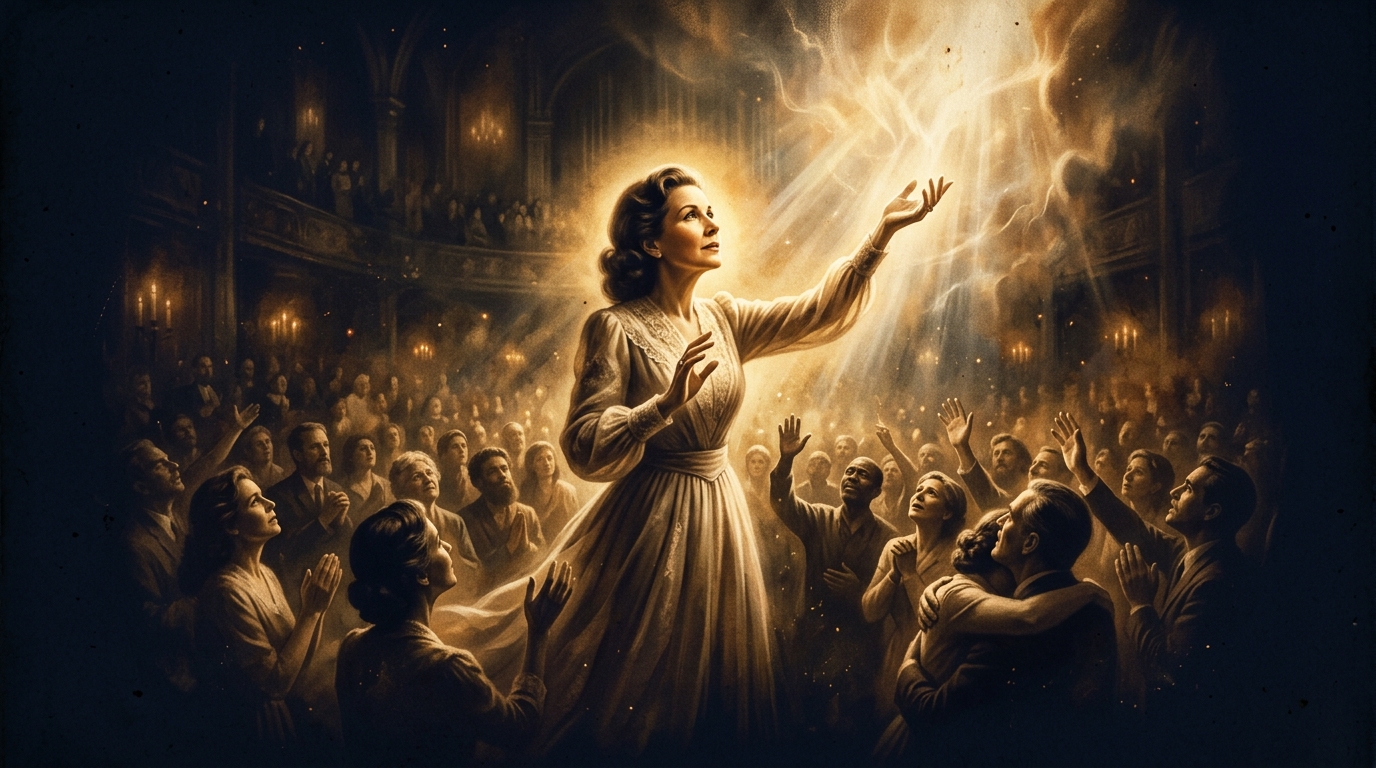
Kathryn Johanna Kuhlman was born on May 9, 1907, in Concordia, Missouri, and by her own account experienced a dramatic conversion at age fourteen. Largely self-taught in theology, she began itinerant preaching in Idaho and Colorado during the late 1920s and early 1930s, a period when female evangelists were a conspicuous minority in American Protestantism. Her early ministry was overshadowed — and nearly destroyed — by a scandal involving her marriage to divorced evangelist Burroughs Waltrip in 1938, a union she eventually dissolved in 1948. It was only after that rupture, which she described as a painful spiritual reckoning, that her healing ministry emerged in earnest. Beginning in Franklin, Pennsylvania, in 1946, and consolidated at Carnegie Hall in Pittsburgh beginning in 1948, her services acquired a character that distinguished her sharply from the more confrontational tent-revival healers of her era: she wore elegant gowns, conducted services with a symphonic orchestra, and explicitly refused to ask the sick to 'come forward' for laying on of hands, insisting instead that healings occurred spontaneously through the sovereign movement of what she called the Holy Spirit.
Kuhlman's Pittsburgh ministry grew into a nationally syndicated radio program, 'Heart to Heart,' and eventually a television broadcast, 'I Believe in Miracles,' which ran from 1966 to 1975 and was distributed to hundreds of stations. The program brought her into millions of American homes and transformed her from a regional curiosity into a genuinely national figure. Her healing services — relocated to the Shrine Auditorium in Los Angeles for monthly gatherings — regularly drew crowds of 7,000 or more, and the documented waiting lists for seats stretched to weeks. What separated her public profile from many contemporaries was the Catholic constituency she attracted: Roman Catholic charismatics in significant numbers attended her services following the emergence of the Catholic charismatic renewal in the late 1960s, an ecumenical crossing of denominational lines that was itself a historically notable phenomenon. Cardinal John Wright, a senior Vatican official, reportedly met with her privately, and she was received by Pope Paul VI — documented historical meetings that gave her ministry a remarkable inter-confessional dimension.
The medical evidence surrounding Kuhlman's ministry has been the subject of both popular reporting and limited formal investigation. Dr. William Nolen, a skeptical surgeon, investigated a number of healing claims following her Los Angeles services and published his findings in his 1974 book 'Healing: A Doctor in Search of a Miracle,' concluding that he could not authenticate a single organic disease cure attributable to her services, while acknowledging that functional and psychosomatic conditions sometimes improved. By contrast, Dr. H. Richard Casdorph, a cardiologist, published 'The Miracles' (1976), presenting ten medically documented case studies — with radiological and clinical records — which he argued represented genuine organic healings he could not explain by conventional medicine. These two bodies of evidence sit in unresolved tension, and mainstream medicine has not adjudicated between them. What is historically documented without dispute is that Kuhlman's services produced intense psychological and physiological responses in attendees, that thousands testified to recoveries they attributed to her ministry, and that she herself consistently deflected personal credit, insisting — with evident sincerity to those who knew her — that she was 'a woman who didn't even know how to preach.'
Kuhlman died on February 20, 1976, in Tulsa, Oklahoma, following open-heart surgery. She was interred at Forest Lawn Memorial Park in Glendale, California. Her theological legacy is layered and contested: she influenced a generation of charismatic leaders including Benny Hinn and Kenneth Hagin, whose subsequent ministries have attracted far sharper scrutiny, and scholars of American religion — including David Edwin Harrell Jr. and Harvey Cox — have positioned her within the broader currents of Pentecostalism's mid-century transformation from a marginal subculture into a mainstream religious force. She remains a figure who resists easy categorization: too sophisticated for the tent-revival world, too experiential for mainline Protestantism, and too individual for any single denominational tradition to fully claim.
Key Claims
Timeline
Evidence
Multiple Perspectives
Biblical Lens
Scripture Threads
Sources & Further Study
Questions to Explore
Go Deeper Path
Follow the Thread
Continue the Investigation
You’ve reached the Full Archive portion of this Case File.
Ask the Archivist
about this fileSign in to ask the Archivist
Create a free account to ask the Archivist 1 grounded question each day, cited straight from the CODEX case files.
Discussion
0Share findings, questions, and evidence with fellow Seekers. Be respectful and cite sources where you can.
No comments yet. Be the first to open this thread.