
 Codex Illustration
The Knights Templar
Founded in the wake of the First Crusade to protect Christian pilgrims, the Knights Templar rose to become the most powerful military-religious order of the medieval world—only to be violently dissolved amid accusations of heresy, sodomy, and idol worship, leaving behind centuries of legend that refuse to die.
Overview
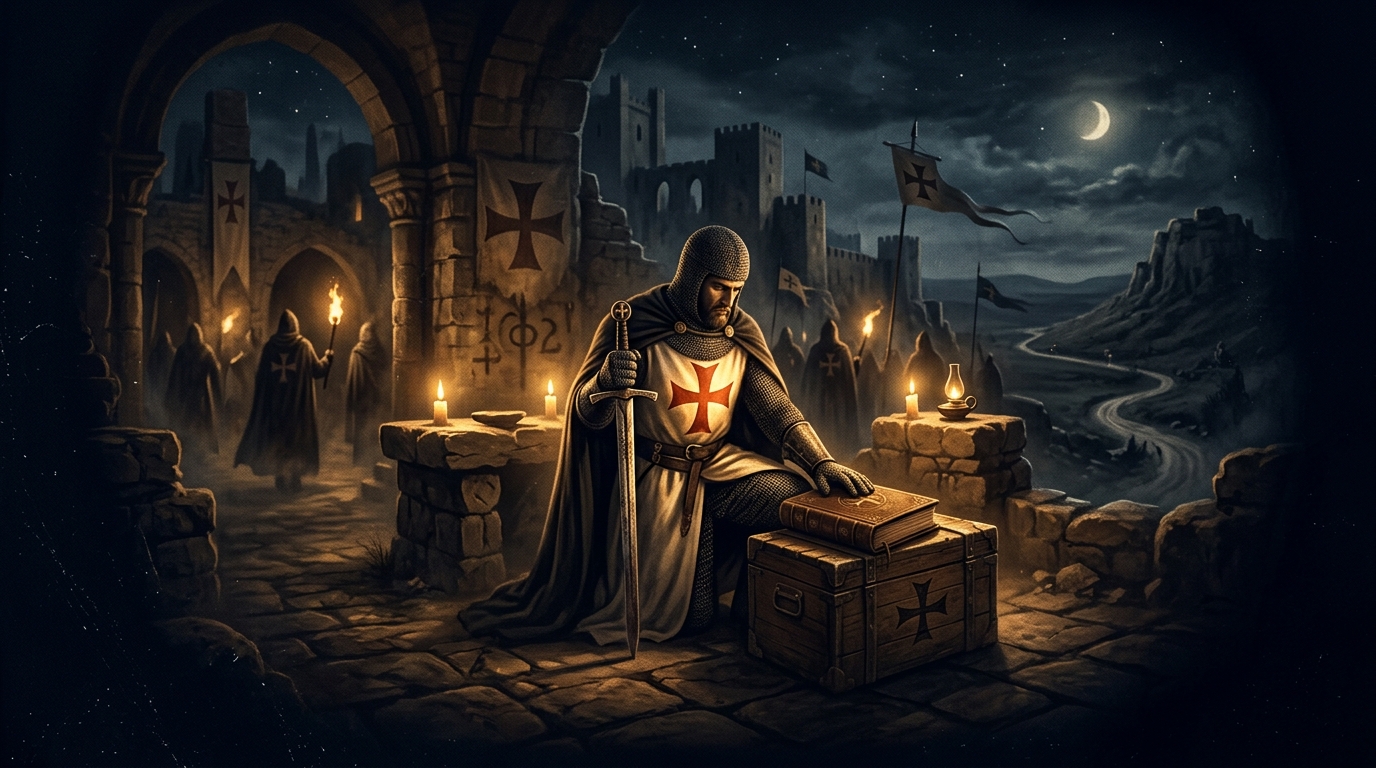
The Poor Fellow-Soldiers of Christ and of the Temple of Solomon—known to history as the Knights Templar—were founded circa 1119 AD in Jerusalem by a small band of French knights led by Hugues de Payens. Endorsed by Bernard of Clairvaux and formally recognized at the Council of Troyes in 1129, the order established its headquarters on the Temple Mount, in a structure believed to stand atop the ruins of Solomon's Temple. This location proved spiritually and symbolically charged, and rumors persisted almost from the order's founding that the knights had excavated beneath their compound, seeking sacred relics or ancient knowledge. Within a century, through papal privilege and battlefield prowess, the Templars had grown into a transnational institution controlling vast estates, pioneering early forms of banking, and fielding elite forces across the Crusader states.
At their height, the Templars possessed a near-sovereign authority that transcended national boundaries: they answered only to the Pope, held exemption from local taxation and ecclesiastical jurisdiction, and ran what modern historians describe as one of the earliest international financial networks—an early form of letters of credit that allowed pilgrims to deposit funds in Europe and withdraw them in the Holy Land. This financial power, combined with military independence and a secretive initiation ritual, made the order a target of envy and suspicion. When the Crusader states finally fell with the loss of Acre in 1291, the Templars' military raison d'être collapsed, and their wealth and insularity became politically untenable.
The destruction of the order was orchestrated primarily by King Philip IV of France, who was deeply indebted to the Templars and eager to seize their assets. On Friday, October 13, 1307—a date that may have contributed to the superstition surrounding Friday the 13th—Philip ordered the simultaneous arrest of nearly all Templars in France. Under torture, many knights confessed to charges including denial of Christ, spitting on the Cross, obscene kisses during initiation, and worshiping an idol called Baphomet. Pope Clement V, politically beholden to Philip, suppressed the order at the Council of Vienne in 1312. Grand Master Jacques de Molay was burned at the stake in 1314, reportedly cursing both king and pope as he died. Philip IV died within the year; Clement V died within months. The curse became legend.
In the centuries that followed, the Templars were woven into an ever-expanding mythology: Freemasonic traditions claimed descent from the order; esotericists associated them with the Holy Grail, the Ark of the Covenant, and heterodox Gnostic traditions; modern conspiracy theories place them at the origin of every conceivable secret society. Historians are considerably more restrained. Scholarly consensus holds that the torture-induced confessions are unreliable, that the charges of heresy were largely fabricated for political purposes, and that the Templars were, at their core, a deeply orthodox Catholic institution. The legend of what they might have found beneath the Temple Mount, however, continues to animate imaginations and fund archaeological speculation to this day.
Timeline
Evidence
Multiple Perspectives
Biblical Lens
Scripture Threads
Sources & Further Study
Questions to Explore
Follow the Thread
Continue the Investigation
You’ve reached the Full Archive portion of this Case File.
Ask the Archivist
about this fileSign in to ask the Archivist
Create a free account to ask the Archivist 1 grounded question each day, cited straight from the CODEX case files.
Discussion
0Share findings, questions, and evidence with fellow Seekers. Be respectful and cite sources where you can.
No comments yet. Be the first to open this thread.