
 Codex Illustration
Lemurian Mountain Lore
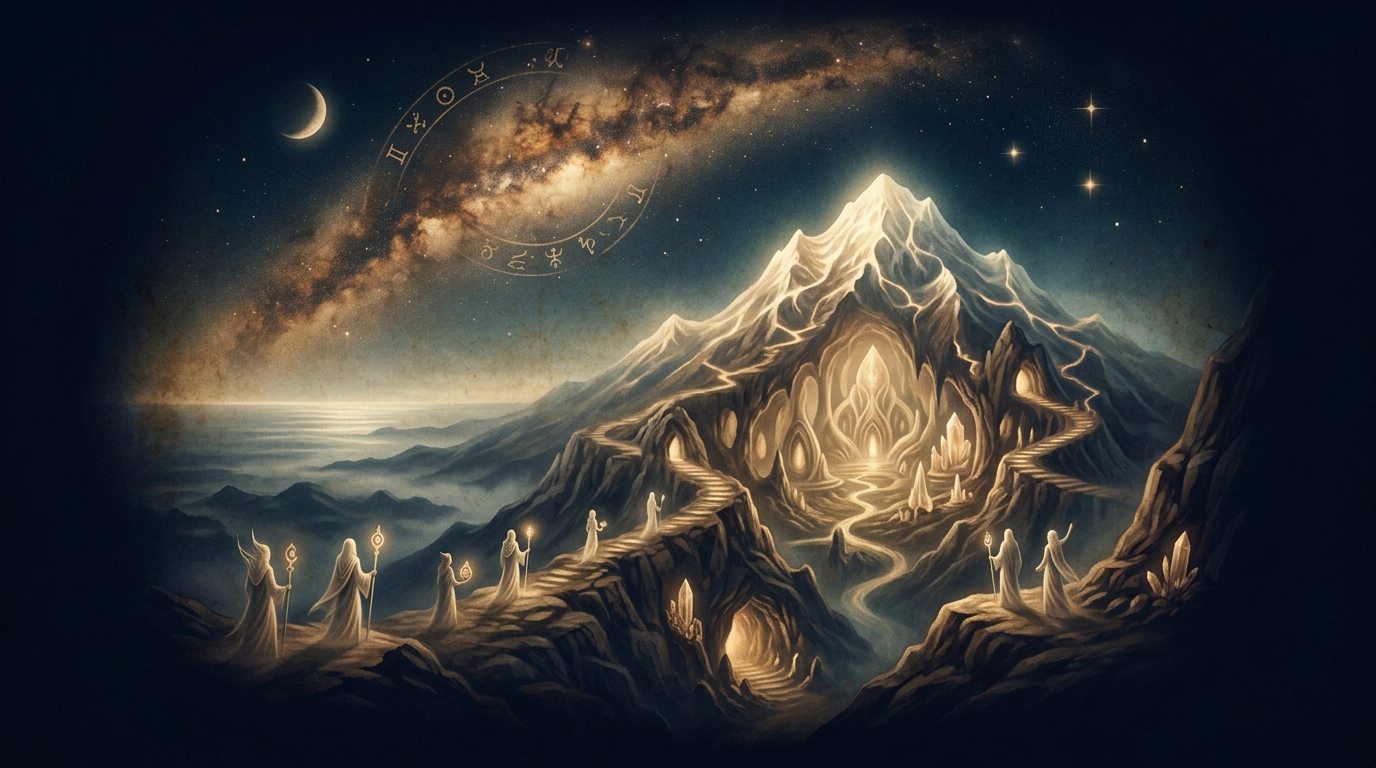
From the slopes of Mount Shasta in northern California to the peaks of the Himalayas, a persistent body of esoteric lore holds that survivors of a sunken Pacific continent called Lemuria retreated into sacred mountains, where they dwell still in hidden subterranean cities — a tradition assembled largely in the nineteenth and twentieth centuries yet drawing on genuine cross-cultural mythologies of vanished peoples and underground realms.
Overview
The idea of Lemuria as a lost continent predates its romantic spiritual elaboration by several decades. In 1864, the English zoologist Philip Sclater coined the term 'Lemuria' in a paper published in the Quarterly Journal of Science, proposing a hypothetical sunken landmass in the Indian Ocean to account for the puzzling distribution of lemur fossils across Madagascar, India, and the Malay Archipelago. Sclater's hypothesis was a serious, if ultimately incorrect, scientific conjecture offered before the mechanisms of continental drift were understood. Ernst Haeckel, the German naturalist, subsequently embraced the idea and speculated — controversially even then — that Lemuria might represent the lost cradle of humanity. By the late nineteenth century, however, plate tectonics had rendered the sunken-continent model unnecessary: the fossil distribution was explained by continental separation, not submersion. What Sclater had offered as a zoological hypothesis, later esotericists transformed into something far more ambitious.
Madame Helena Petrovna Blavatsky, founder of Theosophy, incorporated 'Lemuria' into her elaborate cosmological system in The Secret Doctrine (1888), reframing it as the homeland of a Third Root Race of semi-spiritual, androgynous proto-humans whose civilization predated Atlantis by vast geological epochs. Blavatsky claimed her account derived from a primordial text called the 'Book of Dzyan,' which mainstream scholars have been unable to identify or verify as a genuine historical document. Her follower William Scott-Elliot elaborated the tradition in The Story of Atlantis and the Lost Lemuria (1904), and the Theosophical literature that followed built an increasingly detailed — though entirely unverifiable — picture of Lemurian civilization. It is in this esoteric lineage, rather than in Sclater's zoology, that 'Lemurian mountain lore' properly originates. The specific association of surviving Lemurians with sacred mountains appears to have crystallized most vividly around Mount Shasta in California, popularized through a 1931 novel by Frederick Spencer Oliver (published posthumously as A Dweller on Two Planets) and later amplified by Rosicrucian writer Harvey Spencer Lewis and the 'I AM' Activity movement of Guy Ballard, who claimed in 1934 to have encountered an ascended master called Saint Germain on the slopes of the mountain.
At the popular and spiritual level, the Lemurian mountain tradition encompasses a rich constellation of claims: that Lemurians — described variously as tall, ethereal, highly advanced beings — survived their continent's destruction and established refuge communities inside Mount Shasta, the Himalayas, and other high peaks; that these beings maintain temples of crystal or light within the mountains; that sensitive individuals can receive transmissions of 'Lemurian' wisdom or encounter tunnels leading to inner-earth civilizations; and that certain mountain ranges preserve geological memory or vibrational frequency of the lost civilization. In the New Age synthesis of the late twentieth century, these ideas merged with channeling traditions, crystal healing culture (the marketing of 'Lemurian seed crystals' became a significant commercial phenomenon after the 1990s), and later with some strands of UFO contactee lore. None of these elaborations possesses archaeological, geological, or historical corroboration.
What honest scholarly analysis can observe is that the Lemurian mountain tradition is a genuinely interesting cultural phenomenon — a case study in how a discarded scientific hypothesis became the scaffolding for a new mythology in an era of spiritual seeking. The tradition intersects with genuine anthropological questions about ancient migration, oral traditions of catastrophic flooding preserved across Pacific cultures, and the deep human resonance of mountains as sacred liminal spaces — thresholds between the visible and the invisible, the human and the divine. These genuine cultural and religious threads deserve careful attention even as the specific claims of surviving Lemurian civilizations beneath mountain peaks remain, by any rigorous standard, unsupported by evidence.
Key Claims
Timeline
Evidence
Multiple Perspectives
Biblical Lens
Scripture Threads
Sources & Further Study
Questions to Explore
Go Deeper Path
Follow the Thread
Continue the Investigation
You’ve reached the Full Archive portion of this Case File.
Ask the Archivist
about this fileSign in to ask the Archivist
Create a free account to ask the Archivist 1 grounded question each day, cited straight from the CODEX case files.
Discussion
0Share findings, questions, and evidence with fellow Seekers. Be respectful and cite sources where you can.
No comments yet. Be the first to open this thread.