
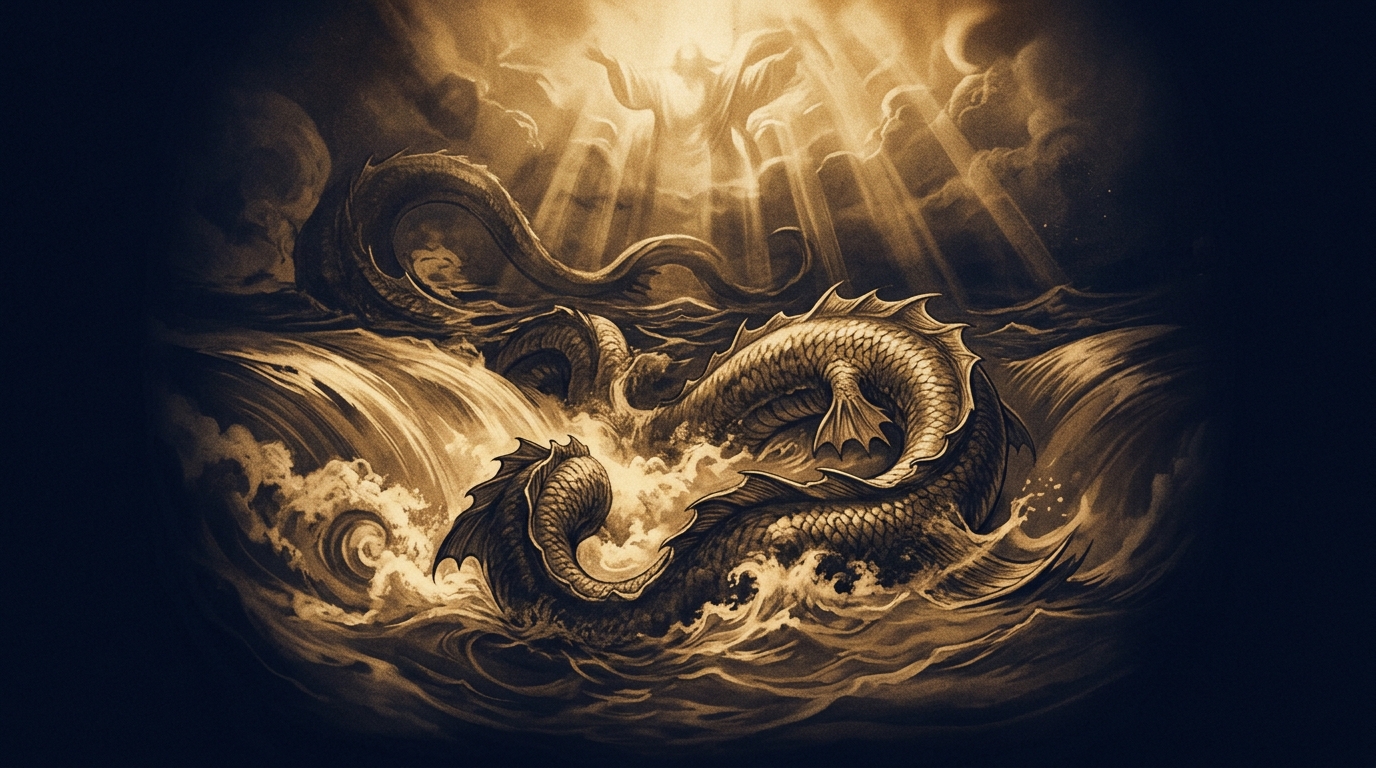
 Codex Illustration
Leviathan
Leviathan — the great sea-dragon of the Hebrew Bible — haunts the deep waters of ancient Near Eastern cosmology as a symbol of primordial chaos, yet YHWH alone commands it, taunts it, and is promised to finally destroy it at the end of the age.
Overview
Few figures in the Hebrew Bible carry the weight of Leviathan. Named from a root possibly related to the Semitic concept of 'coiling' or 'twisting,' the creature appears in Job 41, Psalms 74 and 104, and Isaiah 27 — always in proximity to the deep waters that ancient cosmology associated with chaos, the untameable, and the boundary of ordered creation. What makes Leviathan remarkable is not merely its fearsome description — armored hide, breath of fire, eyes like the dawn — but the theological weight placed upon YHWH's mastery over it. The God of Israel does not slay chaos in a desperate cosmic struggle; he keeps Leviathan as one might keep a pet fish on a hook (Job 41:1), or plays with it as a creature formed for his own inscrutable delight (Psalm 104:26). This posture — sovereign amusement rather than anxious combat — sets the biblical presentation apart from its ancient Near Eastern neighbors in a manner that is, theologically, quite deliberate.
The ancient Near Eastern background is extensive and well-documented by scholars. The Ugaritic texts discovered at Ras Shamra in 1929 contain striking parallels: the storm-god Baal slays Lotan (Litanu), described explicitly as a 'twisting serpent' and a 'powerful one with seven heads' — language nearly identical to Isaiah 27:1's depiction of Leviathan as 'the fleeing serpent' and 'the twisting serpent.' This correspondence is one of the most discussed in comparative ancient Near Eastern scholarship, with figures such as John Day, Mark S. Smith, and Frank Moore Cross exploring the degree of direct literary influence versus shared mythological inheritance. Further afield, the Babylonian Enuma Elish presents Tiamat, the primordial saltwater ocean-dragon slain by Marduk, whose body is divided to form the heavens and earth — a creation-through-combat (Chaoskampf) narrative that illuminates the wider cultural context. The Hebrew Bible's authors appear to have known this broader mythological world intimately, and their reframing of it is a conscious theological act rather than accidental borrowing.
Multiple interpretive perspectives deserve careful presentation. The natural reading — favored by some commentators from medieval times onward and by modern naturalists — identifies Leviathan as a known animal: most commonly the Nile crocodile, occasionally a large cetacean or the now-extinct Sarcosuchus. This reading has merit for portions of Job 41, where physical description is most prominent, but struggles to account for the fire-breathing imagery and the cosmic theological freight the text places upon the creature. A mythopoetic reading, dominant in modern critical scholarship, treats Leviathan as a literary-theological symbol of chaos, imperial power, and cosmic hostility to divine order — an inherited ancient image that the biblical writers deployed with intentional theological revision. A third perspective, taken seriously within some strands of Jewish and Christian tradition as well as by scholars working within a broadly supernatural worldview (notably Michael Heiser), treats Leviathan as a genuine supernatural entity belonging to the hostile spiritual forces arrayed against YHWH's order — neither a metaphor nor a crocodile, but a named member of the cosmic opposition. These three readings need not be mutually exclusive; the biblical authors may have consciously employed a real ancient creature's fearsome qualities as a lens for a much larger theological and cosmic reality.
Eschatologically, Isaiah 27:1 is pivotal: 'In that day the LORD with his hard and great and strong sword will punish Leviathan the fleeing serpent, Leviathan the twisting serpent, and he will slay the dragon that is in the sea.' This verse links the creature to a future divine reckoning, framing Leviathan not merely as a past symbol of defeated chaos but as an ongoing cosmic adversary whose final defeat belongs to the prophetic horizon. The New Testament's vision of the dragon in Revelation — drawing on this same reservoir of imagery — and the explicit connection made by some Fathers between Leviathan and the serpent of Eden or Satan himself, extends this thread into Christian eschatology. Whether one reads these connections as typological, allegorical, or ontologically literal, they constitute one of the most sustained symbolic threads in the entire canon of Western religious literature.
Key Claims
Timeline
Evidence
Multiple Perspectives
Biblical Lens
Scripture Threads
Sources & Further Study
Questions to Explore
Go Deeper Path
Follow the Thread
Continue the Investigation
You’ve reached the Full Archive portion of this Case File.
Ask the Archivist
about this fileSign in to ask the Archivist
Create a free account to ask the Archivist 1 grounded question each day, cited straight from the CODEX case files.
Discussion
0Share findings, questions, and evidence with fellow Seekers. Be respectful and cite sources where you can.
No comments yet. Be the first to open this thread.