
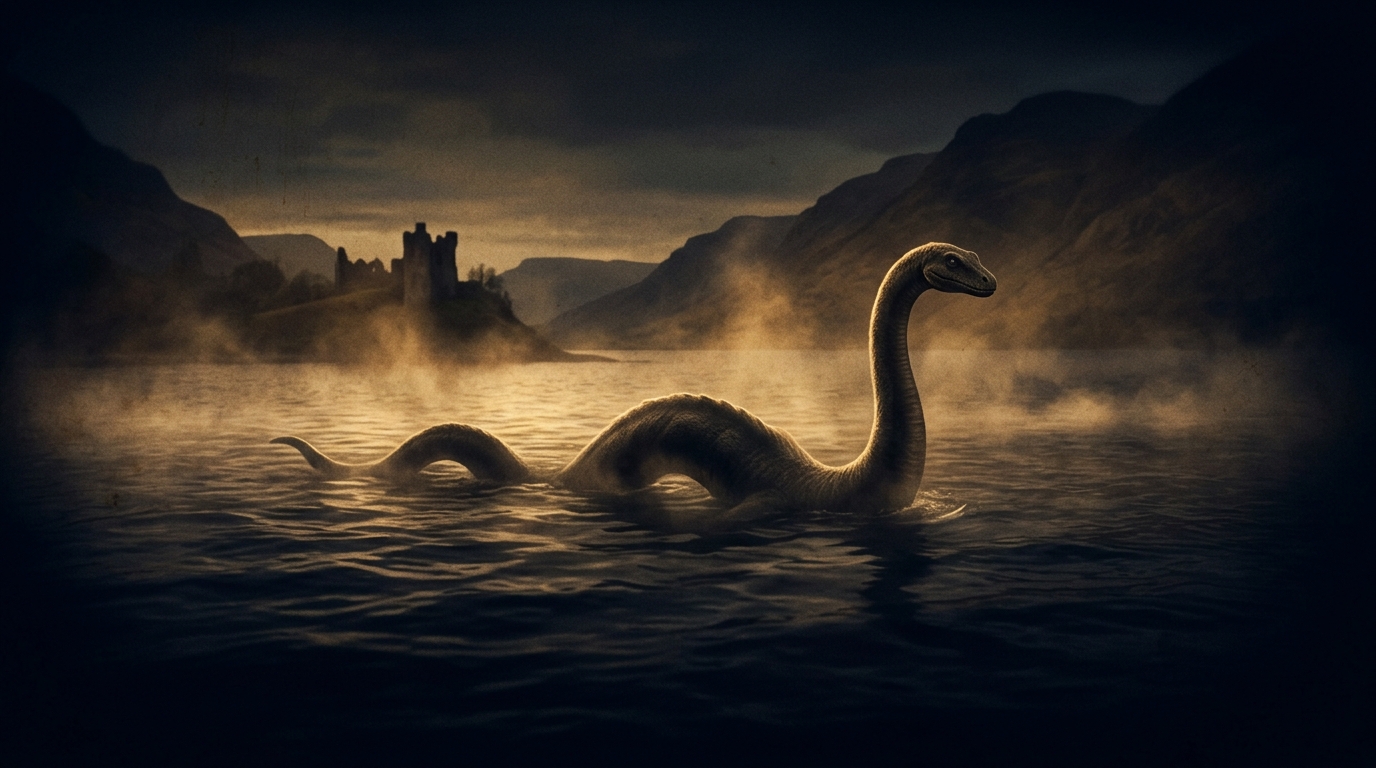
 Codex Illustration
Loch Ness Monster
For nearly a century, the dark waters of Loch Ness have harbored one of the world's most enduring mysteries — a creature variously described as serpentine, plesiosaur-like, or simply enormous, whose existence remains unconfirmed by science yet stubbornly persistent in human imagination.
Overview
Loch Ness is a vast, peat-darkened ribbon of water stretching roughly 37 kilometres through the Scottish Highlands, reaching depths of over 220 metres — deep enough, enthusiasts note, to conceal almost anything. Modern fascination with a large unknown creature in these waters crystallised in 1933, when John Mackay and his wife reported seeing a violent disturbance on the loch's surface, a sighting soon publicised by the Inverness Courier. That same year, a newly constructed road along the northern shore opened the loch to unprecedented public observation, generating a cascade of additional reports. The phenomenon quickly attracted international press coverage, amateur investigators, and — in short order — the persistent cultural mythology that endures to the present day. What is less often acknowledged is that the story did not begin in 1933.
The historical record contains earlier antecedents, the most frequently cited being a passage in Adomnán's seventh-century hagiography Vita Columbae (Life of St. Columba), which describes the sixth-century Irish monk Columba rebuking a 'water beast' (Latin: bestia aquatica) in the River Ness, reportedly saving a swimmer's life. Scholars debate whether this episode reflects an encounter with a real animal, a literary convention common to early Christian hagiography — in which saints routinely tame or rebuke dangerous creatures — or a piece of theological symbolism. Highland tradition also preserves the figure of the each-uisge or kelpie, a shape-shifting water horse capable of dragging people to their deaths, a creature-type common across Celtic folklore from Ireland to Orkney. Some researchers propose that the modern 'Nessie' legend is at least partially a rationalised, secularised descendant of these older supernatural water-creature traditions, stripped of their overtly magical character and reframed for a scientific age.
The investigation of Loch Ness over the twentieth century produced several notable episodes, none more consequential — or more damaging — than the so-called Surgeon's Photograph of 1934, long the most widely reproduced supposed image of the creature, depicting a small head and long neck rising from the water. Decades later, in a 1975 expose and subsequently in investigator David Martin and Alastair Boyd's research published in the 1990s, the photograph was revealed to be a deliberate hoax: a toy submarine fitted with a sculpted head, engineered by big-game hunter Marmaduke Wetherell and associates, reportedly as an act of revenge against the Daily Mail newspaper. The confession came largely through the deathbed account of Christian Spurling, Wetherell's stepson. This revelation did not end serious investigation, but it permanently complicated the evidentiary landscape. Subsequent scientific efforts — including the Robert Rines-led Academy of Applied Science underwater photography expeditions of 1972 and 1975, multiple sonar surveys across the decades, and a large-scale environmental DNA (eDNA) survey led by Professor Neil Gemmell of the University of Otago in 2018 — have failed to detect any evidence of a large unknown vertebrate. The 2018 study, notable for its methodological rigour, found abundant European eel DNA in the loch, prompting Gemmell and colleagues to tentatively advance the hypothesis that unusually large eels might account for some sightings, a suggestion that remains unconfirmed but scientifically plausible.
What the Loch Ness phenomenon most reliably documents is not a prehistoric survivor but the remarkable resilience of mystery as a cultural need. The loch sits at the intersection of ancient landscape, pre-modern supernatural tradition, Victorian-era natural history enthusiasm, twentieth-century mass media, and post-war tourism economics — a confluence that proved almost uniquely fertile for myth-making. Serious cryptozoologists distinguish between the documented fact of persistent, sincere eyewitness testimony (some offered by credible individuals including military officers and trained naturalists) and the entirely separate, scientifically unsubstantiated claim that such testimony constitutes evidence for a large unknown animal. The honest position, held by most mainstream zoologists and supported by the current evidence, is that Loch Ness almost certainly contains no undiscovered megafauna — but that the question of why so many people have perceived and reported something remarkable there remains genuinely interesting.
Key Claims
Timeline
Evidence
Multiple Perspectives
Biblical Lens
Scripture Threads
Sources & Further Study
Questions to Explore
Go Deeper Path
Follow the Thread
Continue the Investigation
You’ve reached the Full Archive portion of this Case File.
Ask the Archivist
about this fileSign in to ask the Archivist
Create a free account to ask the Archivist 1 grounded question each day, cited straight from the CODEX case files.
Discussion
0Share findings, questions, and evidence with fellow Seekers. Be respectful and cite sources where you can.
No comments yet. Be the first to open this thread.