
 Codex Illustration
Majestic 12 Documents
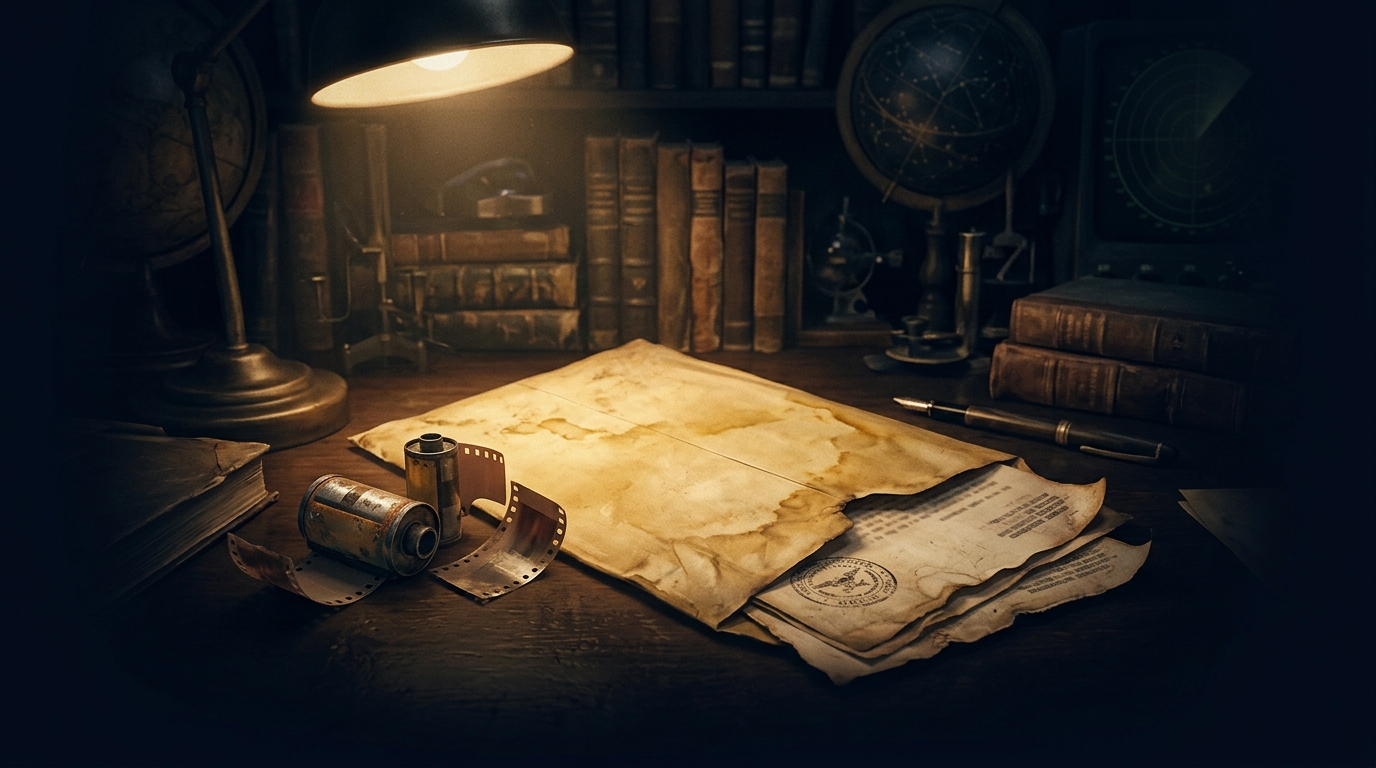
In 1984, a roll of undeveloped film arrived anonymously at a UFO researcher's door, purportedly revealing a classified executive briefing for President-Elect Eisenhower describing a secret committee — Majestic 12 — formed to manage recovered extraterrestrial hardware and bodies after Roswell. The FBI investigated, stamped the documents 'BOGUS,' and most researchers — including serious UFO investigators — regard them as sophisticated forgeries; yet they remain among the most culturally potent artifacts in the history of UFO lore.
Overview
The MJ-12 documents constitute one of the strangest episodes in the post-war history of government secrecy and UFO mythology. In December 1984, a roll of undeveloped 35mm film arrived without return address at the Burbank, California home of television producer and UFO investigator Jaime Shandera. When developed, the film revealed what appeared to be a November 1952 briefing document prepared for President-Elect Dwight D. Eisenhower, signed by then-CIA Director Roscoe Hillenkoetter, detailing the formation by President Harry Truman of a twelve-member panel of scientists, military officials, and intelligence figures tasked with containing the aftermath of the 1947 Roswell crash. The committee's alleged members — a roster that included Vannevar Bush, James Forrestal, General Hoyt Vandenberg, and others — were all real, distinguished figures of the early Cold War establishment, which lent the documents an initial veneer of plausibility. Researchers Stanton Friedman, William Moore, and Shandera spent years promoting the documents as authentic, arguing they represented the most significant evidence of government UFO concealment ever to surface.
Skepticism, however, mounted quickly and from multiple directions. The FBI's Washington Field Office obtained a copy and, after analysis, formally designated the documents 'BOGUS' in a 1988 memorandum. Forensic document examiners and historians identified a cascade of anachronisms: the date format used on the alleged Truman memorandum ('September 24, 1947') employed a style not standard in Truman-era executive correspondence; the typeface characteristics did not match authenticated documents from the relevant period; and Truman's signature appeared to have been mechanically transferred from an unrelated authenticated letter. Historian and document analyst Barry Greenwood, along with Philip J. Klass — a rigorous and often acerbic skeptic — published detailed technical critiques in the late 1980s and early 1990s that remain largely unanswered by proponents. The Air Force Office of Special Investigations (AFOSI) also investigated and found no corroborating evidence in classified records.
Perhaps more revealing than the documents themselves is their genealogy of reception. The MJ-12 papers arrived at a culturally primed moment: Roswell had only recently re-entered public consciousness through the work of Stanton Friedman and Charles Berlitz, and the Reagan era's atmosphere of governmental opacity made the existence of secret committees entirely imaginable to a broad public. The documents functioned less as evidence and more as myth-crystallization: they gave narrative form to already-circulating suspicions, populating the Roswell story with named officials, institutional machinery, and bureaucratic language that mimicked authentic Cold War secrecy culture. Subsequent waves of alleged MJ-12 documents — surfacing through researcher Timothy Cooper in the 1990s and numbering in the hundreds of pages — were evaluated by even sympathetic analysts such as Stanton Friedman with increasing unease; many of these later documents are now widely dismissed even within UFO research communities.
The endurance of MJ-12 as a cultural reference point speaks to something deeper than the documents' content. They arrived at the intersection of Cold War institutional distrust, genuine government deception programs (many of which were later confirmed — see MKULTRA, Operation Mockingbird, and COINTELPRO), and a human appetite for the possibility that official reality is a managed facade. Whether the forgeries were produced by a lone hoaxer, an intelligence disinformation operation intended to muddy genuine UFO research, or some combination thereof, remains — in a genuinely documented sense — unknown. That ambiguity is itself part of the documents' power: in a landscape where proven government deceptions make further deceptions plausible, the impossibility of absolute disproof becomes, paradoxically, a kind of perpetual fuel.
Key Claims
Timeline
Evidence
Multiple Perspectives
Biblical Lens
Scripture Threads
Sources & Further Study
Questions to Explore
Go Deeper Path
Follow the Thread
Continue the Investigation
You’ve reached the Full Archive portion of this Case File.
Ask the Archivist
about this fileSign in to ask the Archivist
Create a free account to ask the Archivist 1 grounded question each day, cited straight from the CODEX case files.
Discussion
0Share findings, questions, and evidence with fellow Seekers. Be respectful and cite sources where you can.
No comments yet. Be the first to open this thread.