
 Codex Illustration
Men in Black
Since the early 1950s, witnesses of unidentified aerial phenomena have reported visits from pale, oddly behaved men in dark suits who warn them to remain silent — a folklore tradition whose origins are disputed, whose psychological dimensions are real, and whose ultimate nature remains one of the stranger open questions in modern anomalous research.
Overview
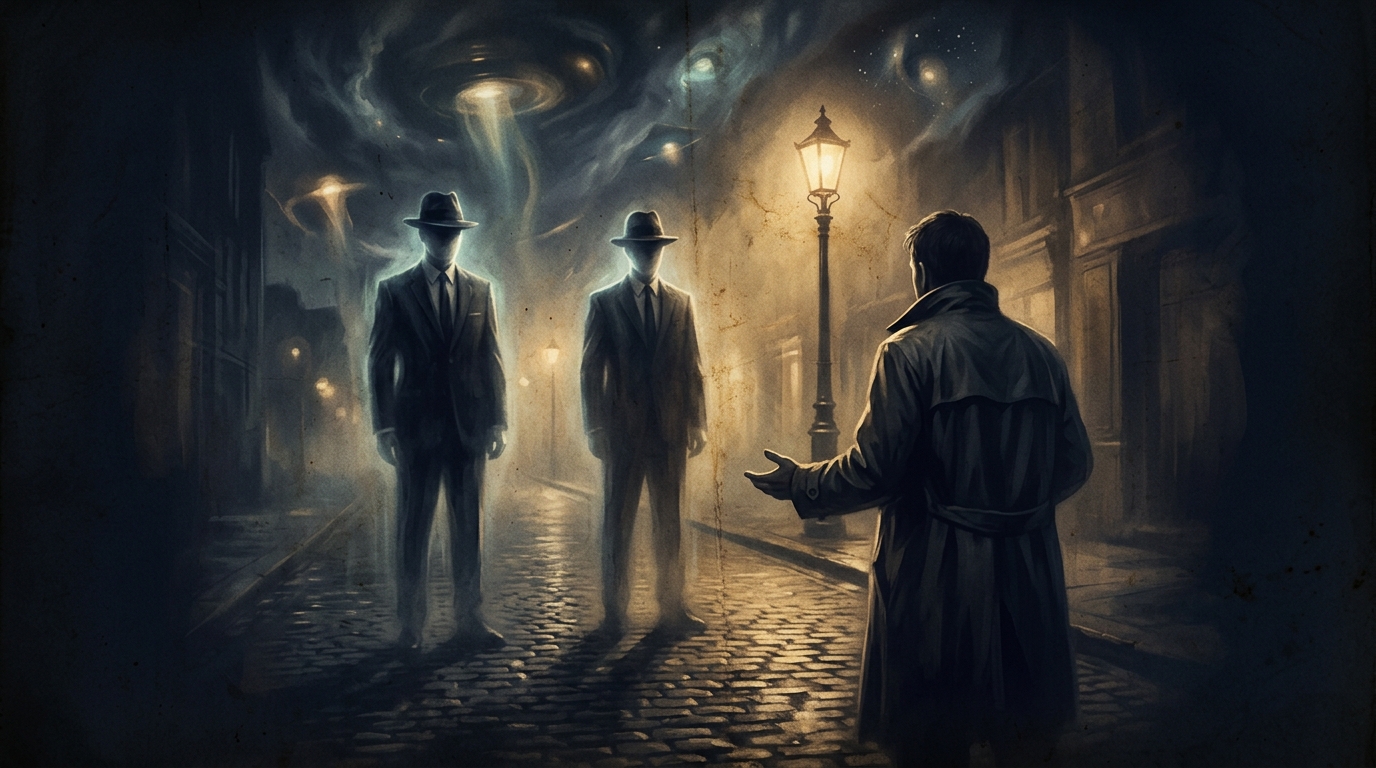
The Men in Black (MIB) phenomenon entered public awareness in the early 1950s through the accounts of Albert K. Bender, a Connecticut-based UFO researcher who claimed that three dark-suited men visited him in 1953, confiscated his research materials, and delivered an unambiguous warning to cease his investigations. Bender later elaborated these encounters in his 1962 book, describing the visitors as possessing strange, luminous eyes, an unnatural pallor, and a hypnotic authority that he found impossible to resist. Whether or not Bender's account reflects a genuine experience, it established the archetypal template for hundreds of subsequent MIB reports that would accumulate across the following decades — accounts that share, with remarkable consistency, the same unsettling details: ill-fitting vintage clothing, halting or robotic speech patterns, apparent unfamiliarity with ordinary social conventions, and a tendency to arrive at a witness's door before any public account of their sighting had been made.
Researchers who have attempted to map the sociological and psychological contours of the MIB tradition — among them John Keel, whose 1975 work The Mothman Prophecies treated MIB as a genuine high-strangeness phenomenon, and later scholars such as Jerome Clark, whose encyclopedic survey of UFO folklore remains a standard reference — have noted that the phenomenon does not map cleanly onto any single explanatory category. The most straightforward hypothesis — that MIB are government intelligence agents intimidating civilians — finds some indirect support in the documented history of covert programs such as Project Blue Book and the later revelations of COINTELPRO, both of which demonstrate that federal agencies did monitor and sometimes interfere with citizen UFO groups. However, no declassified document has ever confirmed a systematic MIB program, and the stranger phenomenological details (the robotic manner, the apparent clairvoyance about sighting details, the physical anomalies reported by witnesses) do not fit the profile of a routine intelligence operation.
A significant alternative interpretive tradition, developed most rigorously by the researcher and writer Peter Rojcewicz, situates MIB within the broader cross-cultural literature of what he called 'encounter with the other' — liminal figures who appear at moments of anomalous experience and function, in a manner reminiscent of folkloric daimons or psychopomps, as boundary markers between ordinary reality and whatever lies beyond it. Rojcewicz, whose academic work at the Juilliard School and in folklore studies gave him unusual interdisciplinary leverage, argued in his 1987 essay 'The 'Men in Black' Experience and Tradition' (published in the Journal of American Folklore) that the MIB archetype bears deep structural kinship with the 'dark stranger' figures of European fairy lore, demonic visitor traditions, and shamanic initiatory encounters. This framing neither confirms nor denies the literal reality of MIB encounters but insists that something psychologically and culturally significant is occurring in the reports.
By the 1990s the MIB had been thoroughly absorbed into popular culture — most visibly through Lowell Cunningham's comic book series and the 1997 Will Smith film franchise — a process that simultaneously broadened public familiarity with the legend and complicated any serious research into it. Contemporary investigators working within organizations such as the Center for UFO Studies (CUFOS) or drawing on the archival work of the late Jerome Clark acknowledge that the bedrock of the tradition consists of a relatively small number of pre-media-saturation accounts that cannot be easily explained as confabulation or pop-culture contamination. Among these, cases such as the 1967 encounter reported by Dr. Herbert Hopkins — a physician and UFO investigator who described a meeting with a bald, pallid figure who caused a coin to dematerialize before his eyes — continue to resist comfortable resolution and to occupy a genuinely anomalous corner of the modern strange-experience literature.
Key Claims
Timeline
Evidence
Multiple Perspectives
Biblical Lens
Scripture Threads
Sources & Further Study
Questions to Explore
Go Deeper Path
Follow the Thread
Continue the Investigation
You’ve reached the Full Archive portion of this Case File.
Ask the Archivist
about this fileSign in to ask the Archivist
Create a free account to ask the Archivist 1 grounded question each day, cited straight from the CODEX case files.
Discussion
0Share findings, questions, and evidence with fellow Seekers. Be respectful and cite sources where you can.
No comments yet. Be the first to open this thread.