
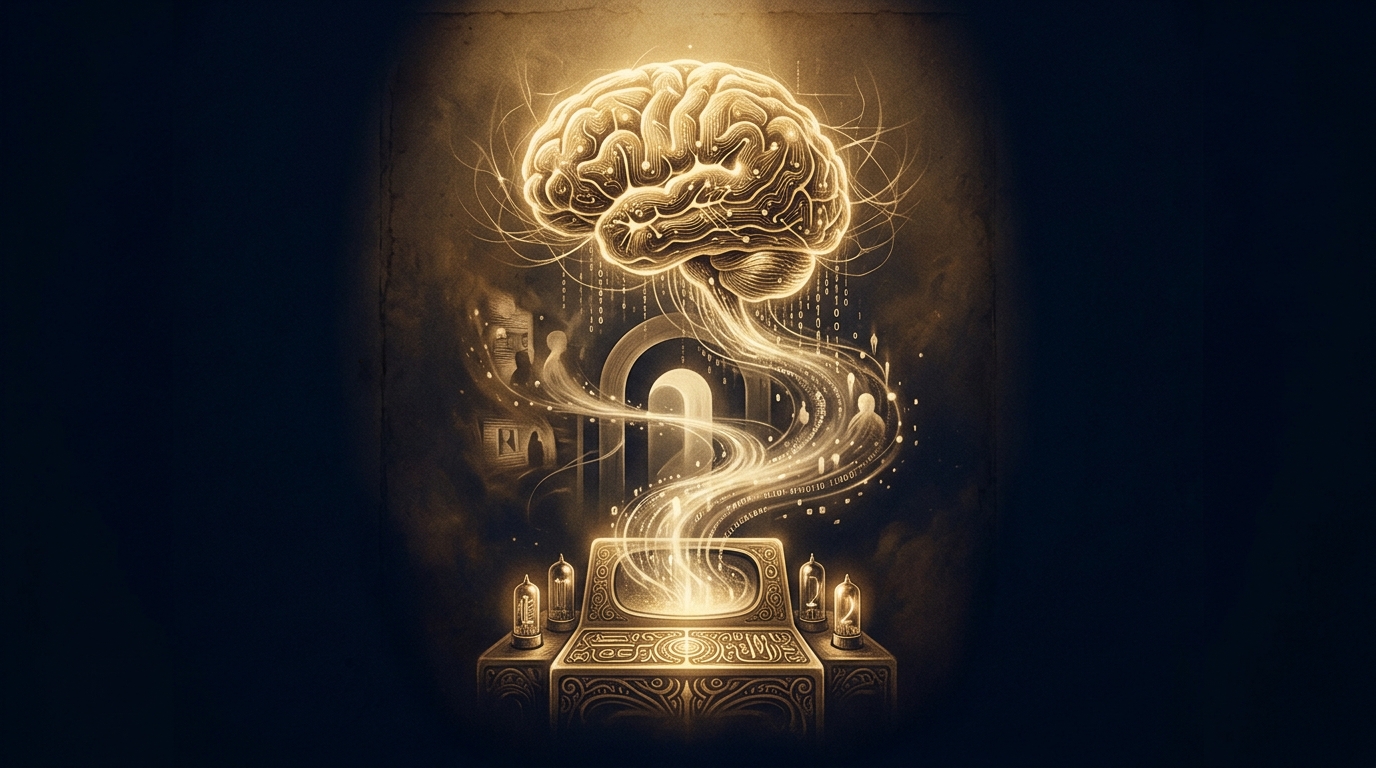
 Codex Illustration
Mind Uploading
Mind uploading — the hypothetical process of scanning, mapping, and transferring the complete informational structure of a human brain into a digital substrate — sits at the intersection of neuroscience, computer science, and ancient human longing for immortality, raising questions that neither science nor philosophy has yet resolved.
Overview
The concept of mind uploading, sometimes called whole brain emulation (WBE) or substrate-independent minds, proposes that the self — including memory, personality, cognition, and subjective experience — can be extracted from biological tissue and instantiated in a non-biological medium. Proponents argue that if consciousness is fundamentally an information-processing pattern rather than a property of organic chemistry, then sufficiently detailed replication of that pattern should, in principle, preserve personal identity. This idea draws on functionalist theories in philosophy of mind, particularly those associated with figures such as Daniel Dennett and Marvin Minsky, and has been significantly amplified by transhumanist thinkers including Ray Kurzweil, whose 2005 work 'The Singularity Is Near' offered a detailed technological roadmap toward what he terms the merger of human and machine intelligence. As of the early twenty-first century, no technology remotely capable of achieving mind uploading exists, and the theoretical framework remains deeply contested.
The scientific obstacles are formidable and, many researchers argue, possibly insurmountable with any foreseeable technology. The human brain contains approximately 86 billion neurons connected by an estimated 100 trillion synapses, and the precise wiring diagram — known as the connectome — represents only one layer of relevant biological complexity. Neuroscientists such as Miguel Nicolelis have argued that consciousness depends not merely on synaptic connectivity but on the dynamic, temporal, electrochemical processes of living tissue in ways that a static digital map might fundamentally fail to capture. The Blue Brain Project, led by Henry Markram at the École Polytechnique Fédérale de Lausanne, has pursued computational modeling of cortical columns and, more ambitiously, a full digital mouse brain simulation — representing documented, peer-reviewed scientific work. However, even within that project, the relationship between accurate neural simulation and the emergence of subjective experience remains an open and intensely debated question.
Beyond the technical challenges lies a deeper philosophical puzzle that no laboratory instrument can resolve: the hard problem of consciousness, a term coined by philosopher David Chalmers in 1995. Even granting a perfect functional replica of a brain, it remains genuinely unclear whether such a replica would be conscious in any meaningful sense, or whether it would be an extraordinarily sophisticated philosophical zombie — behaviorally indistinguishable from a conscious being yet experiencing nothing at all. The personal identity problem compounds this: a copied mind may simply be a copy, with the original person either dead or continuing to exist in parallel, producing a digital twin rather than a transferred self. These are not merely engineering problems awaiting better processors; they are conceptual difficulties that strike at the foundations of what a person is. The philosopher Derek Parfit explored these themes extensively in 'Reasons and Persons' (1984), concluding that personal identity may be less determinate than common intuition suggests — a conclusion that offers cold comfort to anyone hoping that uploading preserves 'them.'
Culturally, the idea of mind uploading has migrated rapidly from academic philosophy into popular imagination, fueled by science fiction, technology journalism, and the public pronouncements of Silicon Valley figures. Companies such as Nectome have attracted scrutiny — and controversy — for exploring chemical brain preservation as a potential precursor to future uploading, though critics including neuroscientists at MIT have publicly challenged whether such approaches could preserve the relevant neural information even in principle. The broader transhumanist movement frames mind uploading as the logical culmination of humanity's technological project: the final conquest of biological limitation. Critics — from philosophers to theologians to disability scholars — counter that this framing misunderstands what a human life is, treats the body as incidental hardware, and risks producing a technology of profound social inequality should digital immortality ever approach feasibility. The archive notes that the distance between present science and the claims made in popular discourse on this subject is vast, and intellectual honesty demands that this gap be clearly marked.
Key Claims
Timeline
Evidence
Multiple Perspectives
Biblical Lens
Scripture Threads
Sources & Further Study
Questions to Explore
Go Deeper Path
Follow the Thread
Continue the Investigation
You’ve reached the Full Archive portion of this Case File.
Ask the Archivist
about this fileSign in to ask the Archivist
Create a free account to ask the Archivist 1 grounded question each day, cited straight from the CODEX case files.
Discussion
0Share findings, questions, and evidence with fellow Seekers. Be respectful and cite sources where you can.
No comments yet. Be the first to open this thread.