
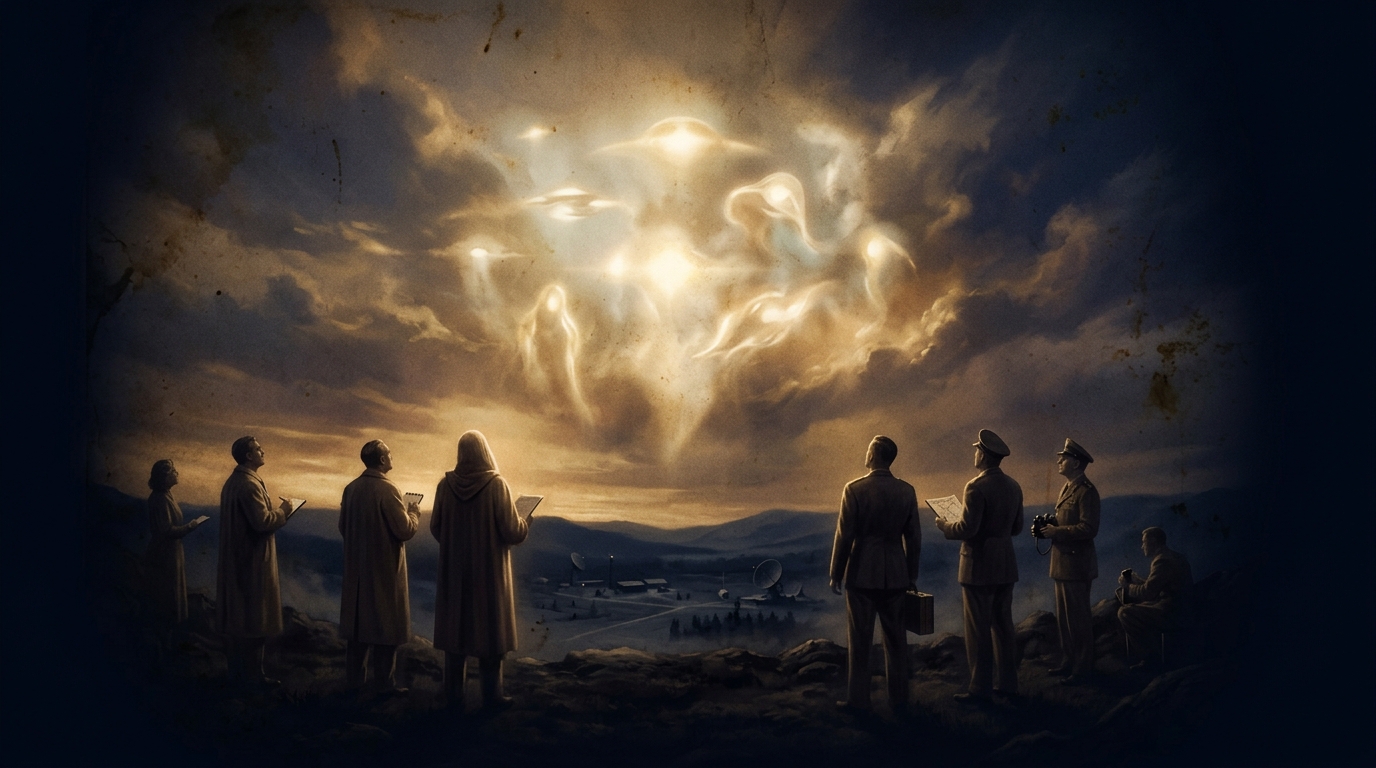
 Codex Illustration
Modern UAP Disclosure
Since 2017, a cascade of declassified military footage, congressional hearings, and whistleblower testimonies has transformed Unidentified Aerial Phenomena from fringe speculation into a subject of formal government inquiry—raising urgent questions about technology, national security, and the very nature of intelligence itself.
Overview
The modern UAP disclosure era is conventionally traced to December 2017, when the New York Times published an investigation revealing the existence of the Pentagon's Advanced Aerospace Threat Identification Program (AATIP), accompanied by declassified gun-camera footage from U.S. Navy pilots showing objects exhibiting flight characteristics—instantaneous acceleration, hypersonic velocity without thermal signatures, trans-medium travel—that no publicly acknowledged technology can explain. The revelation was not merely that anomalous objects had been observed, but that elements of the U.S. intelligence and defense establishment had been quietly studying them for years, and that some officials believed the data warranted serious scientific investigation. This marked a decisive break from the dismissive official posture that had characterized government communications on the subject since Project Blue Book's closure in 1969.
Subsequent years produced an accelerating series of official disclosures. In 2020, the Department of Defense formally acknowledged three previously leaked videos (dubbed 'FLIR1,' 'Gimbal,' and 'Go Fast') as genuine Navy sensor recordings. In 2021, the Office of the Director of National Intelligence released a preliminary assessment acknowledging 144 UAP encounters, declining to explain the majority, and flagging a small subset as exhibiting 'unusual flight characteristics.' Congress moved with unusual bipartisan urgency: the UAP Disclosure Act of 2023 was embedded in the National Defense Authorization Act, and public hearings in 2023 featured decorated military veterans offering sworn testimony, including former intelligence officer David Grusch, who alleged under oath that the U.S. government possesses non-human craft and biological materials—claims that remain officially unconfirmed but have not been criminally challenged.
The epistemological challenge of UAP disclosure is considerable. The evidentiary chain is fragmented: sensor data from advanced military platforms is compelling but classified; pilot testimony is credible but inherently interpretive; whistleblower accounts are specific but unverifiable without document releases that have not occurred. Serious researchers such as Jacques Vallée, Garry Nolan (Stanford immunologist), and Avi Loeb (Harvard astrophysicist) have called for rigorous scientific protocols, while intelligence community veterans caution that adversarial drone programs or sensor artifacts may account for a significant portion of cases. The field is further complicated by a long history of deliberate disinformation operations, documented in cases like the MJ-12 documents, which makes the separation of genuine anomaly from planted narrative genuinely difficult.
Beyond the empirical and national security dimensions lies a deeper set of questions that no congressional hearing has yet addressed: What would confirmed non-human intelligence mean for human self-understanding, for religious frameworks that locate humanity at the center of a created order, and for political structures built on the assumption of human monopoly over advanced technology? Theologians, philosophers of mind, and scholars of comparative religion have begun to engage these questions, while investigators like Vallée have long argued that the UAP phenomenon intersects with folklore, religious apparitions, and altered states of consciousness in ways that suggest it may be as much a phenomenon of the human interior as of physical space.
Timeline
Evidence
Multiple Perspectives
Biblical Lens
Scripture Threads
Sources & Further Study
Questions to Explore
Follow the Thread
Continue the Investigation
You’ve reached the Full Archive portion of this Case File.
Ask the Archivist
about this fileSign in to ask the Archivist
Create a free account to ask the Archivist 1 grounded question each day, cited straight from the CODEX case files.
Discussion
0Share findings, questions, and evidence with fellow Seekers. Be respectful and cite sources where you can.
No comments yet. Be the first to open this thread.