
 Codex Illustration
Molech
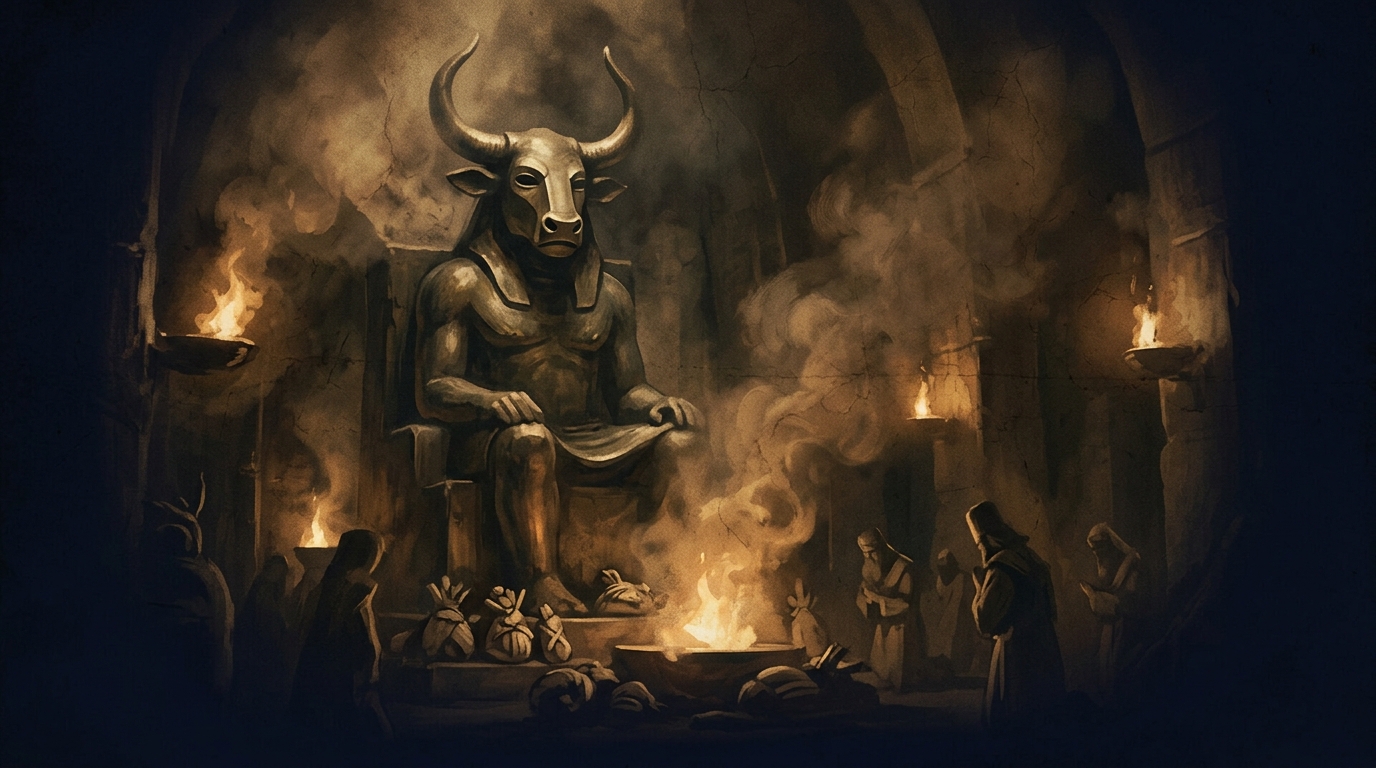
Molech — variously rendered Moloch, Milcom, or simply 'the king' — stands as one of the most disturbing figures in the religious landscape of the ancient Near East, condemned in the Hebrew Bible as the recipient of child sacrifice and intimately associated with a valley outside Jerusalem that would eventually lend its name to the Jewish and Christian concept of eternal judgment.
Overview
Few names in the ancient world carry the weight of Molech. Mentioned in the Torah, condemned by the prophets, and associated with the Topheth — a ritual site in the Valley of Hinnom (Hebrew: Ge-Hinnom) just southwest of Jerusalem — Molech has haunted theological imagination for millennia. The Hebrew Bible presents the worship of this figure as among the most grievous abominations imaginable, explicitly prohibiting Israelites from 'passing their children through the fire to Molech' (Leviticus 18:21; 20:2–5). The prophet Jeremiah (32:35) records this practice as something that had not even 'entered God's mind' as a command, underscoring the depth of its perceived perversity. The reforming king Josiah is credited with desecrating the Topheth in the late seventh century BC, and the site subsequently served as a refuse and corpse dump whose perpetually smoldering fires became the template for Gehenna — the New Testament's primary image of judgment and, in later tradition, 'hell' itself.
The central scholarly controversy surrounding Molech concerns a deceptively simple question: is 'Molech' the proper name of a god, or does the Hebrew term molek denote a type of sacrificial rite? The classical identification connects Molech with the Ammonite deity Milcom (1 Kings 11:5, 7), treating both as royal-title epithets derived from the Semitic root mlk ('king'). A landmark challenge came from the German scholar Otto Eissfeldt, who proposed in his 1935 monograph Molk als Opferbegriff that molek was not a divine name but rather a technical term for a specific votive sacrifice — a thesis he grounded partly in Punic and North African inscriptions using the term mlk alongside molk 'adam ('human sacrifice') and molk 'omor ('animal substitute'). This hypothesis reframed the Hebrew texts as prohibiting a category of ritual act rather than the veneration of a distinct deity, profoundly shifting how scholars read the relevant passages. Subsequent scholars, notably John Day and George Heider in separate monographs during the 1980s, pushed back substantially, arguing that both a divine identity and a sacrificial rite may have been operative simultaneously — and that Eissfeldt's Punic evidence, while real, does not straightforwardly map onto the earlier Canaanite and Israelite contexts.
The material archaeology bearing on this debate is both illuminating and contested. Excavations at Carthage and other Phoenician-influenced sites in North Africa uncovered burial precincts known as tophets — a term scholars have borrowed directly from the biblical Topheth — containing urns with the calcined bones of infants and young children, sometimes intermingled with animal bones. These sites, most extensively studied at Carthage's Precinct of Tanit, span roughly the eighth through second centuries BC. For a generation of scholars, this evidence confirmed the biblical and classical literary accounts of child sacrifice in Phoenician religion. However, a significant revisionist argument emerged in the early twenty-first century, led by scholars including Josephine Quinn and Mark Woolmer, who argue that statistical analysis of the skeletal remains suggests many of the children died of natural causes and were given honorable votive burial — making the Tophet a cemetery rather than a sacrificial precinct. This revisionist reading remains contested; other bioarchaeologists, such as Patricia Smith and Jeffrey Schwartz, have argued the bone evidence is consistent with sacrifice. The debate is alive, consequential, and far from settled.
Within the interpretive framework associated with biblical scholar Michael Heiser — drawing on his reading of Deuteronomy 32:8–9, Psalm 82, and the broader concept of the Divine Council — Molech can be understood as one of the rebellious 'sons of God' (elohim) to whom the nations were assigned after the Tower of Babel incident, now demanding illicit and lethal worship from the very people meant to belong to Yahweh alone. On this reading, the prohibition against Molech worship is not merely a moral injunction against child murder (though it is certainly that) but a theological declaration of war: Yahweh is reclaiming the inheritance of his people from entities who have corrupted the nations. The Valley of Hinnom — defiled, desecrated, smoldering — thus becomes a geographic scar in Israel's sacred landscape, a liminal space where the boundary between legitimate worship and catastrophic rebellion had been most grotesquely violated. That this valley became 'Gehenna' is, within this framework, profoundly appropriate: it is literally the site where the worship of a rival elohim had consumed children, transformed by prophetic memory into the defining image of divine judgment upon all that opposes Yahweh.
Key Claims
Timeline
Evidence
Multiple Perspectives
Biblical Lens
Scripture Threads
Sources & Further Study
Questions to Explore
Go Deeper Path
Follow the Thread
Continue the Investigation
You’ve reached the Full Archive portion of this Case File.
Ask the Archivist
about this fileSign in to ask the Archivist
Create a free account to ask the Archivist 1 grounded question each day, cited straight from the CODEX case files.
Discussion
0Share findings, questions, and evidence with fellow Seekers. Be respectful and cite sources where you can.
No comments yet. Be the first to open this thread.