
 Codex Illustration
Moon-Eyed People
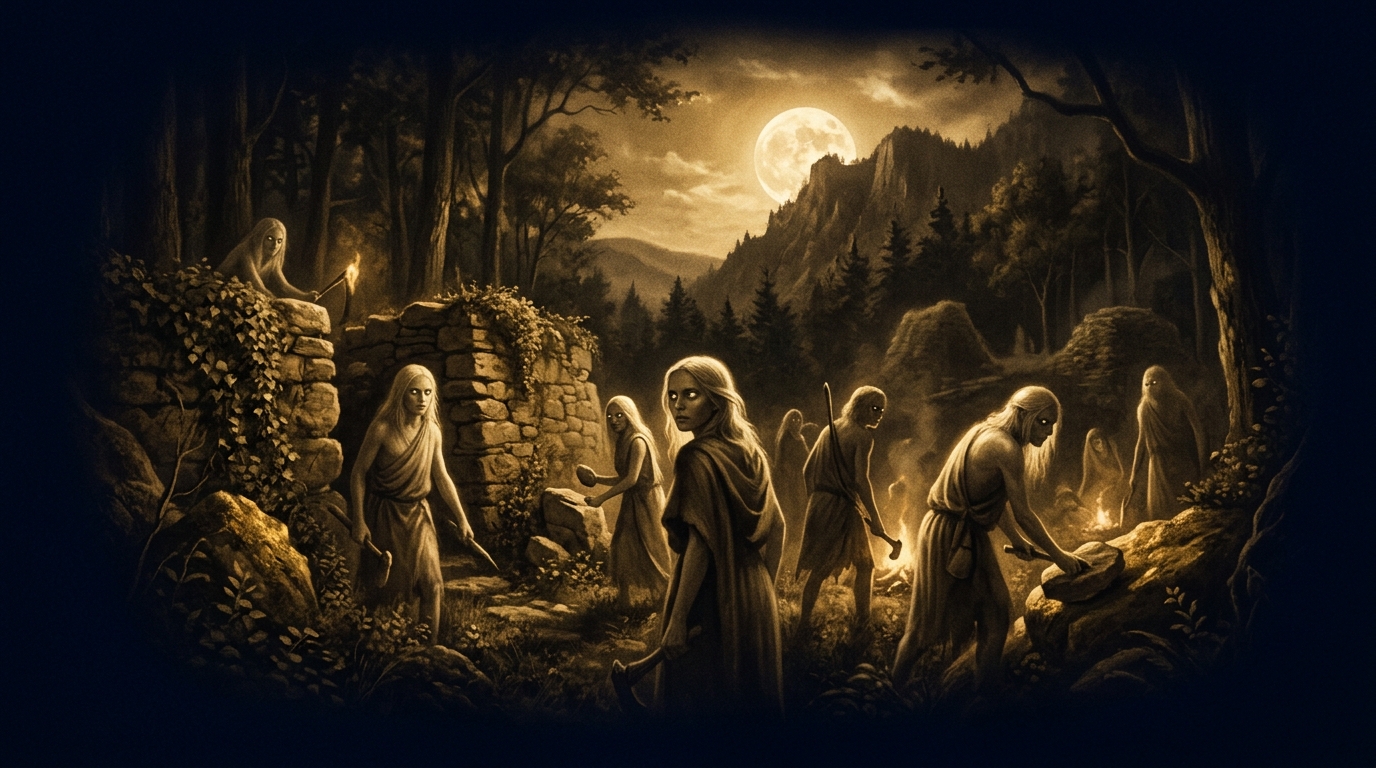
Cherokee oral tradition preserves accounts of a pale, light-sensitive people said to have inhabited the southern Appalachians before the Cherokee themselves arrived — builders of stone walls and earthworks whose origins and fate remain genuinely unresolved by archaeology and ethnography alike.
Overview
Among the most intriguing and least-examined strands of Appalachian prehistory is the Cherokee tradition of the Ani'-Kutâni or, more specifically, the 'moon-eyed people' — a pale, small-statured folk said to have been nearly blind in daylight, conducting their affairs by moonlight and retreating underground or westward when the Cherokee expanded into the mountain country of what is now Georgia, Tennessee, and the Carolinas. The tradition was recorded in recognizable form as early as 1775 by the trader and naturalist Benjamin Hawkins, and was later elaborated by John Haywood in his 1823 work on Tennessee history, where the moon-eyed people are explicitly described as a pre-Cherokee population who built stone enclosures and were driven out or destroyed. It is important to note at the outset that these accounts represent historical colonial-era transcriptions of oral tradition — not primary Cherokee documents — and carry all the interpretive complications such transmission entails.
The most frequently cited physical site associated with the legend is Fort Mountain State Park in Murray County, Georgia, where a serpentine stone wall roughly 855 feet long and of uncertain age crowns a ridge of the Blue Ridge Mountains. The wall's origin is genuinely debated: mainstream archaeologists generally attribute it to Late Woodland or Mississippian-period Native construction, possibly for ceremonial or defensive purposes, while popular writers have connected it to the moon-eyed people or, in a separate but related tradition, to the Welsh prince Madoc who allegedly explored North America in the twelfth century. Neither the Madoc hypothesis nor the moon-eyed attribution has been confirmed by archaeological excavation, and the wall remains undated by rigorous radiocarbon analysis in the publicly available literature.
The question of who the moon-eyed people might represent in historical terms has attracted several competing interpretations. Ethnographers such as James Mooney, whose monumental 1900 Smithsonian Bureau of American Ethnology work 'Myths of the Cherokee' remains a foundational source, treated the tradition as a genuine layer of Cherokee historical memory, possibly encoding recollections of an earlier displaced population. Some researchers have proposed that the tradition preserves memory of an actual pre-Cherokee culture — perhaps the people associated with the Woodland or Archaic periods — while others have noted the physiological description (pale skin, large or sensitive eyes) and suggested the tale may encode memory of early European contact, albinism within a prior group, or even the transfer of older motifs from unrelated traditions. Each of these hypotheses carries different evidentiary weight, and none has achieved scholarly consensus.
What makes the moon-eyed people tradition genuinely compelling as a subject of serious inquiry is precisely what makes it so resistant to resolution: it sits at the intersection of oral history, colonial-era ethnographic transcription, ambiguous archaeology, and the broader unresolved question of pre-Columbian population movements in eastern North America. The tradition is neither pure invention nor straightforward history. It is, in the archive's estimation, a genuine piece of cultural memory whose referent — whatever that referent may have been — has been obscured by time, translation, and the catastrophic disruptions of the colonial period. It invites careful investigation rather than either dismissal or enthusiastic overclaiming.
Key Claims
Timeline
Evidence
Multiple Perspectives
Biblical Lens
Scripture Threads
Sources & Further Study
Questions to Explore
Go Deeper Path
Follow the Thread
Continue the Investigation
You’ve reached the Full Archive portion of this Case File.
Ask the Archivist
about this fileSign in to ask the Archivist
Create a free account to ask the Archivist 1 grounded question each day, cited straight from the CODEX case files.
Discussion
0Share findings, questions, and evidence with fellow Seekers. Be respectful and cite sources where you can.
No comments yet. Be the first to open this thread.