
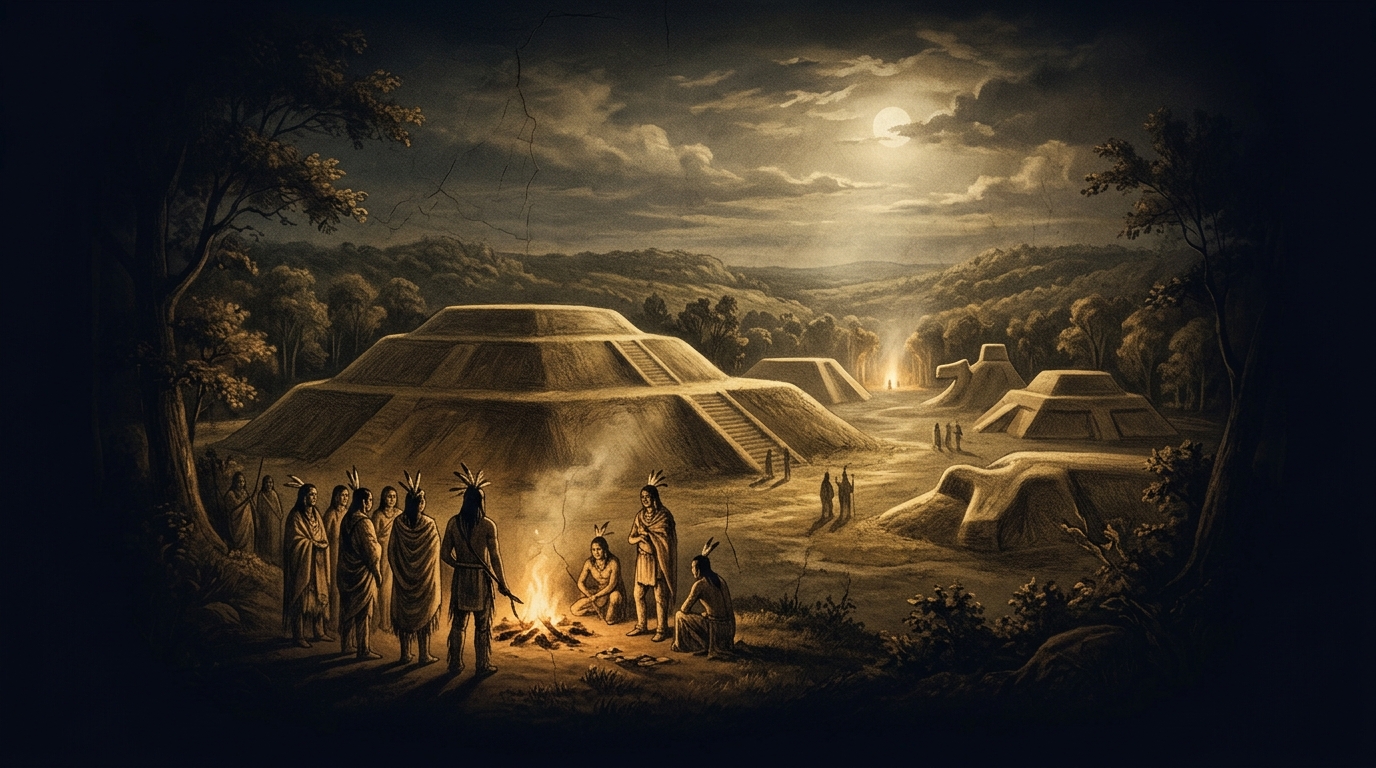
 Codex Illustration
Mound Builders
Across the eastern half of North America, hundreds of thousands of earthen mounds — some geometric, some effigy-shaped, some towering over ten stories — stand as enduring testament to sophisticated Indigenous civilizations whose complexity 19th-century Euro-American scholarship was, for ideological reasons, systematically reluctant to acknowledge.
Overview
Between roughly 3500 BCE and 1600 CE, a succession of Indigenous North American cultures constructed earthworks of staggering scale and variety across the continent's interior. The Archaic-period Watson Brake site in Louisiana, radiocarbon-dated to approximately 3400 BCE, predates the better-known Poverty Point complex by nearly two millennia and pushes the record of organized earthwork construction in North America back far beyond what scholars once imagined. Subsequent traditions — Adena (c. 1000–100 BCE), Hopewell (c. 100 BCE–500 CE), and the Mississippian culture (c. 800–1600 CE) — each elaborated the earthen mound tradition in distinctive ways: burial mounds, ceremonial platform mounds, and the extraordinary geometric enclosures of the Ohio River valley. Cahokia, near present-day Collinsville, Illinois, reached its zenith around 1100 CE with a population estimated by some archaeologists at ten to twenty thousand, making it one of the largest pre-Columbian cities north of Mexico. Monks Mound, Cahokia's central platform, contains more earthen volume than Egypt's Great Pyramid of Giza — a documented archaeological fact that continues to astonish.
The question of who built these structures became, in the 19th century, one of the most consequential and morally freighted controversies in American intellectual history. As Euro-American settlers expanded into the Ohio and Mississippi valleys, they encountered mounds of remarkable engineering and concluded — with little archaeological evidence and considerable cultural motivation — that the builders could not possibly have been the ancestors of contemporary Native American peoples. Various candidates were proposed: a mythologized 'lost race' of superior white inhabitants, Phoenicians, wandering Israelites, even survivors of a sunken continent. These theories were not merely idle speculation; they served a political function, providing a pseudo-historical justification for dispossessing Native peoples by framing them as latecomers who had themselves displaced or destroyed the 'true' builders. Popular writers, land speculators, and even some otherwise credentialed individuals promulgated these ideas widely, and they circulated through 19th-century American culture with remarkable persistence.
The scientific refutation of the 'lost race' mythology came decisively — though not immediately culturally — with the work of Cyrus Thomas and the Bureau of American Ethnology. In 1894, Thomas published 'Report on the Mound Explorations of the Bureau of Ethnology,' a systematic survey of hundreds of sites across the eastern United States. His findings were unambiguous: the mound builders were demonstrably the ancestors of Indigenous peoples still living in North America. Artifacts found within mounds showed continuity with historic Native material culture; skeletal remains aligned with Indigenous populations; oral traditions of numerous tribes preserved memory of mound construction. Thomas's report is considered a landmark of American archaeology, and subsequent decades of excavation, radiocarbon dating, and comparative ethnography have only reinforced his central conclusions. The scholarly consensus today is essentially unanimous: the mounds were built by Indigenous North Americans across multiple distinct cultural traditions spanning millennia.
Yet the 'lost race' narrative proved extraordinarily durable in popular culture, and its afterlives continue to surface in various forms — in 19th-century religious texts, in early 20th-century pseudoarchaeology, and in contemporary internet claims about giant skeletons supposedly suppressed by the Smithsonian Institution. These modern iterations recycle the same structural logic as the original myth: an impressive ancient achievement is deemed inexplicable without invoking a superior or mysterious outside agency, implicitly or explicitly denying the intellectual and organizational capacity of Indigenous peoples. Scholars of archaeology, history, and Indigenous studies have identified this pattern as a persistent form of what is sometimes called 'archaeological racism,' a dynamic worth naming clearly while still engaging seriously with the genuine and fascinating questions the mounds pose about prehistoric social organization, cosmology, and long-distance exchange networks.
Key Claims
Timeline
Evidence
Multiple Perspectives
Biblical Lens
Scripture Threads
Sources & Further Study
Questions to Explore
Go Deeper Path
Follow the Thread
Continue the Investigation
You’ve reached the Full Archive portion of this Case File.
Ask the Archivist
about this fileSign in to ask the Archivist
Create a free account to ask the Archivist 1 grounded question each day, cited straight from the CODEX case files.
Discussion
0Share findings, questions, and evidence with fellow Seekers. Be respectful and cite sources where you can.
No comments yet. Be the first to open this thread.