
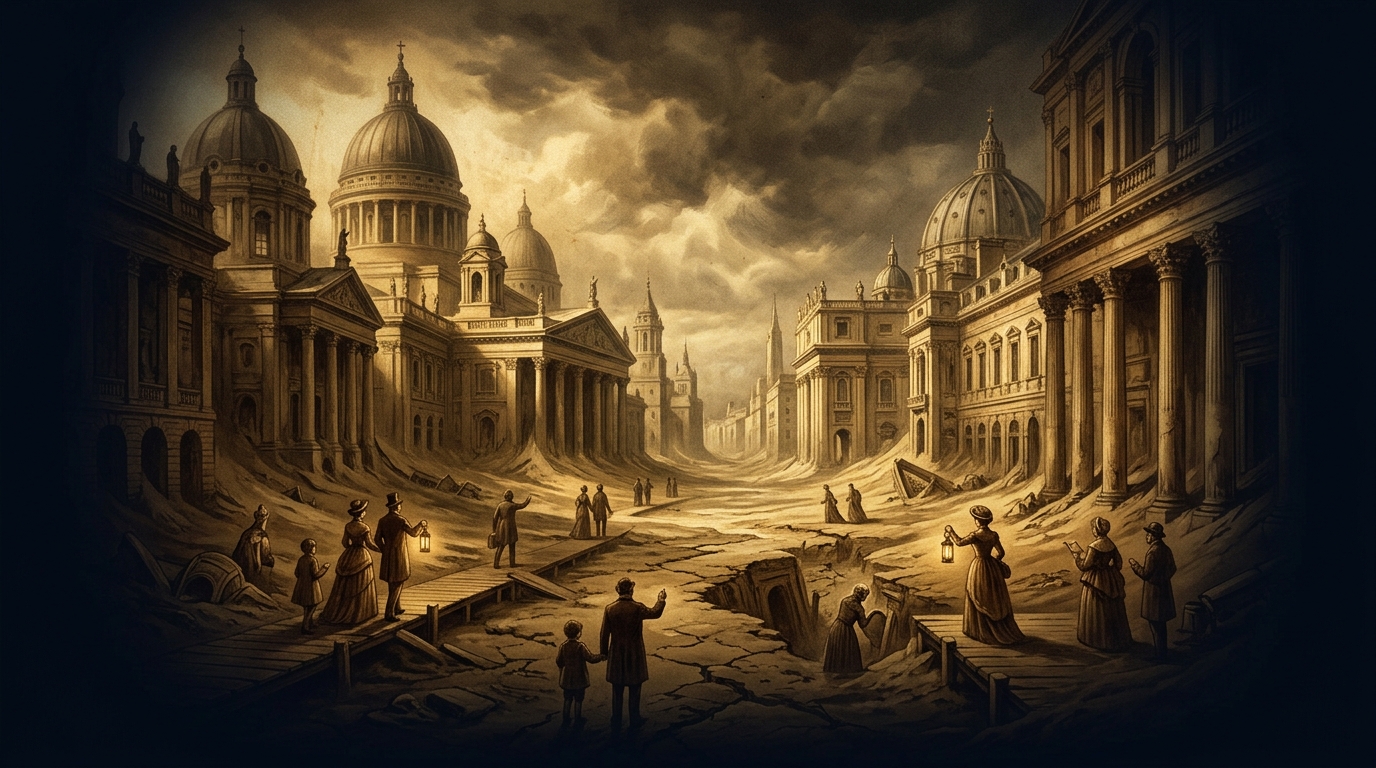
 Codex Illustration
Mud Flood Theory
A viral internet phenomenon beginning roughly around 2015 proposes that a catastrophic global deluge of mud buried an advanced pre-existing civilization sometime in the 18th or 19th century, erasing its memory and allowing a shadowy elite to reset human history — a claim that, while emotionally resonant and visually compelling, is unsupported by archaeological, geological, or documentary evidence.
Overview
The Mud Flood Theory holds, in its most common iteration, that the world experienced a catastrophic inundation of mud — distinct from but sometimes conflated with flood mythology — that buried the lower stories of buildings across multiple continents, exterminated or scattered a sophisticated prior population, and permitted a ruling class to repopulate the earth with orphaned foundlings while rewriting the historical record. Proponents point to what they describe as architectural anomalies: ground-floor windows that sit at or below street grade, basement levels that appear to have once been inhabited main floors, monumental civic buildings supposedly too grand for the modest 19th-century municipalities that claim to have constructed them, and the apparent uniformity of 'Tartarian' architectural styles across geographically distant cities. These observations are presented on YouTube channels, forums, and social media as self-evident proof of deliberate concealment. It should be stated clearly: none of these claims have been validated by professional historians, geologists, archaeologists, or structural engineers working from peer-reviewed evidence.
The documented explanation for sunken ground floors and below-grade windows is considerably more mundane, though genuinely interesting in its own right. Urban grade-raising — the deliberate elevation of city street levels through the importation of fill material — is a thoroughly documented historical engineering practice. Chicago's famous 19th-century grade-raising project, for instance, lifted entire city blocks by several feet to address catastrophic drainage and sanitation problems, a process recorded in contemporary newspapers, engineering journals, and civic archives. Similar programs occurred in Boston, Seattle (whose 'Underground City' is a well-known tourist attraction built atop a raised street grid), and numerous European cities. Victorian-era building codes, shifting fashions in basement usage, and the gradual accumulation of centuries of urban detritus all contributed independently to the phenomenon of partially submerged ground floors. These are documented facts of urban history, not mysteries requiring a hidden catastrophe for their explanation.
The theory's appeal is not difficult to understand from a cultural and psychological standpoint. It draws on real human intuitions: that monumental architecture implies a lost sophistication, that official history may omit inconvenient truths, and that catastrophe has shaped human civilization in ways mainstream academia sometimes underestimates. The aesthetic of 'Tartaria' — a vaguely Eurasian empire of baroque grandeur allegedly erased from the record — taps into genuine nostalgia and a suspicion of institutional authority that has intensified in the social media era. Scholars of folklore and conspiracy culture, including those working in the tradition of researchers like Michael Barkun (A Culture of Conspiracy, University of California Press, 2003), observe that such narratives frequently flourish when trust in institutions is low and when visual 'evidence' can circulate faster than contextualizing expertise. The Mud Flood phenomenon is therefore worth examining not as history, but as a revealing artifact of contemporary folklore.
From a biblical and theological standpoint, the theory's most conspicuous touchstone is the genre of global catastrophism — the intuition, widespread across human cultures, that a great disruption once severed humanity from an earlier, more glorious state. The biblical flood narrative (Genesis 6–9) and its cognates in texts like the Epic of Gilgamesh represent genuine ancient memory of catastrophic events, processed through theological frameworks. The Mud Flood theory, however, locates its proposed catastrophe in the 18th or 19th century CE and implies a conspiracy of silence by identifiable human elites — a claim that would require the complicit silence of millions of architects, engineers, surveyors, local historians, newspaper editors, and ordinary citizens across dozens of countries simultaneously. No credible mechanism for such suppression has been proposed, and the documentary, photographic, and physical evidence for conventional urban history remains extensive, publicly accessible, and uncontradicted by any peer-reviewed finding.
Key Claims
Timeline
Evidence
Multiple Perspectives
Biblical Lens
Scripture Threads
Sources & Further Study
Questions to Explore
Go Deeper Path
Follow the Thread
Continue the Investigation
You’ve reached the Full Archive portion of this Case File.
Ask the Archivist
about this fileSign in to ask the Archivist
Create a free account to ask the Archivist 1 grounded question each day, cited straight from the CODEX case files.
Discussion
0Share findings, questions, and evidence with fellow Seekers. Be respectful and cite sources where you can.
No comments yet. Be the first to open this thread.