
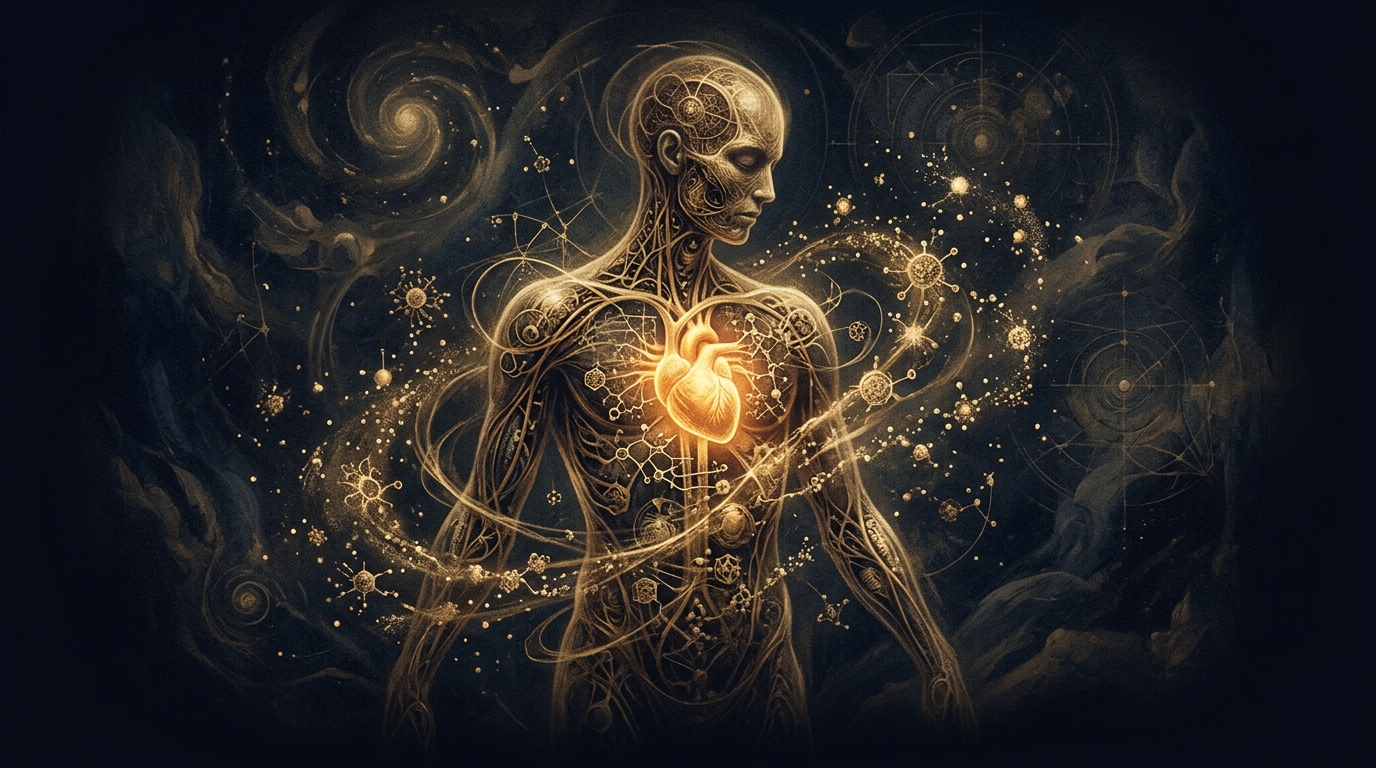
 Codex Illustration
Nanorobotics and the Future Body
Nanorobotics — the engineering of machines at the scale of individual molecules and cells — promises to rewrite the biological limits of the human body, offering visions of targeted cancer therapy, cellular repair, and indefinite physical enhancement that simultaneously excite scientists and trouble philosophers, ethicists, and theologians.
Overview
The concept of operating machines at nanometer scales entered scientific discourse seriously with physicist Richard Feynman's 1959 lecture 'There's Plenty of Room at the Bottom,' in which he speculated, with characteristic precision, that there was no fundamental physical law preventing the manipulation of matter at the atomic level. K. Eric Drexler formalized the vision three decades later in his 1986 book Engines of Creation, proposing 'assemblers' — programmable molecular machines capable of building virtually any physically permissible structure atom by atom. While Drexler's specific assembler model remains contested among chemists and materials scientists, his work catalyzed an entire generation of inquiry. Today, documented progress in DNA nanotechnology, synthetic molecular motors, lipid nanoparticle drug delivery (as seen in mRNA vaccine platforms), and self-assembling peptide structures has moved nanoscale engineering from thought experiment to laboratory reality, even if true autonomous nanorobots of the science-fiction variety remain largely unrealized.
The most substantiated near-term applications lie in biomedicine. Research groups at institutions including MIT, ETH Zurich, and Harvard's Wyss Institute have demonstrated functional DNA origami structures capable of targeted drug delivery, as well as micro- and nanoscale swimming robots guided by magnetic fields through simulated bodily fluids. In 2023, researchers published peer-reviewed demonstrations of nanoscale machines navigating complex fluidic environments at the cellular scale. These are not autonomous reasoning machines — they are carefully engineered chemical and physical systems — but the trajectory is unmistakable. The FDA's approval of lipid nanoparticle delivery systems for RNA therapeutics constitutes a documented, if modest, proof-of-concept that engineered nanoscale structures can function inside living human bodies with measurable clinical effect.
Beyond medicine, the more speculative horizon involves what transhumanist thinkers — among them Ray Kurzweil, Nick Bostrom, and Aubrey de Grey — describe as 'whole-body nanomedicine': a theoretical future in which populations of nanorobots patrol the bloodstream, reverse cellular senescence, repair DNA mismatches in real time, and ultimately arrest or reverse biological aging. Kurzweil's Singularity University lectures and his book The Singularity Is Near (2005) project that such capabilities may emerge within decades. These projections are regarded with measured skepticism by mainstream biogerontologists, who note that the regulatory, thermodynamic, power-supply, and biocompatibility challenges are formidable. The gap between functional lipid nanoparticles and self-replicating, decision-making intracellular machines is — by most scientific estimates — enormous.
The deepest questions nanorobotics raises are not engineering questions but anthropological ones. If the cellular substrate of the human body can be incrementally replaced, repaired, or augmented by engineered machinery, at what point does the organism cease to be recognizably human in the traditional biological sense? Philosophers of mind, bioethicists, and religious thinkers have all engaged this threshold question with genuine seriousness. The archive's related entries on transhumanism, mind uploading, the image of God, and digital immortality map the broader intellectual and theological terrain into which nanorobotics emphatically intrudes. Whether this technology ultimately represents medicine's highest aspiration or an unprecedented transgression of created limits is, at present, genuinely unresolved — and the honest researcher must hold both possibilities with open hands.
Key Claims
Timeline
Evidence
Multiple Perspectives
Biblical Lens
Scripture Threads
Sources & Further Study
Questions to Explore
Go Deeper Path
Follow the Thread
Continue the Investigation
You’ve reached the Full Archive portion of this Case File.
Ask the Archivist
about this fileSign in to ask the Archivist
Create a free account to ask the Archivist 1 grounded question each day, cited straight from the CODEX case files.
Discussion
0Share findings, questions, and evidence with fellow Seekers. Be respectful and cite sources where you can.
No comments yet. Be the first to open this thread.