
 Codex Illustration
Natanz Nuclear Facility
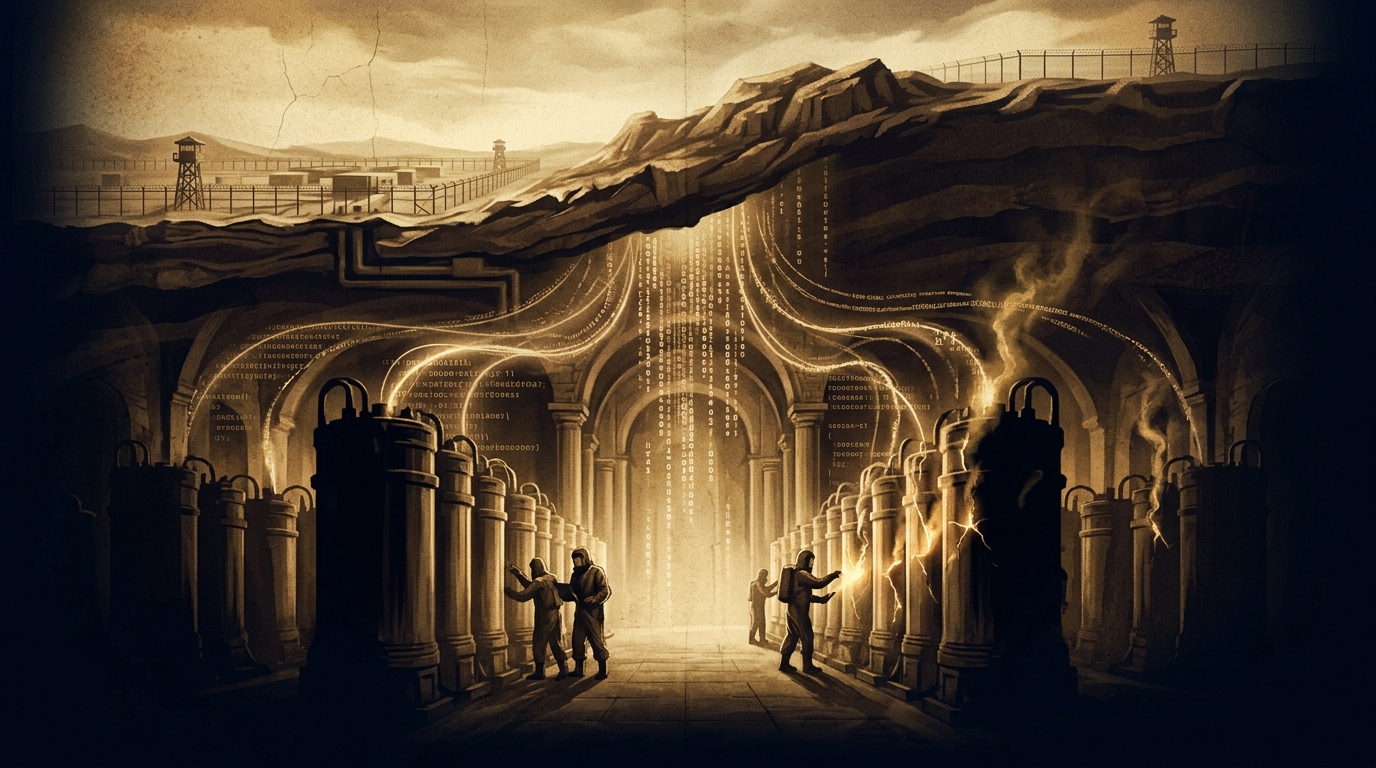
Buried beneath the desert of central Iran, the Natanz nuclear complex became the epicenter of the most consequential covert operation in the history of cyberwarfare — a secret campaign waged in code rather than ordinance, reshaping the boundaries of modern statecraft and the meaning of war itself.
Overview
The Natanz Fuel Enrichment Plant, located approximately 250 kilometers south of Tehran in Isfahan Province, is Iran's principal uranium enrichment facility and the most heavily scrutinized nuclear site on earth. Construction of the above-ground pilot plant and the deep underground halls began in the late 1990s, though the facility's existence was not publicly acknowledged until August 2002, when the National Council of Resistance of Iran — an Iranian opposition group — disclosed its coordinates to the world. The revelation triggered an international crisis, initiating a decade-long confrontation between Iran, the International Atomic Energy Agency (IAEA), and Western governments who feared the facility's centrifuge cascades were oriented less toward civilian energy production than toward a clandestine weapons program. What followed was one of the most complex, protracted, and consequential diplomatic standoffs of the post-Cold War era.
The facility itself is a feat of hardened engineering. The underground enrichment halls at Natanz are buried under approximately eight meters of concrete and another eight meters of soil, designed explicitly to withstand conventional aerial bombardment. At peak operation, the plant housed tens of thousands of IR-1 centrifuges — machines of extraordinary delicacy that spin uranium hexafluoride gas at supersonic speeds to separate fissile U-235 from the more common U-238 isotope. The IAEA installed cameras and seals at Natanz beginning in 2003 under the Additional Protocol to the Nuclear Non-Proliferation Treaty, providing a degree of international monitoring — though the agency repeatedly reported Iran's incomplete cooperation and undisclosed parallel activities. The documented history of Natanz is, in many respects, a history of declared facts and suspected concealment existing simultaneously in the same physical space.
The facility's most dramatic chapter opened sometime around 2007–2008, when a sophisticated cyberweapon — later identified by investigative journalists and security researchers as Stuxnet — was introduced into the Natanz control systems. Stuxnet was a joint operation reportedly conducted by the United States National Security Agency and Israeli Unit 8200, though neither government has ever officially confirmed authorship. The malware was engineered with remarkable specificity: it targeted Siemens programmable logic controllers governing centrifuge motor frequencies, causing machines to spin erratically while reporting normal readings to operators. Somewhere between 900 and 2,000 centrifuges were physically destroyed before Iranian engineers identified the intrusion. The operation, reportedly codenamed Olympic Games and authorized under the Bush administration before being continued under President Obama, represented the first documented use of a cyberweapon to cause kinetic physical destruction — a threshold crossing with profound implications for international law and the future of warfare.
Since the discovery of Stuxnet in 2010 and its attribution by researchers at Symantec and the Kaspersky Lab, Natanz has remained at the center of ongoing geopolitical tension. Iran has continued enriching uranium at the site at progressively higher levels of purity — briefly surpassing 60 percent enriched uranium, approaching weapons-grade threshold — while negotiations over the Joint Comprehensive Plan of Action (JCPOA, 2015) and its subsequent collapse (2018) repeatedly cited Natanz as the central variable in regional security calculations. The facility has also survived at least two suspected physical sabotage incidents: an explosion and fire at an advanced centrifuge assembly hall in July 2020, and a power outage in April 2021, both widely attributed in the international press to Israeli intelligence operations, though Israel maintained its customary posture of neither confirming nor denying. The story of Natanz is, ultimately, a story about the shape of power in the twenty-first century — about what nations will do in secret, what they can accomplish through code and sabotage rather than declared war, and how the line between peace and conflict has become nearly impossible to locate.
Key Claims
Timeline
Evidence
Multiple Perspectives
Biblical Lens
Scripture Threads
Sources & Further Study
Questions to Explore
Go Deeper Path
Follow the Thread
Continue the Investigation
You’ve reached the Full Archive portion of this Case File.
Ask the Archivist
about this fileSign in to ask the Archivist
Create a free account to ask the Archivist 1 grounded question each day, cited straight from the CODEX case files.
Discussion
0Share findings, questions, and evidence with fellow Seekers. Be respectful and cite sources where you can.
No comments yet. Be the first to open this thread.