
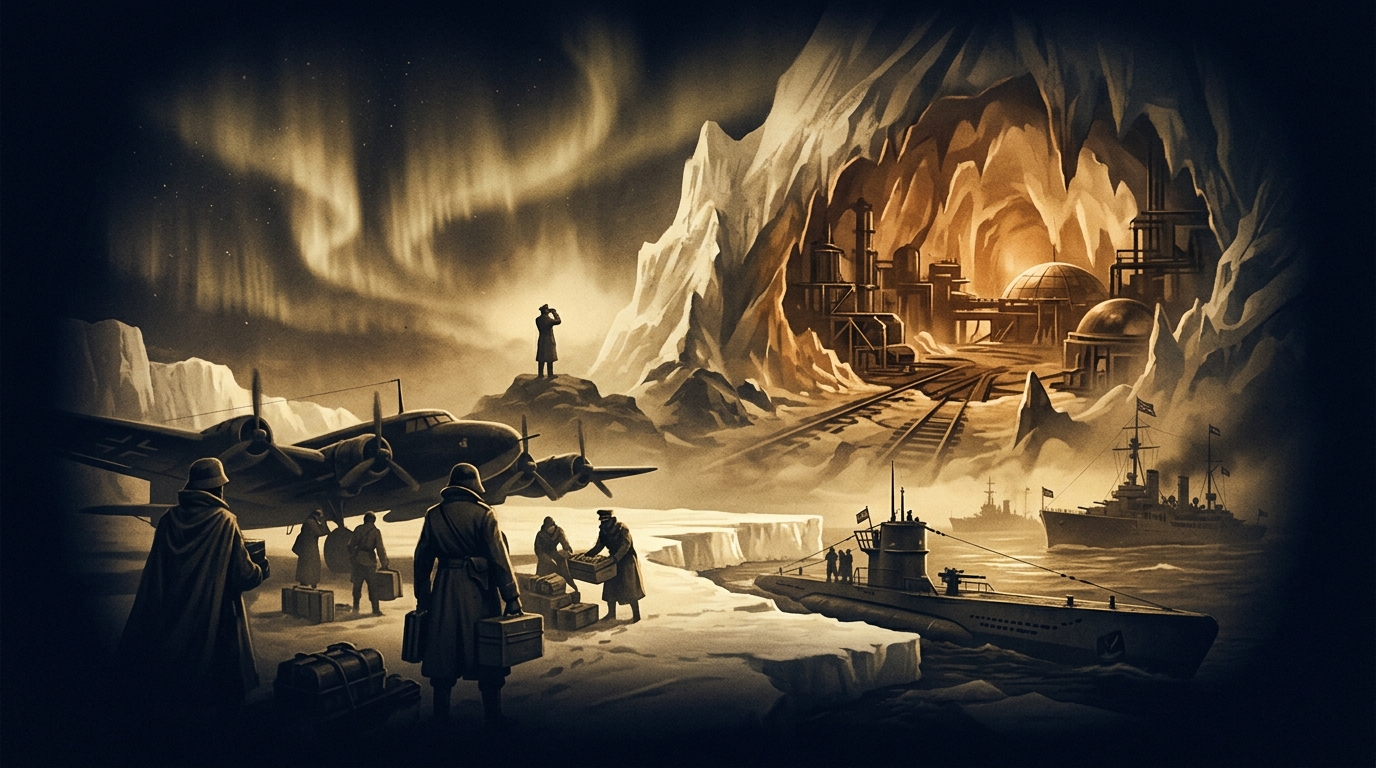
 Codex Illustration
Nazi Antarctica and Operation Highjump Conspiracy Claims
In the final years of World War II, Nazi Germany dispatched an expedition to Antarctica, sparking decades of speculation about secret bases, underground refuges, and a postwar military confrontation — claims that intersect genuine Cold War history with elaborate and largely unverifiable mythology.
Overview
The documented historical record is clear on several points: Germany conducted a genuine Antarctic expedition in 1938–1939 under Alfred Ritscher, ostensibly to survey territory for a possible whaling station and to assert German geopolitical claims. The expedition mapped roughly 600,000 square kilometers of the Antarctic interior, dropping aluminium markers bearing the swastika. The territory was dubbed Neuschwabenland, a name derived from the German naval vessel Schwabenland that served as the expedition's base ship. This is established history, supported by German naval and Foreign Office records from the period. What followed the war, however, is where documented fact begins to blur into contested claim, folklore, and outright fabrication.
Operation Highjump (officially designated Task Force 68) was a large-scale United States Navy expedition to Antarctica, conducted between August 1946 and February 1947 under the command of Rear Admiral Richard E. Byrd. Its stated objectives, as documented in the official U.S. Navy record, included establishing the Antarctic research base Little America IV, training personnel and testing equipment in extreme cold conditions, consolidating and extending American sovereignty claims, and conducting aerial photographic surveys. The operation involved approximately 4,700 men, thirteen ships, and twenty-three aircraft — a scale far beyond typical peacetime scientific missions. This disproportionate military character has fed speculation that the true purpose was something the Navy did not disclose. Nonetheless, historians of Cold War strategy have offered a more parsimonious interpretation: the postwar period saw active great-power competition over Antarctica's strategic real estate, and the United States sought to establish a dominant presence before the Soviet Union could do so.
The conspiracy claims elaborating upon these two documented episodes form a layered and internally varied mythology. At their least dramatic, proponents suggest that Nazi submarines, some of which did operate in southern Atlantic waters, may have transported personnel or materials to Antarctica in the war's final months, possibly establishing a modest clandestine refuge. At their most elaborate, the claims assert that a fully operational secret base called 'Base 211' or 'Neu-Schwabenland' was constructed beneath the Antarctic ice, complete with advanced technology — including, in some versions, extraterrestrial craft — and that Operation Highjump was a failed military assault on this base, repulsed by weapons beyond conventional Allied capability. Admiral Byrd is frequently quoted in these narratives as having warned of enemies capable of striking from pole to pole, though the provenance of this specific quotation and its context is disputed; versions of it appear to derive from a 1947 Chilean newspaper interview, the full text of which is difficult to independently verify in its commonly circulated form.
What the historical record does not support is the elaborate mythology surrounding Base 211. No credible archaeological, photographic, or signals-intelligence evidence of a functioning Nazi Antarctic installation has been produced or evaluated by mainstream researchers. German U-boat operational records, studied extensively by naval historians including Clay Blair in his meticulous two-volume study of the U-boat war, show no documented missions to Antarctica in 1944–1945. The claims circulate primarily through fringe publishing, internet communities, and sensational documentaries, drawing on a small number of ambiguous primary sources and a large body of fabricated or misattributed quotations. The mythology nonetheless rewards careful study, not as evidence of a hidden base, but as a revealing case study in how genuine historical strangeness — a Nazi polar expedition, an oversized postwar military operation, the fog of Cold War secrecy — can serve as substrate for increasingly elaborate alternative histories.
Key Claims
Timeline
Evidence
Multiple Perspectives
Biblical Lens
Scripture Threads
Sources & Further Study
Questions to Explore
Go Deeper Path
Follow the Thread
Continue the Investigation
You’ve reached the Full Archive portion of this Case File.
Ask the Archivist
about this fileSign in to ask the Archivist
Create a free account to ask the Archivist 1 grounded question each day, cited straight from the CODEX case files.
Discussion
0Share findings, questions, and evidence with fellow Seekers. Be respectful and cite sources where you can.
No comments yet. Be the first to open this thread.