
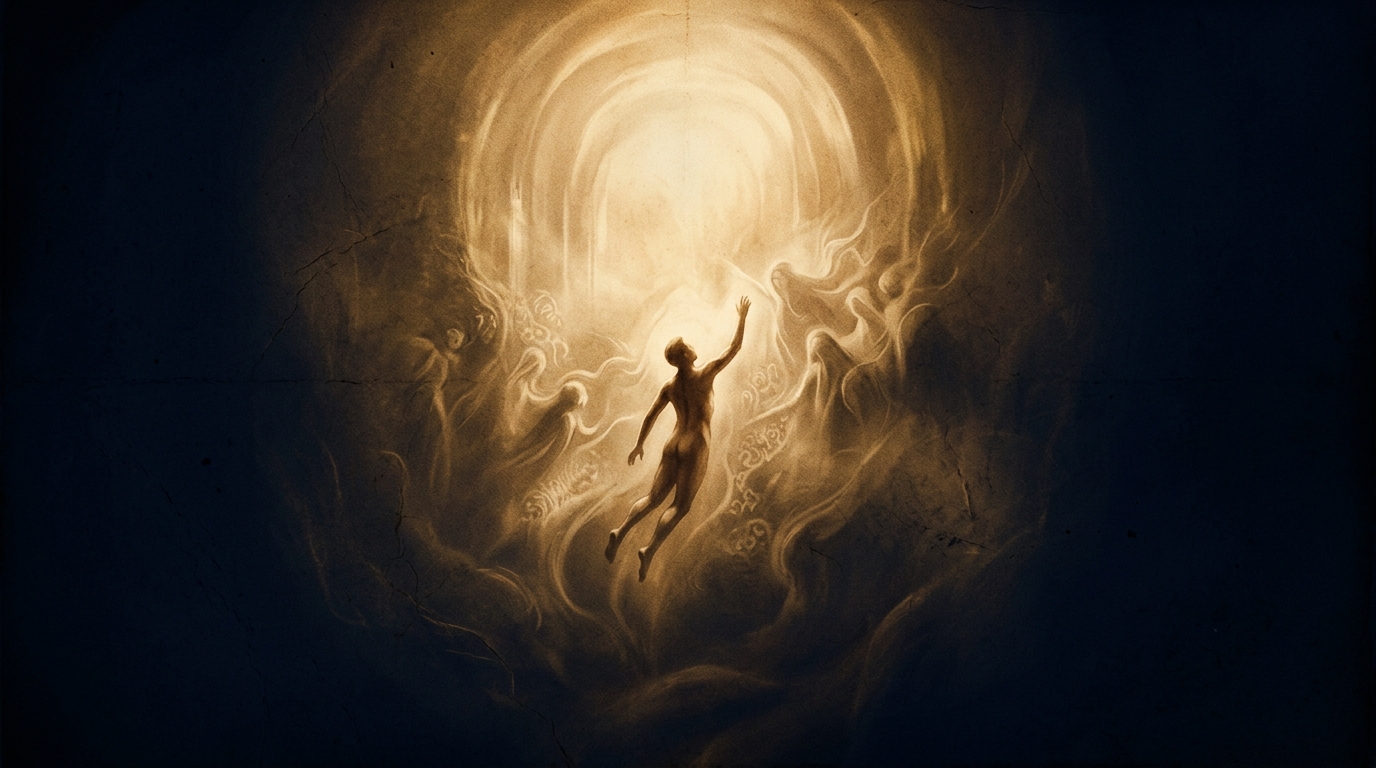
 Codex Illustration
Near-Death Experiences
Near-death experiences—vivid, often transformative encounters reported by individuals on the threshold of death—challenge materialist assumptions about consciousness and have generated serious scientific inquiry, deep theological reflection, and enduring cross-cultural fascination.
Overview
Near-death experiences (NDEs) are reported by a significant minority of individuals who survive cardiac arrest, severe trauma, or clinical death. Common elements include a sense of leaving the body, traversing a dark tunnel, encountering an overwhelming light or luminous being, reviewing one's life in panoramic detail, meeting deceased relatives, and arriving at a boundary or threshold before returning to the body. These accounts have been documented across virtually every culture and historical period, suggesting either a universal feature of human neurology, a genuine encounter with a non-material dimension, or some combination of both. Modern medical documentation, beginning systematically in the 1970s, has moved the subject from folk narrative into the domain of peer-reviewed inquiry.
The landmark work of psychiatrist Raymond Moody, published in 1975, introduced the phrase 'near-death experience' to mainstream discourse and catalyzed decades of research. Subsequent investigators—including cardiologist Pim van Lommel, physicians Sam Parnia and Michael Sabom, and psychologist Kenneth Ring—designed prospective studies attempting to control for pharmacological, physiological, and psychological variables. The Dutch AWARE (AWAreness during REsuscitation) study, led by Parnia, sought verifiable out-of-body perception during resuscitation by placing hidden targets in operating rooms, yielding limited but provocative results. Van Lommel's prospective Dutch study, published in The Lancet in 2001, found that a consistent subset of resuscitated cardiac patients reported NDEs regardless of medication, psychological history, or duration of unconsciousness—a finding difficult to explain via standard neurological models alone.
Theological and philosophical responses to NDEs span an enormous range. Materialist neuroscientists attribute the phenomena to oxygen deprivation, REM intrusion, endorphin release, or temporal-lobe excitation. Researchers sympathetic to dualist or panpsychist models argue that the consistency, veridical content, and life-altering aftermath of NDEs resist purely reductive explanations. From a Christian theological standpoint, NDEs raise acute questions about the intermediate state between death and resurrection, the nature of the soul, the reliability of experiential knowledge of the divine, and whether encounters with 'beings of light' are categorically benign. Cross-cultural data further complicates tidy interpretations: Hindu experiencers may encounter Yamaraj, the god of death; Western accounts disproportionately feature Christ-like figures; non-Western accounts sometimes feature darker or more ambiguous entities.
The broader significance of NDEs extends into philosophy of mind, where they constitute one of the most contested empirical challenges to physicalism. If even a fraction of reported veridical perceptions during verified cardiac arrest are accurate—if a patient genuinely observed details later confirmed—they imply that consciousness can operate independently of neural substrate, at least transiently. This remains deeply contested but has attracted serious philosophical attention from thinkers such as David Chalmers and has been woven into discussions of the 'hard problem of consciousness.' For theologians and biblical scholars, NDEs invite reflection on scriptural themes of Sheol, the intermediate state, resurrection, and the nature of human personhood without requiring that every experiential account be given uncritical theological authority.
Timeline
Evidence
Multiple Perspectives
Biblical Lens
Scripture Threads
Sources & Further Study
Questions to Explore
Follow the Thread
Continue the Investigation
You’ve reached the Full Archive portion of this Case File.
Ask the Archivist
about this fileSign in to ask the Archivist
Create a free account to ask the Archivist 1 grounded question each day, cited straight from the CODEX case files.
Discussion
0Share findings, questions, and evidence with fellow Seekers. Be respectful and cite sources where you can.
No comments yet. Be the first to open this thread.