
 Codex Illustration
Nevada Triangle
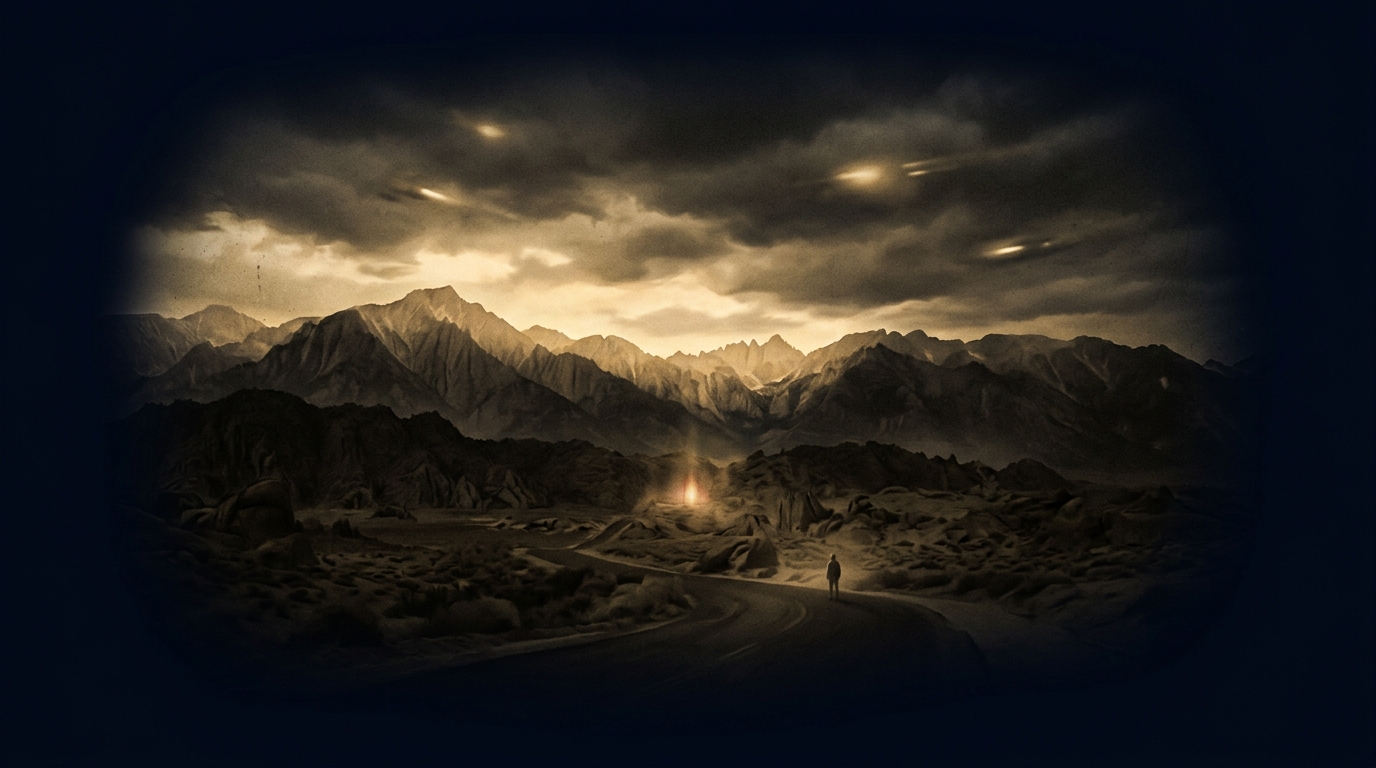
A loosely defined region of the American West — broadly encompassing the Sierra Nevada, the Great Basin, and portions of Nevada and California — where an unusually high number of aircraft disappearances have been recorded, inviting both rational meteorological explanation and more speculative theories about geomagnetic or electromagnetic anomalies.
Overview
The Nevada Triangle is a popular designation, not a formally recognized geographic or aeronautical classification, applied to a swath of the western United States roughly bounded by Las Vegas, Nevada; Fresno, California; and the Oregon border — a zone dominated by the Sierra Nevada mountain range, high desert plateaus, and the remote reaches of the Great Basin. Within this region, the National Transportation Safety Board (NTSB) and aviation historians have documented a statistically notable number of small-aircraft accidents and disappearances over the past several decades, with some estimates suggesting that more than two thousand aircraft have been lost in the Sierra Nevada range and adjacent terrain since the mid-twentieth century. The most prominent of these disappearances is that of adventurer and aviator Steve Fossett, whose single-engine Bellanca Citabria vanished in September 2007 during what was intended to be a brief recreational flight over the Nevada desert. The search for Fossett mobilized one of the most extensive aerial search operations in U.S. history, and his wreckage was not found until October 2008, discovered by a hiker in the remote Mammoth Lakes area of the eastern Sierra.
The terrain and meteorology of the region offer compelling, evidence-grounded explanations for the elevated accident rate. The Sierra Nevada presents some of the most hazardous flying conditions in the continental United States: abrupt elevation changes from valley floors to peaks exceeding 14,000 feet, severe and unpredictable mountain wave turbulence, rapidly developing afternoon thunderstorms, limited navigational landmarks over vast stretches of uninhabited desert, and historical gaps in radar and radio coverage in the most remote sectors. Aviation safety researchers and the NTSB have consistently cited pilot error in conjunction with these environmental hazards — particularly the phenomenon of visual flight rules pilots inadvertently entering instrument meteorological conditions — as the primary causal factors. The physical difficulty of searching terrain that ranges from dense conifer forest to sheer granite cliffs to remote alkali flats also means that wreckage, once lost, can remain hidden for years or even decades, a fact that amplifies the apparent mystery surrounding individual disappearances.
The popular framing of the Nevada Triangle as an anomalous zone analogous to the Bermuda Triangle emerged largely through aviation enthusiast publications, regional journalism, and internet culture in the 1990s and 2000s, accelerating dramatically following the Fossett disappearance. Some proponents have proposed electromagnetic anomalies, geomagnetic irregularities associated with mineral-rich desert geology, or even classified military activity emanating from installations such as Nellis Air Force Base and the Nevada Test and Training Range as potential contributing factors. A smaller subset of popular theorists has invoked comparisons to reported UAP activity over the Nevada desert — particularly in proximity to the restricted airspace surrounding Area 51 — though no credible evidence links classified programs to civilian aircraft disappearances. These speculative frameworks have found audiences in popular media and online communities but have not attracted serious peer-reviewed investigation.
The Nevada Triangle illustrates a broader epistemological problem in the study of anomalous zones: the human tendency to impose geographic pattern on what may be a confluence of mundane environmental, meteorological, and human-factors variables. The concentration of losses in this region reflects the intersection of challenging terrain, a high density of general aviation traffic drawn to recreational flying over scenic mountain and desert landscapes, and the statistical inevitability that remote regions will retain their secrets longer. Scholars of aviation safety, geographers, and cognitive psychologists have each offered tools for assessing such claims, and the consensus leans firmly toward natural explanation — while acknowledging that the scale of documented losses, and the emotional weight of cases like Fossett's, lend the phenomenon a genuine cultural resonance that merits thoughtful rather than dismissive attention.
Key Claims
Timeline
Evidence
Multiple Perspectives
Biblical Lens
Scripture Threads
Sources & Further Study
Questions to Explore
Go Deeper Path
Follow the Thread
Continue the Investigation
You’ve reached the Full Archive portion of this Case File.
Ask the Archivist
about this fileSign in to ask the Archivist
Create a free account to ask the Archivist 1 grounded question each day, cited straight from the CODEX case files.
Discussion
0Share findings, questions, and evidence with fellow Seekers. Be respectful and cite sources where you can.
No comments yet. Be the first to open this thread.