
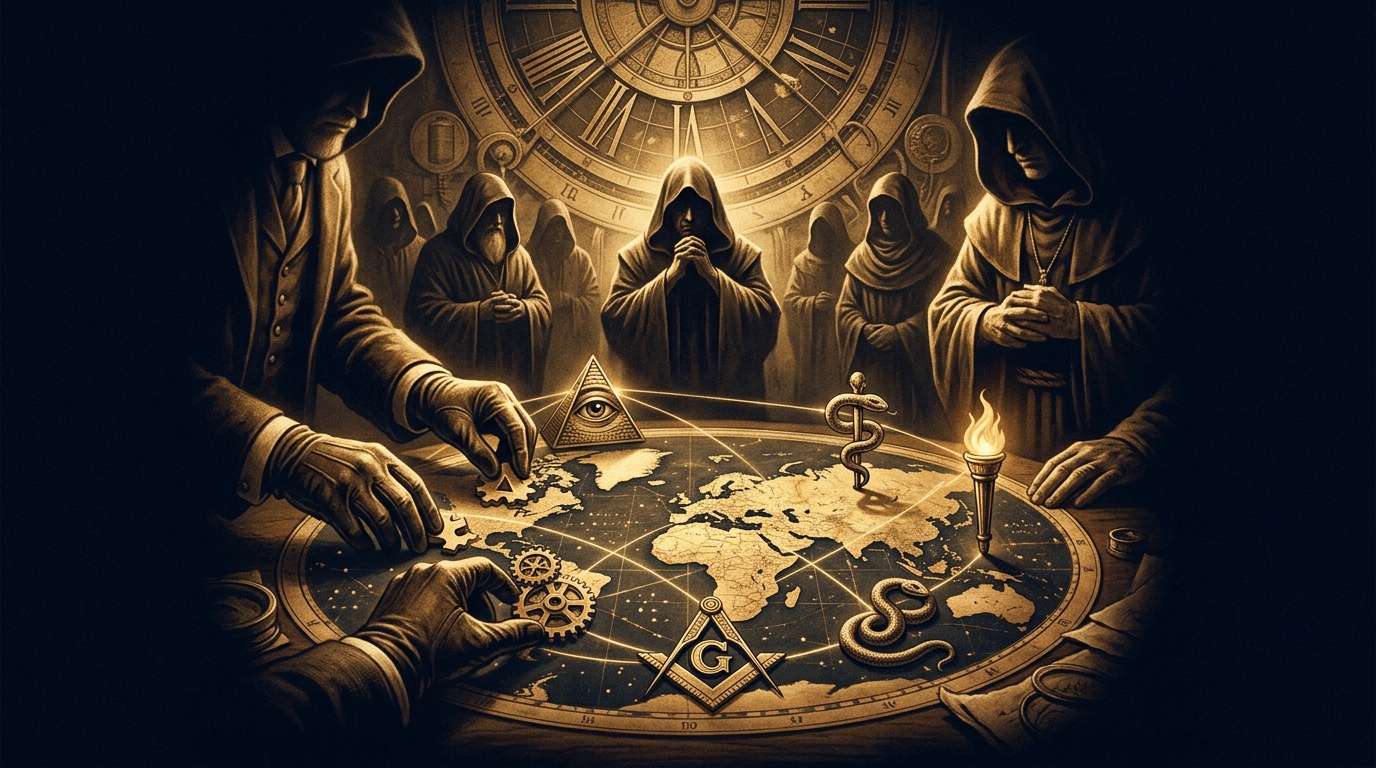
 Codex Illustration
New World Order
A phrase born in the corridors of legitimate diplomacy and co-opted by a sprawling conspiracy metanarrative, 'New World Order' sits at the precise intersection where documented geopolitical ambition meets the human tendency to detect a single, hidden hand behind every turning of history.
Overview
The phrase 'New World Order' carries a double life that no single assessment can collapse. In its first, historically documented sense, it refers to a series of genuine political visions articulated by heads of state at pivotal moments of global transition. Woodrow Wilson's Fourteen Points (1918) imagined an international framework to prevent further catastrophic wars. H. G. Wells popularized the phrase in his 1940 book of the same name, envisioning a technocratic planetary governance. Most famously, President George H. W. Bush used it in a nationally televised address on September 11, 1990 — and again before a joint session of Congress on January 29, 1991 — to describe a post–Cold War era of collective security, multilateral cooperation, and the rule of international law. In this context, the phrase carried no hidden program; it was a rhetorical framing of observable geopolitical transformation, recorded in the Congressional Record and widely analyzed by historians and political scientists.
In its second, far more contentious sense, 'New World Order' (often abbreviated NWO) functions as the master narrative of modern conspiracy culture: the claim that a small, secret oligarchy — variously identified as the Illuminati, Freemasons, Rothschild banking interests, the Council on Foreign Relations, the Bilderberg Group, the Committee of 300, or some combination thereof — is systematically working to dissolve national sovereignty, establish a single world government, introduce a universal digital currency, and impose a syncretic one-world religion. In this reading, every major war, economic crisis, pandemic, and international institution is a manufactured stepping stone toward total planetary control. The intellectual genealogy of this version traces through John Robison's Proofs of a Conspiracy (1798), through the anti-Masonic movements of the nineteenth century, through Nesta Webster's interwar writings, and into the postwar American far-right before exploding into mainstream visibility via shortwave radio, Pat Robertson's 1991 book The New World Order, and the early internet.
The extraordinary persistence of this metanarrative rests, in part, on a kernel of legitimate concern that serious scholars do not dismiss. Real supranational institutions — the United Nations, the International Monetary Fund, the World Bank, the World Economic Forum, the Bilderberg Group, and the Council on Foreign Relations — do coordinate policy among unelected or only loosely accountable actors. Elite networks do shape global economic and political outcomes in ways that receive insufficient democratic scrutiny. Scholars such as Carroll Quigley (Tragedy and Hope, 1966) documented, from an insider perspective, the influence of Anglo-American banking and policy networks on twentieth-century geopolitics — a work frequently cited by conspiracy theorists but whose actual argument is considerably more nuanced than those citations suggest. The concern about concentrated power and diminished national accountability is a legitimate tension in democratic theory; the leap from that concern to a single, coordinated master plan managed by a unified secret cabal is where documented history gives way to speculation unsupported by direct evidence.
What the 'New World Order' conspiracy theory ultimately represents is a synthetic metanarrative — a framework that draws every other conspiracy thread (Illuminati, Freemasonry, UFO cover-ups, financial manipulation, population control) into a single explanatory structure. Cultural theorists such as Michael Barkun (A Culture of Conspiracy, 2003) describe this as 'superconspiracy' thinking: a hermeneutic in which nothing is accidental, everything is connected, and the connecting agent is always malevolent and hidden. The psychological and sociological mechanisms driving such thinking — pattern recognition under uncertainty, distrust of institutions, the comfort of a legible enemy — are well-studied phenomena. This does not mean every specific claim bundled under the NWO label is false; some documented government programs (MKUltra, Operation Gladio, COINTELPRO) confirm that covert coordination and deliberate deception by state actors are real. The critical discipline is distinguishing the documented from the speculative, the real institutional concern from the unfounded totalizing plot.
Key Claims
Timeline
Evidence
Multiple Perspectives
Biblical Lens
Scripture Threads
Sources & Further Study
Questions to Explore
Go Deeper Path
Follow the Thread
Continue the Investigation
You’ve reached the Full Archive portion of this Case File.
Ask the Archivist
about this fileSign in to ask the Archivist
Create a free account to ask the Archivist 1 grounded question each day, cited straight from the CODEX case files.
Discussion
0Share findings, questions, and evidence with fellow Seekers. Be respectful and cite sources where you can.
No comments yet. Be the first to open this thread.