
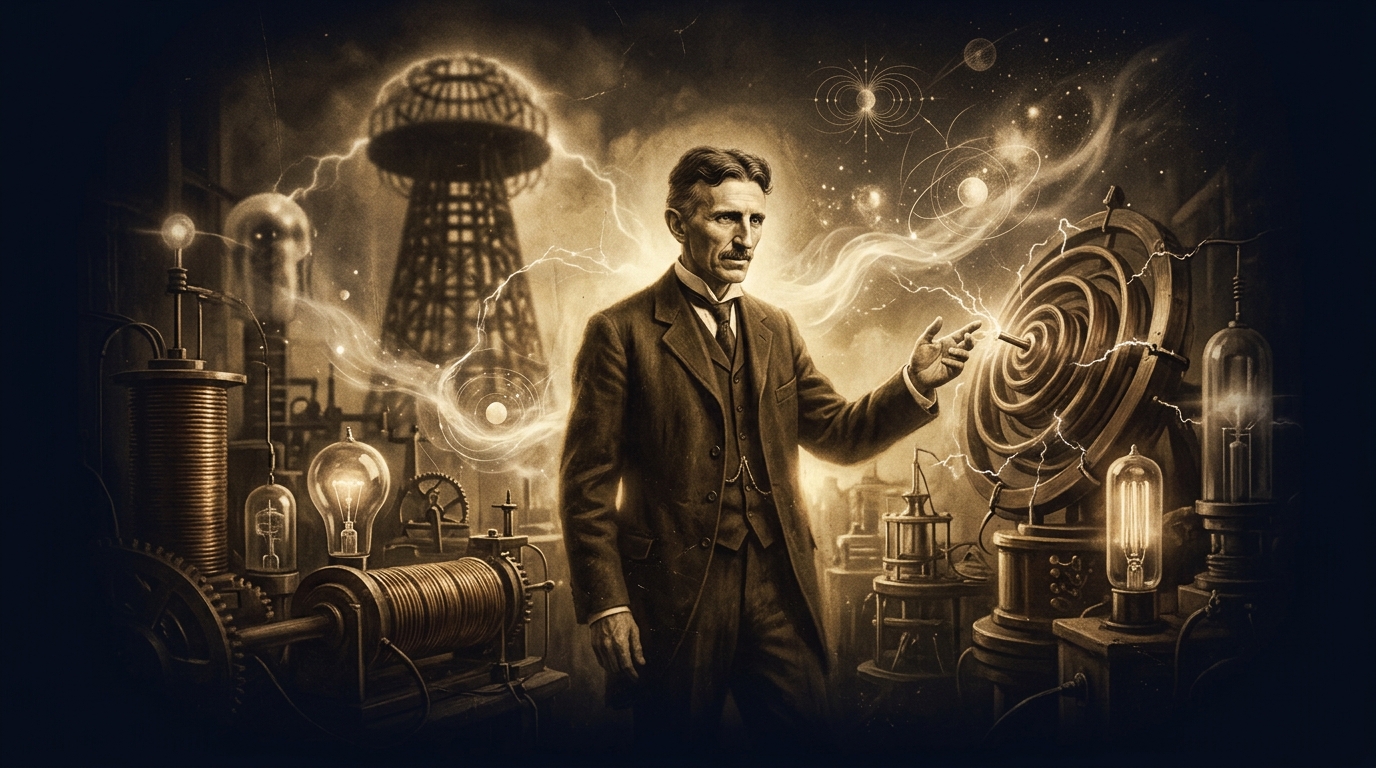
 Codex Illustration
Nikola Tesla
Nikola Tesla was one of the most consequential electrical engineers in history, whose documented achievements in alternating current and wireless transmission formed the backbone of modern civilization — yet whose unfinished dreams and confiscated papers became the raw material for decades of speculative mythology about suppressed genius and hidden energy technologies.
Overview
Nikola Tesla (1856–1943) was born in Smiljan, in the Austrian Empire (present-day Croatia), and immigrated to the United States in 1884. His documented technical contributions are extraordinary by any standard: the polyphase alternating-current (AC) electrical system, the AC induction motor, and fundamental work on rotating magnetic fields form the engineering foundation of virtually every electrical grid operating today. These achievements were accomplished in real laboratories, filed with the U.S. Patent Office, and verified by the engineers, investors, and manufacturers who built the modern electrical age upon them. His public 'War of Currents' conflict with Thomas Edison — a battle between AC and direct current (DC) systems — is a documented episode in industrial history, not legend, and Tesla's system ultimately prevailed through the backing of George Westinghouse.
Beyond the induction motor and polyphase power, Tesla pursued genuinely visionary — and in some cases, genuinely eccentric — experiments that remain historically documented even if their results were never fully realized. His Colorado Springs laboratory (1899–1900) produced high-voltage resonance experiments and the dramatic creation of artificial lightning. He held and documented radio transmission experiments that preceded Guglielmo Marconi's famous 1901 transatlantic demonstration; the U.S. Supreme Court, in 1943, posthumously acknowledged Tesla's prior radio patents. The Wardenclyffe Tower project (1901–1917), funded initially by financier J.P. Morgan, was Tesla's most ambitious dream: a global wireless power and communications network. It was never completed. Morgan withdrew funding when Tesla's commercial wireless communications plans appeared to conflict with Morgan's own interests in wired telegraph infrastructure, and the tower was demolished in 1917. The 1895 fire that gutted Tesla's Manhattan laboratory on Fifth Avenue, destroying years of work and apparatus, is a documented historical event whose full consequences for his research remain unknowable.
Tesla died alone in Room 3327 of the New Yorker Hotel on January 7, 1943. What happened next has become one of the most discussed episodes in the fringe literature surrounding him. The U.S. Office of Alien Property Custodian — a wartime government agency — took custody of his papers and effects. Dr. John G. Trump, a distinguished MIT electrical engineer and the uncle of Donald Trump, was brought in to evaluate the technical contents. Trump's declassified report, available through the FBI's online vault, concluded that Tesla's papers contained no workable new scientific principles of military significance and no viable 'death ray' apparatus. This official finding is frequently cited both by skeptics (as evidence that the mystery is overblown) and, paradoxically, by believers in suppression theories (as evidence that the interesting material had already been removed).
The Tesla of popular culture has, in many respects, eclipsed the historical figure. The claims that orbit his name include the 'free energy suppression' theory — the idea that Tesla discovered a means of extracting limitless energy from the environment and that this was buried by corporate or government interests — claims that crucial papers were stolen or hidden, and, in the most far-reaching fringe extensions, the notion that ancient monuments such as the Great Pyramid were themselves designed as energy-generating resonance machines operating on Teslan principles. Each of these claims merits its own careful examination. The documented record supports a portrait of a brilliant, eccentric, financially ruinous inventor whose most ambitious projects were defeated by economics, failed engineering, and institutional indifference rather than active suppression. The more extraordinary claims remain, at present, speculative — compelling in narrative but unsupported by the quality of evidence the historical record demands.
Key Claims
Timeline
Evidence
Multiple Perspectives
Biblical Lens
Scripture Threads
Sources & Further Study
Questions to Explore
Go Deeper Path
Carry the Investigation
Field gear inspired by this Codex case file.
Follow the Thread
Continue the Investigation
You’ve reached the Full Archive portion of this Case File.
Ask the Archivist
about this fileSign in to ask the Archivist
Create a free account to ask the Archivist 1 grounded question each day, cited straight from the CODEX case files.
Discussion
0Share findings, questions, and evidence with fellow Seekers. Be respectful and cite sources where you can.
No comments yet. Be the first to open this thread.