
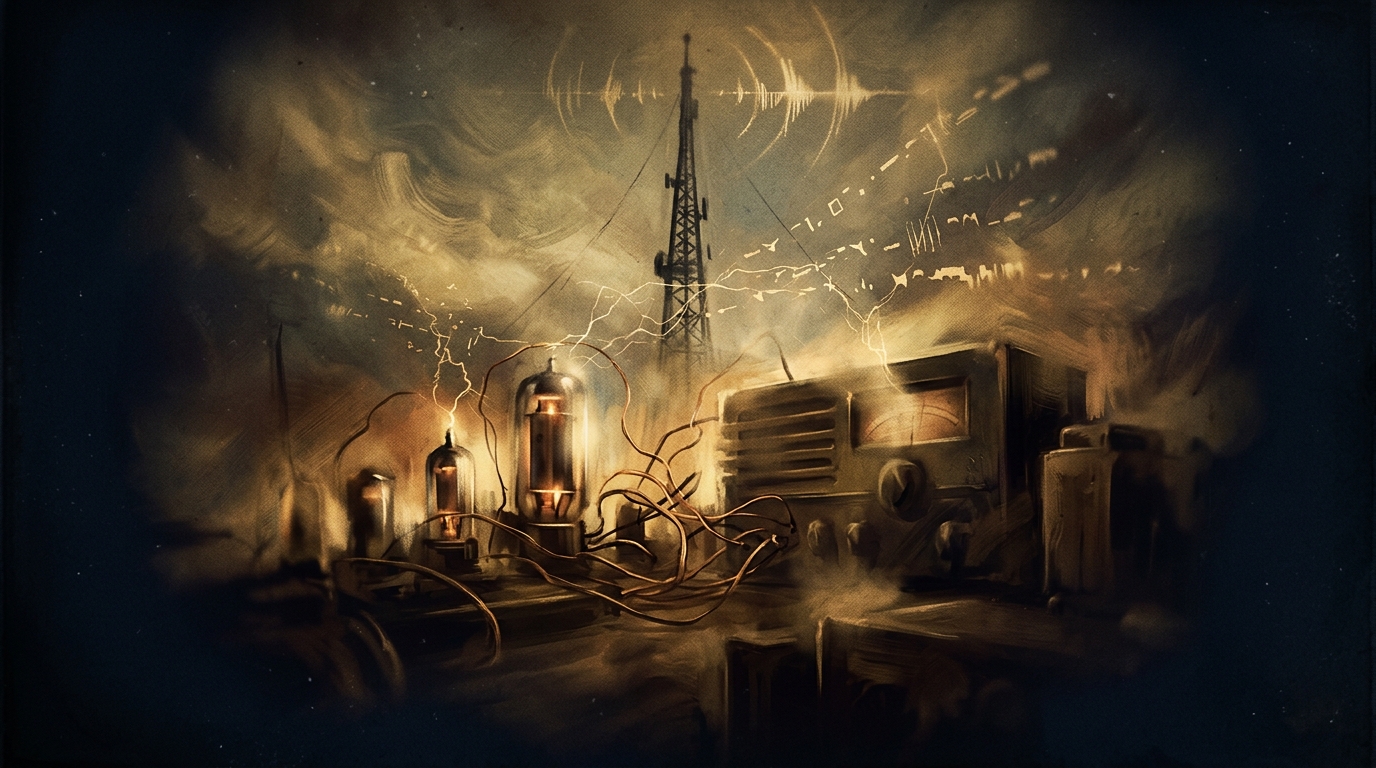
 Codex Illustration
Numbers Stations
Shortwave radio stations broadcasting streams of numbers, letters, or synthesized voices in apparent code have haunted the airwaves since at least the First World War — and the most credible evidence confirms they were, and in some cases remain, operational tools of state intelligence agencies delivering encrypted instructions to field agents.
Overview
For decades, listeners across the shortwave spectrum encountered a deeply unsettling phenomenon: transmissions that began without preamble — often a mechanical female voice counting in Spanish, German, Russian, or English — delivering sequences of five-digit number groups before cutting to silence. No call sign, no identification, no explanation. Known to the hobbyist and intelligence communities alike as 'numbers stations,' these broadcasts defied ordinary radio logic. They were not pirate stations seeking an audience; they were not commercial signals; they appeared indifferent to being heard. Yet they continued for years, sometimes decades, transmitting on regular schedules from fixed frequencies, apparently to no one and to everyone simultaneously.
The operational logic of numbers stations is, in retrospect, elegant in its simplicity. A field agent anywhere in the world — equipped only with a shortwave receiver and a one-time pad (a pre-shared cipher key used once and then destroyed) — could receive a message broadcast simultaneously to thousands of listeners and yet decode it alone. Because the one-time pad, when properly used, is mathematically unbreakable, and because the transmission is entirely one-directional, the intelligence agency transmitting the message cannot be linked to any specific receiver. There is no two-way signal to intercept, no digital handshake to trace, no server to subpoena. The architecture is almost brutally robust against modern signals intelligence. This is not speculation: it is the logical inference drawn from the mechanics of one-time-pad cryptography, and it has been confirmed by at least one major Western court proceeding.
The clearest documented confirmation of this inference came from the 1998 U.S. federal prosecution of the Cuban 'Red Avispa' (Wasp Network) spy ring. U.S. Department of Justice court filings and trial evidence — publicly available documents — established that Cuban intelligence agents operating in Florida decoded messages received from a Cuban numbers station (known to hobbyists as 'Atencion,' after its characteristic opening call) using one-time-pad software on a laptop computer. This was not a theory; it was evidence submitted in a federal courtroom, and several defendants were convicted. A similar confirmed link emerged in Britain in 1988, when a Czech intelligence defector, Josef Frolik, and subsequent declassified material from the Czech StB, described the use of shortwave one-way voice links (OWVLs) to communicate with agents in the West. The Conet Project, a landmark archival compilation of numbers station recordings assembled by Irdial-Discs beginning in the 1990s, provided the most comprehensive public audio record of the phenomenon, though it carried no classified intelligence value in itself.
Despite these documented anchors, much surrounding numbers stations remains genuinely uncertain. The full roster of transmitting nations, the identities of active agents who may have used them, the precise current operational status of surviving stations, and the meaning of anomalous transmissions that do not fit the standard intelligence model — including certain polytonal and musical-interval broadcasts — remain matters of informed inference, archival research, and, in some cases, unresolved speculation. The Lincolnshire Poacher (almost certainly tied to British GCHQ and MI6 operations in Cyprus), the Swedish Rhapsody, and the eerie Counting Station (UVB-76, or 'The Buzzer') attributed to Russian military signals add layers of complexity suggesting that the phenomenon is neither monolithic nor fully explained by the confirmed Cuban case alone.
Key Claims
Timeline
Evidence
Multiple Perspectives
Biblical Lens
Scripture Threads
Sources & Further Study
Questions to Explore
Go Deeper Path
Follow the Thread
Continue the Investigation
You’ve reached the Full Archive portion of this Case File.
Ask the Archivist
about this fileSign in to ask the Archivist
Create a free account to ask the Archivist 1 grounded question each day, cited straight from the CODEX case files.
Discussion
0Share findings, questions, and evidence with fellow Seekers. Be respectful and cite sources where you can.
No comments yet. Be the first to open this thread.