
 Codex Illustration
Occult Nazism
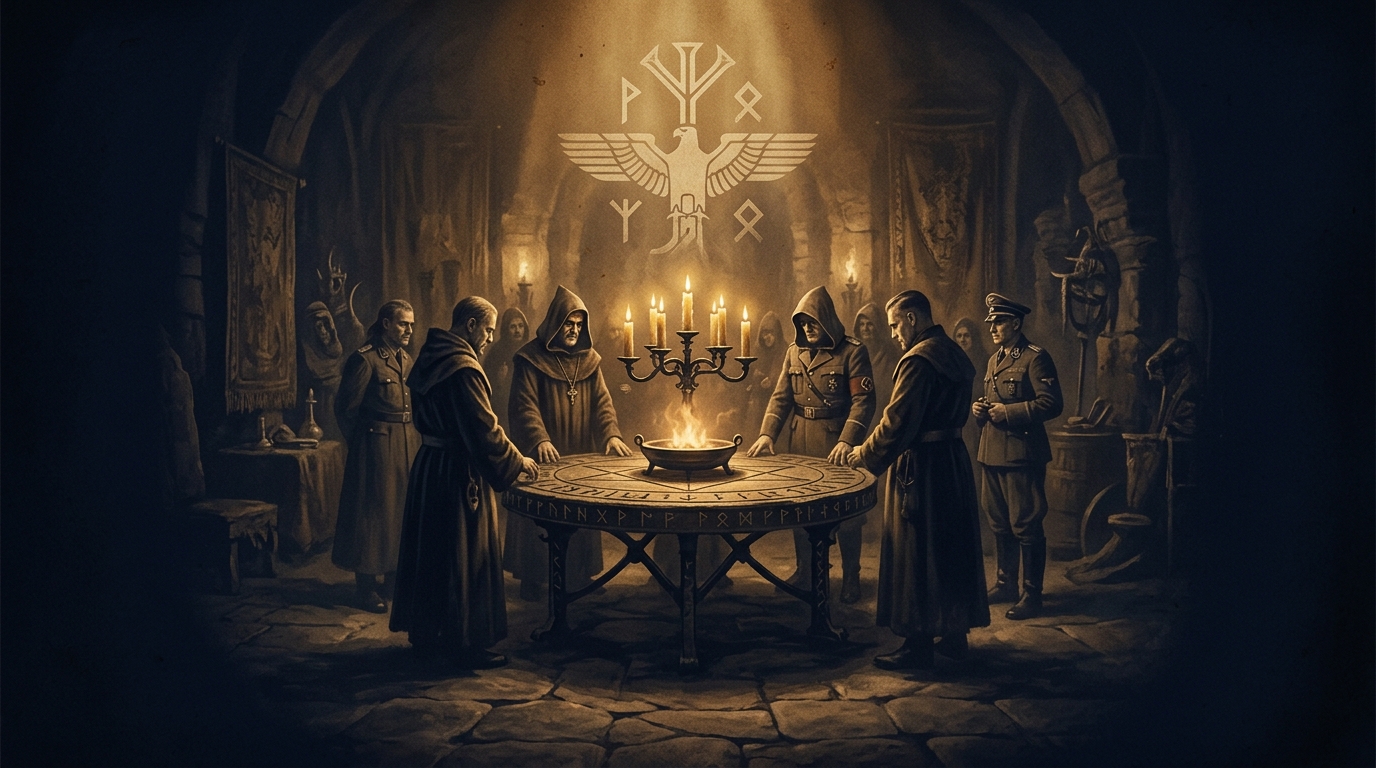
The Third Reich harbored a documented strand of esoteric ideology rooted in Ariosophy, volkisch mysticism, and the Thule Society — yet the popular image of a 'black-magic Reich' directed by occult masters vastly exaggerates what the historical record actually supports.
Overview
The relationship between National Socialism and occultism is one of the most mythologized intersections in modern history. At its verifiable core lies a movement called Ariosophy, developed in early twentieth-century Vienna and Munich by figures such as Guido von List and Jörg Lanz von Liebenfels, which fused pseudo-Aryan racial mythology with runic symbolism, Theosophical borrowings, and mystical interpretations of Germanic antiquity. The Thule Society, founded in Munich in 1918, drew on this current and served as an early incubator of extreme nationalist politics; it counted among its members or associates several figures who would later influence the nascent NSDAP. Rudolf Hess, Heinrich Himmler, and Alfred Rosenberg each brought distinct esoteric interests into the Nazi orbit — Himmler most conspicuously, cultivating the SS as a quasi-chivalric order with its own ceremonial culture centered on Wewelsburg Castle. These are documented historical facts, established by mainstream scholars including Nicholas Goodrick-Clarke in his foundational work The Occult Roots of Nazism.
Yet the gap between this documented ideological inheritance and the popular narrative of Hitler as a practicing occultist or the Reich as a coordinated magical enterprise is substantial. Hitler himself expressed private contempt for astrology and occult dabbling, and post-war Allied assessments — including the wartime OSS psychological profile compiled by Walter Langer — noted his instrumental rather than devotional relationship to mystical symbolism. The Ahnenerbe, Himmler's SS research bureau, pursued genuinely strange projects: expeditions to Tibet, Scandinavia, and the Middle East searching for Aryan origins, runic inscriptions, and mythological artifacts. While documented, these expeditions produced no credible supernatural findings; their significance lies in revealing how pseudo-scientific mysticism was institutionalized within the regime, not in confirming occult power. Scholars such as Eric Kurlander (Hitler's Monsters, 2017) argue that what distinguished Nazi ideology was a unique tolerance for 'border science' — a space between mainstream empiricism and outright occultism — rather than genuine magical practice.
The post-war explosion of occult-Nazi mythology deserves its own analysis. Beginning in the 1960s, a wave of popular books — most notably Louis Pauwels and Jacques Bergier's The Morning of the Magicians (1960) and Trevor Ravenscroft's The Spear of Destiny (1972) — reframed the Third Reich as a supernaturally empowered enterprise guided by hidden masters, Holy Grail quests, and Satanic pacts. These works blended real historical details with speculation, fabricated sources, and outright fiction. Ravenscroft's central claim that Hitler gained occult power through possession of the Spear of Longinus (the lance said to have pierced Christ at the crucifixion) is unsupported by credible evidence and has been dismissed by historians. This mythologized tradition has since been amplified by decades of popular fiction, cinema, and internet culture, creating a feedback loop in which speculation is frequently mistaken for historical record.
The most intellectually honest assessment recognizes a genuine, disturbing phenomenon — an ideological movement that deliberately weaponized myth, symbol, racial pseudo-history, and quasi-religious ceremony to construct a political religion — while firmly distinguishing this from supernatural causation. The Nuremberg rallies were choreographed as liturgical experiences; the SS death's-head insignia and runic symbols were deployed as sacred markers of a new racial elect; the language of blood, soil, and destiny drew consciously on pagan and mystical registers. Whether one interprets this as cynical manipulation of pre-existing esoteric currents, as a genuine expression of volkisch spiritual hunger, or as something darker still, the human and historical consequences were catastrophic. The occult dimension of Nazism is historically real; its supernatural dimension remains, at best, a matter of contested interpretation.
Key Claims
Timeline
Evidence
Multiple Perspectives
Biblical Lens
Scripture Threads
Sources & Further Study
Questions to Explore
Go Deeper Path
Follow the Thread
Continue the Investigation
You’ve reached the Full Archive portion of this Case File.
Ask the Archivist
about this fileSign in to ask the Archivist
Create a free account to ask the Archivist 1 grounded question each day, cited straight from the CODEX case files.
Discussion
0Share findings, questions, and evidence with fellow Seekers. Be respectful and cite sources where you can.
No comments yet. Be the first to open this thread.