
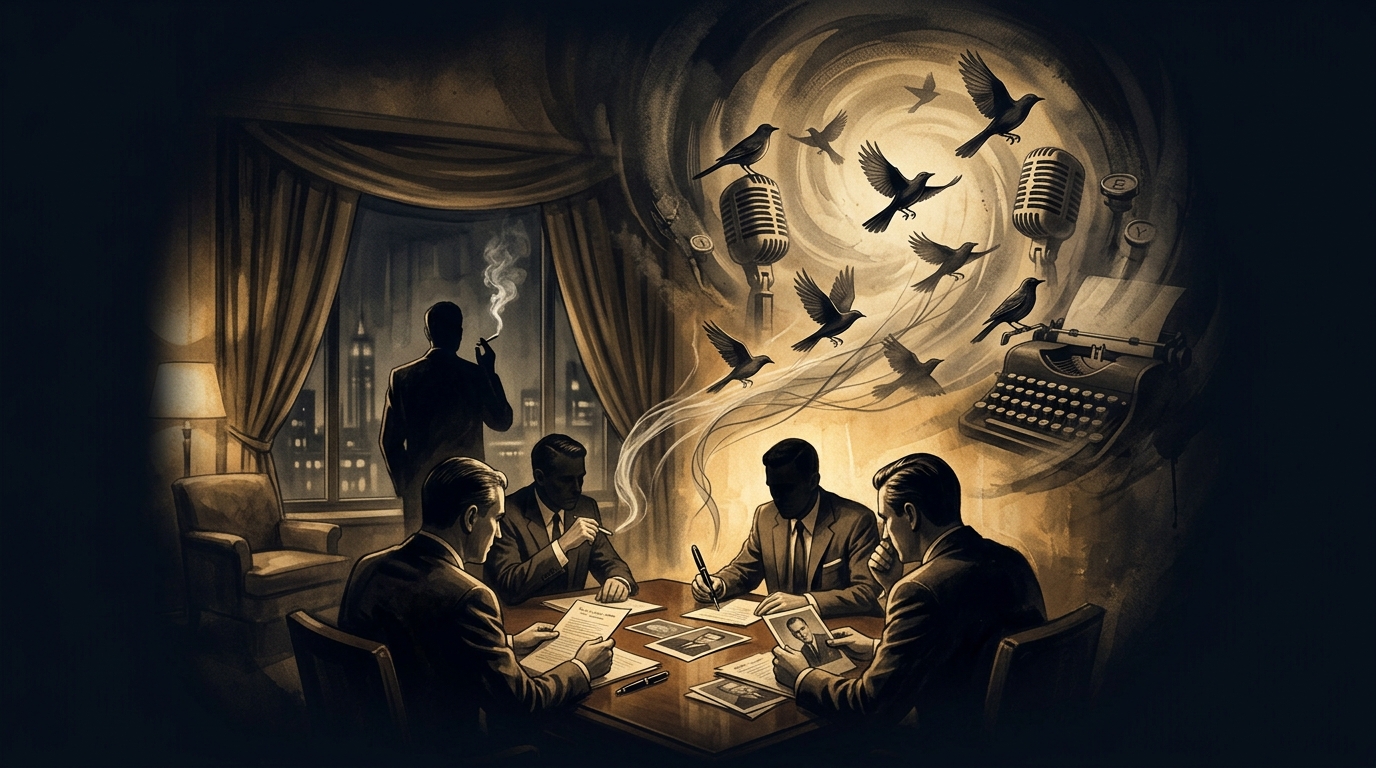
 Codex Illustration
Operation Mockingbird
A documented Cold War-era CIA program that allegedly recruited journalists, editors, and media executives to shape domestic and international public opinion — and whose full scope remains, decades later, a matter of serious historical dispute.
Overview
Operation Mockingbird is the name most commonly attached to a covert Central Intelligence Agency effort, reportedly initiated in the late 1940s and expanding through the 1950s and 1960s, to cultivate relationships with American journalists, news organizations, and broadcast networks for the purpose of influencing public opinion — both domestically and abroad. The program's existence in some form is no longer seriously disputed: the Church Committee investigations of 1975-1976 established, through Senate testimony and declassified documents, that the CIA had maintained relationships with members of the American press. What remains genuinely contested is the program's precise scope, duration, and the degree to which specific stories, editorial decisions, or public narratives were shaped by Agency direction rather than independent journalistic judgment.
The historical record indicates that the program's principal architect, Frank Wisner — director of the Office of Policy Coordination and later Deputy Director of Plans — oversaw what was internally called a 'Mighty Wurlitzer,' a metaphor for the Agency's ambition to play the international media landscape like an instrument. Journalists at major outlets including the Washington Post, New York Times, CBS, and numerous wire services have been identified — with varying degrees of documentation — as having had relationships with the CIA, ranging from passive cooperation to active asset status. The most cited scholarly examination, Carl Bernstein's 1977 Rolling Stone article 'The CIA and the Media,' named over 400 American journalists as having carried out assignments for the Agency, though Bernstein himself distinguished between knowing participants and those who were simply cultivated as sources.
The Church Committee's 1976 findings were significant but deliberately limited in their public disclosure. Senator Frank Church, chairing the Senate Select Committee to Study Governmental Operations with Respect to Intelligence Activities, documented the practice but stopped short of naming specific journalists at the request of CIA Director George H.W. Bush, who argued that full exposure would harm national security and individual careers. This act of institutional self-protection has itself become a subject of scrutiny: critics argue it ensured that the public record remained incomplete, while defenders contend it was a reasonable balance between accountability and operational security. The 1977 revelations by journalist Carl Bernstein, drawing on CIA documents and interviews with Agency veterans, remain among the most substantive primary accounts available to researchers.
In subsequent decades, the term 'Operation Mockingbird' has expanded considerably beyond its documented historical core. Internet-era commentary frequently attributes to the program a level of comprehensive, ongoing editorial control over major American media that goes well beyond what the available evidence supports. Claims circulate that the program was never truly terminated, that it evolved into more sophisticated digital-era influence operations, or that it explains virtually any perceived media bias or narrative uniformity. These claims range from plausible historical hypotheses to demonstrably speculative assertions. The documented historical program is a serious matter warranting sustained scholarly attention; the maximalist popular versions require considerably more skeptical scrutiny.
Key Claims
Timeline
Evidence
Multiple Perspectives
Biblical Lens
Scripture Threads
Sources & Further Study
Questions to Explore
Go Deeper Path
Follow the Thread
Continue the Investigation
You’ve reached the Full Archive portion of this Case File.
Ask the Archivist
about this fileSign in to ask the Archivist
Create a free account to ask the Archivist 1 grounded question each day, cited straight from the CODEX case files.
Discussion
0Share findings, questions, and evidence with fellow Seekers. Be respectful and cite sources where you can.
No comments yet. Be the first to open this thread.