
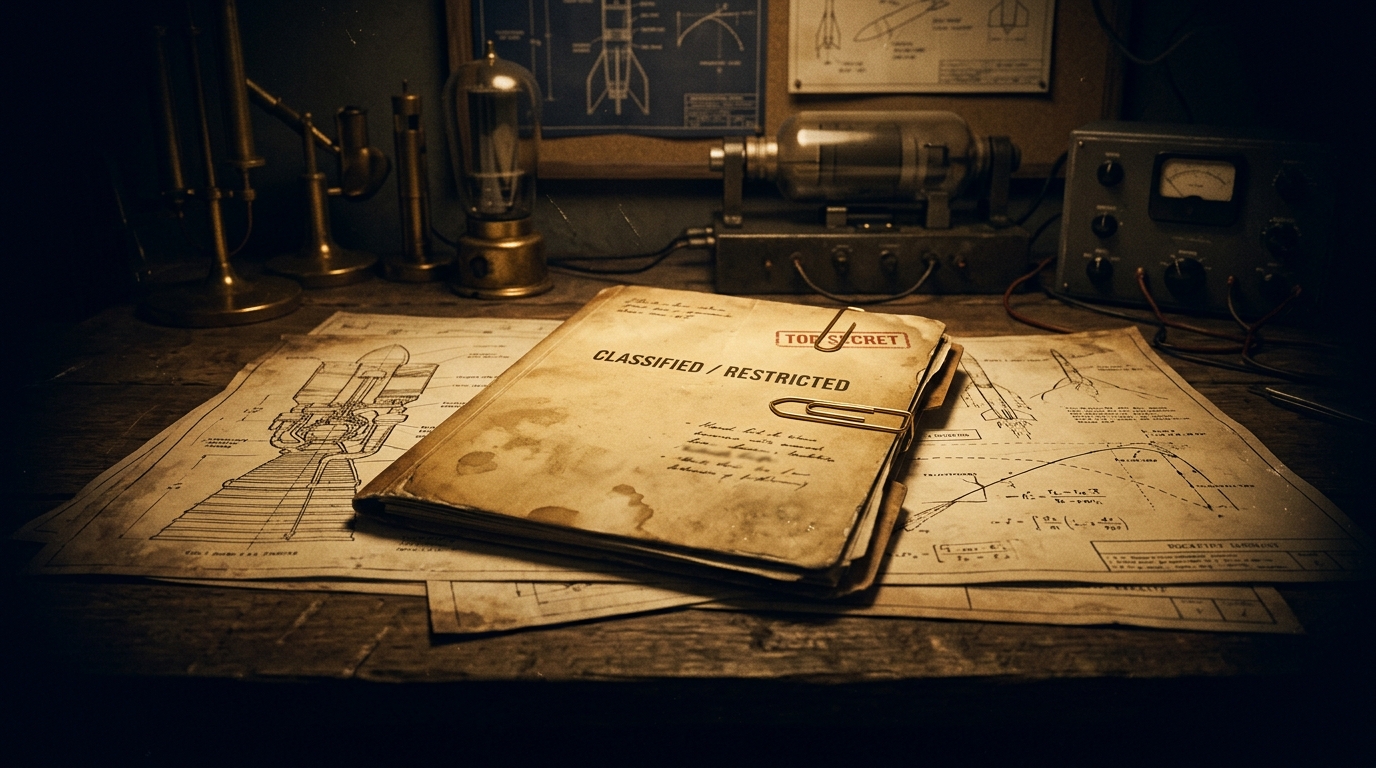
 Codex Illustration
Operation Paperclip
At the close of World War II, the United States government secretly recruited hundreds of former Nazi scientists, engineers, and technicians — many with documented war crimes in their pasts — and quietly absorbed them into the American military-industrial and space programs, trading moral accountability for technological advantage.
Overview
Operation Paperclip was a classified program run by the Joint Intelligence Objectives Agency (JIOA) under the Office of Strategic Services (OSS) and, later, the nascent structures of what would become the CIA. Its formal operational period spanned roughly 1945 to 1959, though recruitment and assimilation of personnel continued well beyond those dates. The program took its name, according to several historians, from the paper clips used to attach favorable biographical summaries to the dossiers of scientists whose actual Nazi Party membership and SS affiliations were deemed inconvenient. The core logic was coldly pragmatic: the Soviet Union was racing to exploit the same talent pool, and American planners concluded that the geopolitical cost of allowing Germany's top rocket engineers, aviation researchers, aerospace physicians, and chemical warfare specialists to fall into Soviet hands was greater than the moral cost of overlooking their wartime records.
The most publicly recognized figure to emerge from Paperclip was Wernher von Braun, the V-2 rocket architect who would go on to become a central figure in NASA's Saturn V program and, in the popular imagination, the very emblem of American space ambition. Less celebrated were figures such as Arthur Rudolph, who supervised V-2 production at the Mittelwerk underground factory using concentration camp slave labor from Dora, or Walter Schreiber and Kurt Blome, medical researchers implicated in biological and chemical weapons experimentation on prisoners. The paper trails surrounding these individuals were, in documented cases, deliberately altered or suppressed by American intelligence officers in order to secure immigration and security clearances. Annie Jacobsen's meticulously sourced 2014 book Operation Paperclip: The Secret Intelligence Program that Brought Nazi Scientists to America reconstructs these sanitization processes in granular detail, drawing on declassified JIOA records, State Department files, and Army Counter Intelligence Corps documents.
The program's scientific yield for the United States was, by narrowly utilitarian measures, substantial. The German rocket team at Fort Bliss, Texas, and later Redstone Arsenal in Huntsville, Alabama — led by von Braun and his Peenemünde colleagues — formed the technical spine of America's early ballistic missile and space launch programs. Paperclip scientists and engineers contributed to the development of the Redstone, Jupiter, and Pershing missiles, and their institutional knowledge was foundational to the Apollo program. In aviation medicine and high-altitude research, German expertise accelerated American fighter pilot performance studies. In the domain of chemical and biological defense, the picture is murkier: some Paperclip-affiliated researchers were connected to programs — including aspects of what would later surface under the MKULTRA umbrella — that raise serious ethical questions about the downstream uses of their imported knowledge.
The moral and historical reckoning with Operation Paperclip has been uneven. During the Cold War, the program was classified and its existence largely hidden from the American public. When elements began emerging through investigative journalism and later Freedom of Information Act requests, the public response was one of genuine discomfort: the architects of American space glory had, in some cases, also been architects of atrocity. Historians debate the degree to which senior American officials — including figures in the State Department and the military — knowingly chose expediency over accountability, and the degree to which individual JIOA officers acted unilaterally in falsifying records. What is documented is that the program represented a systemic institutional choice to subordinate ethical considerations — including obligations to the survivors of Nazi forced-labor programs — to strategic advantage. The program thus stands as one of the Cold War era's clearest case studies in the mechanics of government secrecy, moral compromise, and the uses and costs of scientific knowledge acquired under morally catastrophic conditions.
Key Claims
Timeline
Evidence
Multiple Perspectives
Biblical Lens
Scripture Threads
Sources & Further Study
Questions to Explore
Go Deeper Path
Follow the Thread
Continue the Investigation
You’ve reached the Full Archive portion of this Case File.
Ask the Archivist
about this fileSign in to ask the Archivist
Create a free account to ask the Archivist 1 grounded question each day, cited straight from the CODEX case files.
Discussion
0Share findings, questions, and evidence with fellow Seekers. Be respectful and cite sources where you can.
No comments yet. Be the first to open this thread.