
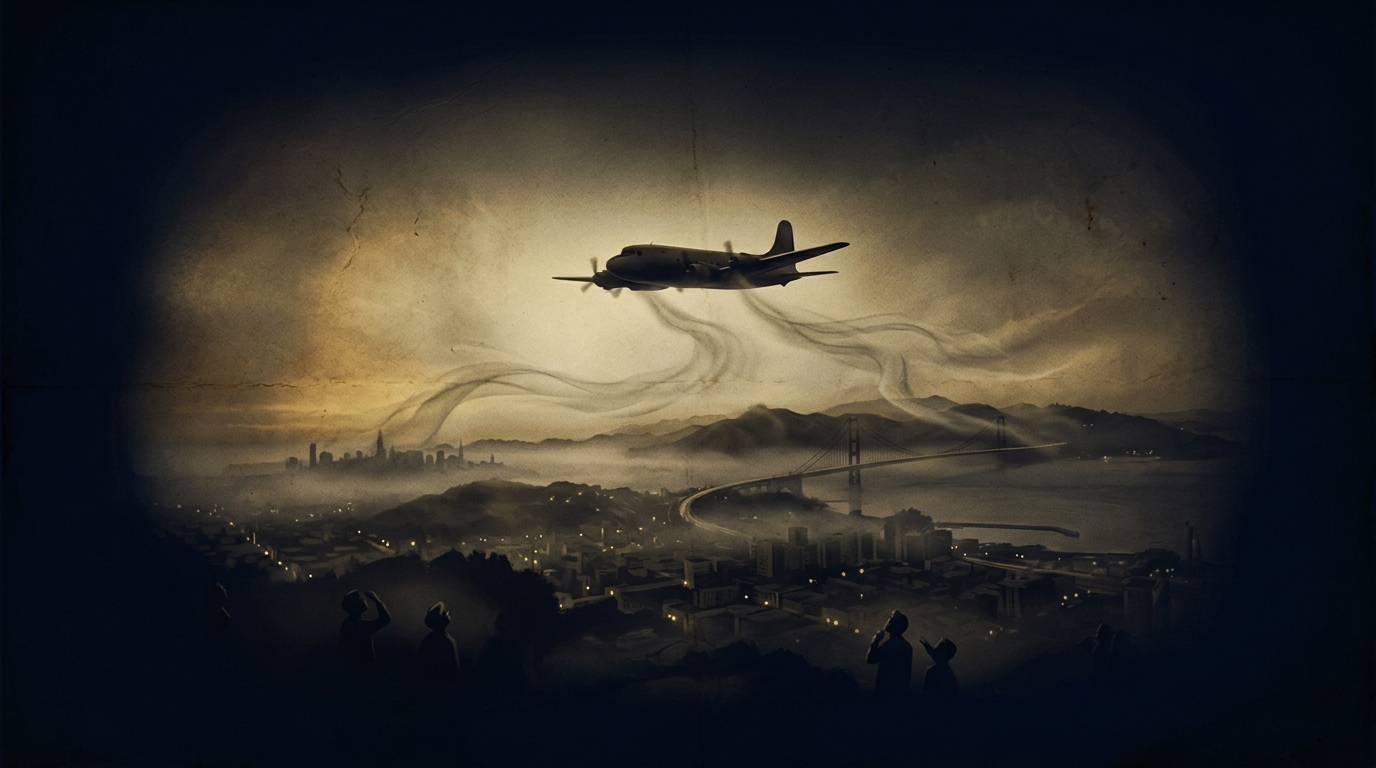
 Codex Illustration
Operation Sea-Spray
Between 1950 and 1969, the United States military covertly released aerosols of bacteria and other agents over the San Francisco Bay Area and other American cities, exposing hundreds of thousands of civilians without their knowledge or consent — an episode now fully declassified, yet still deeply unsettling in its implications.
Overview
Operation Sea-Spray was a series of covert open-air biological vulnerability tests conducted by the United States Army beginning in September 1950. The primary purpose, as documented in declassified Army records, was to assess the susceptibility of a major American port city — San Francisco — to a potential enemy biological attack, and to study how aerosol clouds of bacteria would disperse under real-world meteorological conditions. Navy vessels equipped with aerosol-generating equipment released clouds of Serratia marcescens (a rod-shaped bacterium then considered harmless) and Bacillus globigii (a spore-forming bacterium used as a simulant for anthrax) across the bay and coastal zones. The Army's own after-action reports indicate that nearly every resident of San Francisco was likely exposed during certain release windows, making it one of the largest covert biological exposures of an American civilian population on record.
The operation was not conducted in isolation. Sea-Spray was one component of a broader, multi-decade program known as the Special Operations Division's vulnerability testing initiative, which conducted similar experiments in cities including New York, Washington D.C., Minneapolis, St. Louis, and along the Pennsylvania Turnpike. These programs, sometimes grouped under the umbrella of the Army Chemical Corps' 'open-air testing' mandate, remained classified for decades. Declassified documents — released incrementally through Freedom of Information Act requests and congressional investigations in the 1970s and 1980s — reveal that Army planners were not entirely confident in their safety assessments. Internal memoranda acknowledged uncertainty about Serratia marcescens pathogenicity, particularly in immunocompromised individuals, yet testing proceeded without civilian notification or oversight.
The most consequential and disputed dimension of Sea-Spray concerns a cluster of Serratia marcescens infections that appeared at Stanford University Hospital in San Francisco beginning in late 1950. Eleven patients developed serious infections caused by the organism, and one — Edward Nevin, a retired pipe fitter hospitalized for a pre-existing urinary condition — died in October 1950. His family later brought a wrongful death lawsuit against the federal government, arguing that the Army's releases had caused the hospital outbreak. In 1981, Federal District Judge Samuel Conti ruled against the Nevin family, concluding that causation could not be proven beyond a reasonable doubt and that the government retained sovereign immunity. The legal and epidemiological questions remain genuinely contested among historians of public health and bioethics scholars: the temporal and geographic correlation between the releases and the hospital cluster is striking, but definitive causal proof was never established to the court's satisfaction.
Operation Sea-Spray occupies a documented and sobering position in the history of American government programs. Unlike many entries in the catalog of Cold War secrets, it does not require inference or speculation — the program happened, the releases occurred, and the Army's own records confirm the scale and intent of the operations. What remains contested is the degree of harm caused, the full extent of releases beyond those documented, and the moral and legal accountability of institutions that treated civilian populations as experimental subjects without consent. Scholars of bioethics, public health law, and Cold War history continue to cite Sea-Spray as a foundational case study in the ethics of state power, informed consent, and the tension between national security imperatives and the rights of citizens.
Key Claims
Timeline
Evidence
Multiple Perspectives
Biblical Lens
Scripture Threads
Sources & Further Study
Questions to Explore
Go Deeper Path
Follow the Thread
Continue the Investigation
You’ve reached the Full Archive portion of this Case File.
Ask the Archivist
about this fileSign in to ask the Archivist
Create a free account to ask the Archivist 1 grounded question each day, cited straight from the CODEX case files.
Discussion
0Share findings, questions, and evidence with fellow Seekers. Be respectful and cite sources where you can.
No comments yet. Be the first to open this thread.