
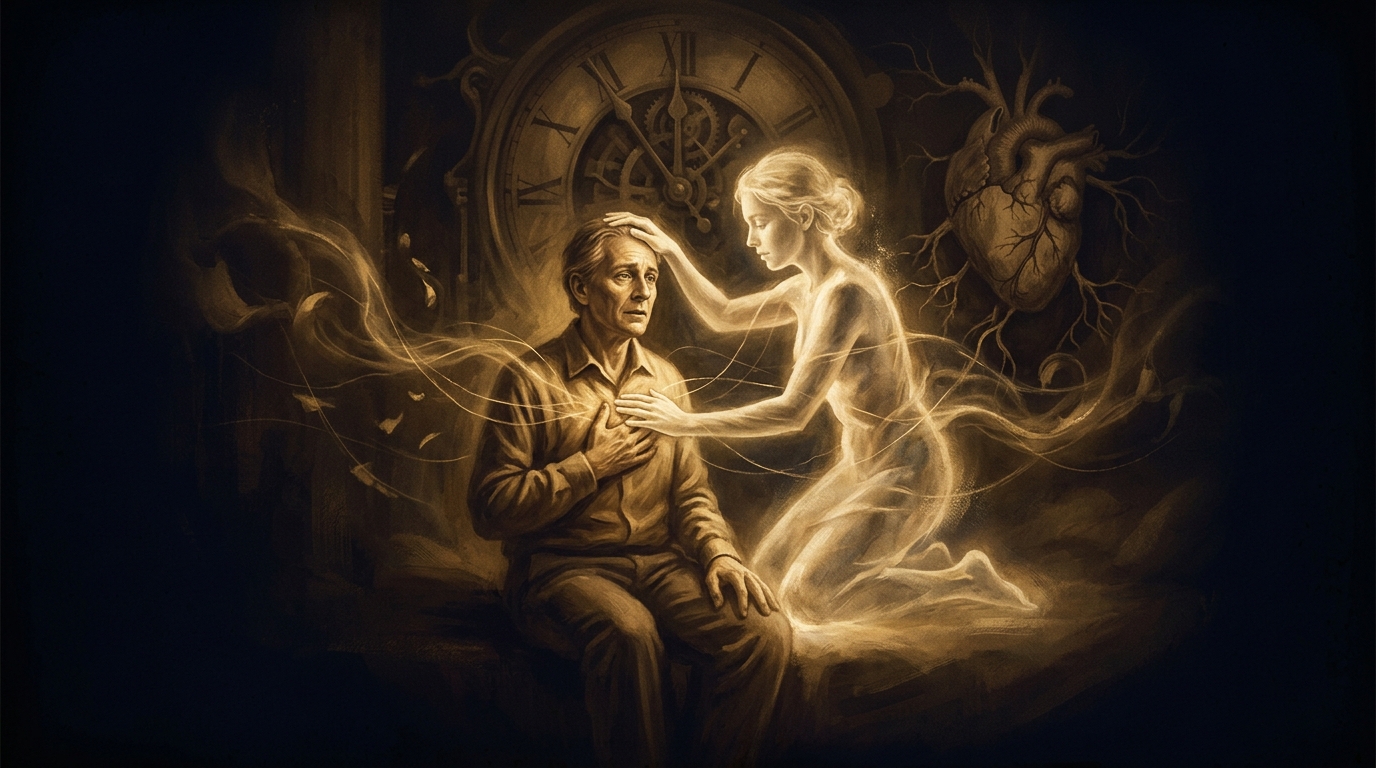
 Codex Illustration
Organ Transplant Personality Claims
A growing body of anecdotal reports — and a contested fringe of medical research — suggests that some organ transplant recipients, particularly heart recipients, acquire tastes, memories, or personality traits that appear to echo those of their deceased donors, raising unsettling questions about where personhood resides in the body.
Overview
Among the stranger phenomena to emerge from the modern era of transplant medicine is a cluster of patient reports in which recipients of donor organs — most often hearts, but occasionally other visceral organs — describe experiencing unfamiliar cravings, emotional shifts, recurring dreams, or even apparent memories that later seem to correspond to verifiable details about the donor's life. These accounts, if taken at face value, challenge the entrenched biomedical assumption that consciousness and personal identity are products of brain activity alone. Cardiologist and author Paul Pearsall, working with psychologists Gary Schwartz and Linda Russek at the University of Arizona in the late 1990s, compiled what remains the most cited collection of such cases, involving dozens of transplant patients and, in some instances, donor families who could independently corroborate specific details. The published case studies are striking in their particularity — recipients reporting cravings for foods the donor reportedly favored, or experiencing emotional associations with music the donor had loved — but the methodology of this work has been contested by mainstream medicine on grounds of small sample size, absence of blinding, and reliance on subjective self-report.
The theoretical framework most often advanced to explain these reports is commonly called 'cellular memory' — the hypothesis that biological tissues, especially those with dense neural-like networks such as the heart, may encode or store information that is not purely neurological in origin. The human heart contains approximately forty thousand specialized neurons in an intrinsic cardiac nervous system, a fact documented in peer-reviewed neurocardiology literature by researchers such as J. Andrew Armour. Proponents argue that this 'little brain of the heart' might carry some form of experiential imprint. Critics, however, note that the presence of cardiac neurons does not constitute evidence for memory storage in any robust sense, and that no mechanism has been proposed that would allow such information to survive the ischemia, preservation, and surgical reimplantation that organs undergo during transplant procedures — a process that is physiologically brutal by any measure.
The most rigorous academic engagement with these claims has come from researchers at the boundary of psychology, neuroscience, and philosophy of mind. Gary Schwartz's broader research program, which includes studies on survival of consciousness after death, has attracted sustained methodological criticism from the skeptical community, notably from philosophers and scientists associated with the Committee for Skeptical Inquiry. Nevertheless, even some skeptically inclined commentators acknowledge that the volume and consistency of these reports — anecdotal as they are — constitute a genuine anomaly deserving of careful study rather than reflexive dismissal. The reports have also drawn interest from scholars of consciousness such as Thomas Nagel, whose philosophical work on the 'hard problem' of consciousness ('What Is It Like to Be a Bat?', 1974) frames exactly the kind of question these cases raise: whether phenomenal experience is exclusively substrate-dependent on brain tissue, or whether it might be distributed across biological systems in ways current neuroscience does not yet understand.
Culturally, the organ transplant personality phenomenon has generated significant popular resonance, appearing in novels, films, and online testimony communities where recipients share experiences that their medical providers rarely engage with seriously. This cultural dimension is itself worth examining: the human intuition that the heart especially carries something of the person — an intuition encoded in language and metaphor across virtually every world culture — may partly explain why these reports arise and why they find ready audiences. Whether that intuition reflects a genuine biological or metaphysical reality, or whether it represents a psychologically comprehensible response to the profound existential experience of carrying another person's organ inside one's body, remains genuinely and honestly unresolved.
Key Claims
Timeline
Evidence
Multiple Perspectives
Biblical Lens
Scripture Threads
Sources & Further Study
Questions to Explore
Go Deeper Path
Follow the Thread
Continue the Investigation
You’ve reached the Full Archive portion of this Case File.
Ask the Archivist
about this fileSign in to ask the Archivist
Create a free account to ask the Archivist 1 grounded question each day, cited straight from the CODEX case files.
Discussion
0Share findings, questions, and evidence with fellow Seekers. Be respectful and cite sources where you can.
No comments yet. Be the first to open this thread.