
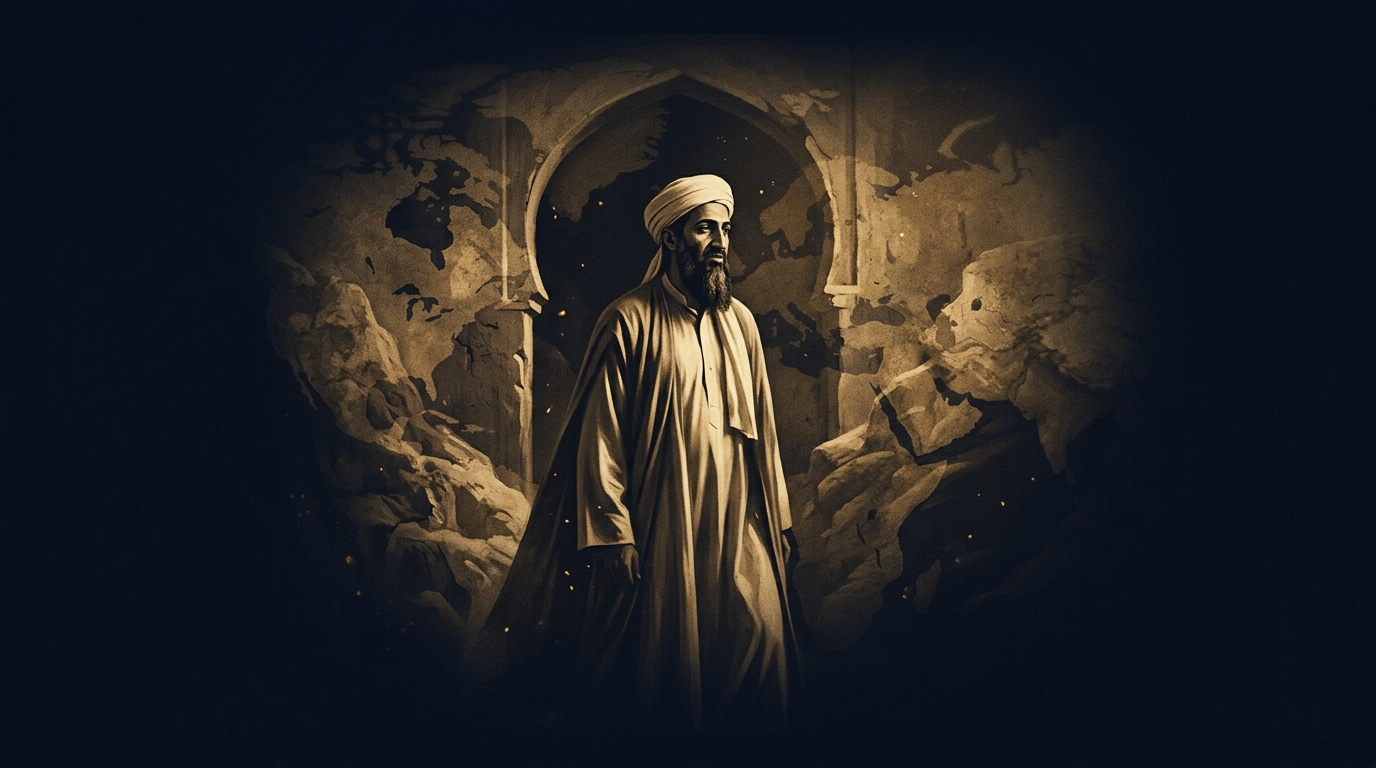
 Codex Illustration
Osama bin Laden
Osama bin Laden, the Saudi-born founder of al-Qaeda, stands at the intersection of documented Cold War geopolitics and enduring conspiratorial mystery — a figure whose biography is largely a matter of historical record, yet whose alleged relationship to American intelligence agencies remains one of the most hotly contested and poorly documented claims in modern political folklore.
Overview
Osama bin Laden was born in 1957 in Riyadh, Saudi Arabia, the seventeenth son of Mohammed bin Awad bin Laden, a billionaire construction magnate with close ties to the Saudi royal family. His early religious formation was shaped by the Muslim Brotherhood-influenced education prevalent in Saudi Arabia during the 1960s and 1970s, and he later came under the influence of Abdullah Azzam, the Palestinian theologian who articulated a modern theology of jihad against foreign occupation. When the Soviet Union invaded Afghanistan in December 1979, bin Laden — then in his early twenties — traveled to Peshawar, Pakistan, and eventually into Afghanistan itself, contributing significant personal wealth and organizational energy to the Arab mujahideen effort. This much is established historical fact, documented by multiple independent investigative journalists, biographers, and government inquiries.
The documented American role in the Soviet-Afghan War is substantial and not in dispute among serious historians. Beginning in earnest under the Carter administration and dramatically expanded under Reagan's CIA Director William Casey, Operation Cyclone — the codename for U.S. support of the Afghan mujahideen — funneled billions of dollars through the Pakistani Inter-Services Intelligence directorate (ISI) to various resistance factions. The arms pipeline, the training programs, and the ISI conduit are all matters of historical record, confirmed by declassified documents, congressional testimony, and authoritative accounts such as Steve Coll's Pulitzer Prize-winning 'Ghost Wars' (2004) and Lawrence Wright's 'The Looming Tower' (2006). What is far less established — and what serious scholars consistently dispute — is the specific claim that the CIA directly recruited, trained, funded, or ran bin Laden himself as a personal asset.
The 'Tim Osman' claim — the assertion that bin Laden traveled to the United States in the 1980s under the alias 'Tim Osman' and met with CIA officers — circulates widely in conspiracy literature and internet forums. Its primary documented source is a single affidavit-style account attributed to a figure named Ted Gunderson, a former FBI agent who made a series of increasingly extraordinary claims across his career before his death in 2011. No corroborating government document, no credible independent journalism, and no declassified intelligence file has surfaced to substantiate this specific claim. The relevant distinction — which is critical and frequently collapsed in popular discourse — is between the United States supporting the broader Afghan resistance movement (documented) and the CIA personally running bin Laden as a controlled asset (not credibly documented). Steve Coll, Lawrence Wright, and the 9/11 Commission Report all address this distinction explicitly and conclude that no direct CIA-bin Laden operational relationship has been established.
Bin Laden's subsequent trajectory — his expulsion from Saudi Arabia in 1991, his years in Sudan, his return to Afghanistan under Taliban protection, the 1998 U.S. embassy bombings in Nairobi and Dar es Salaam, and the September 11, 2001 attacks — are documented by an extensive evidentiary record including trial transcripts, intelligence assessments, and journalistic investigation. His death on May 2, 2011, in a U.S. Navy SEAL raid on a compound in Abbottabad, Pakistan — a garrison town uncomfortably close to the Pakistani Military Academy — is itself a source of ongoing dispute, with investigative journalist Seymour Hersh publishing a contested 2015 account in the London Review of Books alleging that Pakistani intelligence had been holding bin Laden under house arrest and provided intelligence leading to the raid. The official account, detailed in government briefings and accounts such as Mark Bowden's 'The Finish' (2012), remains the dominant and best-documented version, though the Hersh allegations introduced questions that have not been fully resolved in the public record.
Key Claims
Timeline
Evidence
Multiple Perspectives
Biblical Lens
Scripture Threads
Sources & Further Study
Questions to Explore
Go Deeper Path
Follow the Thread
Continue the Investigation
You’ve reached the Full Archive portion of this Case File.
Ask the Archivist
about this fileSign in to ask the Archivist
Create a free account to ask the Archivist 1 grounded question each day, cited straight from the CODEX case files.
Discussion
0Share findings, questions, and evidence with fellow Seekers. Be respectful and cite sources where you can.
No comments yet. Be the first to open this thread.