
 Codex Illustration
Ouija Boards
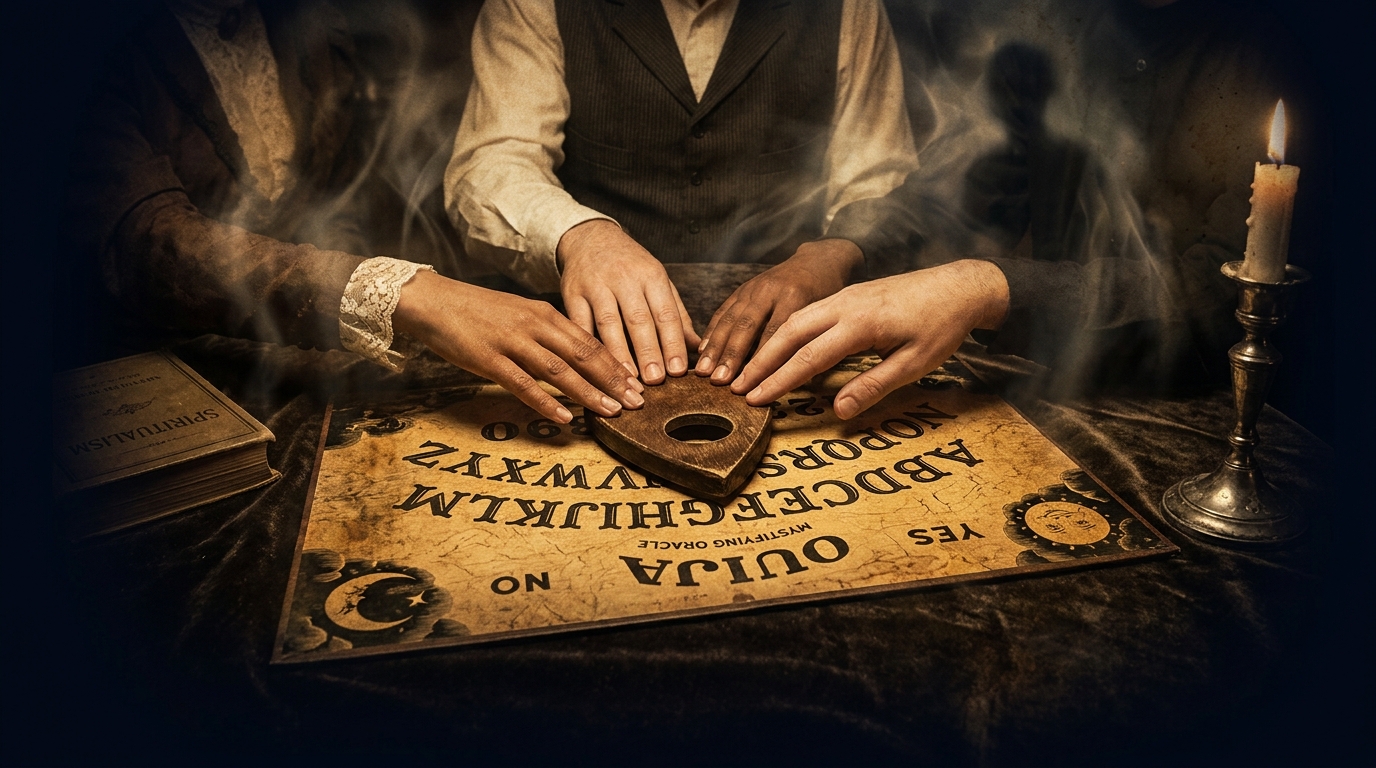
Born in the commercial parlors of 1890s America, the Ouija board occupies a peculiar position at the intersection of Victorian séance culture, mass-market entrepreneurship, and enduring theological alarm — a humble piece of pressed wood that has generated nearly a century and a half of fascination, fear, and fierce academic debate about what, precisely, moves the planchette.
Overview
The talking board emerged not from ancient grimoires or esoteric lodges but from the remarkably mundane world of American patent law and leisure commerce. In 1890, businessman Charles Kennard and associates in Baltimore incorporated the Kennard Novelty Company, filing a patent the following year for a device they called the 'Ouija' or 'Yes-Yes' board. The etymology of the name itself remains disputed: popular tradition claims it is a combination of the French and German words for 'yes,' while inventor Elijah Bond's collaborator Helen Peters reportedly said the board itself spelled out its own name. What is documented and largely uncontested is that the Ouija board was developed, marketed, and sold as an entertainment product during the height of the American Spiritualist movement — a cultural moment in which communicating with the deceased was treated by millions as a plausible, even fashionable, pursuit. William Fuld, who acquired control of the company in the early twentieth century, became synonymous with the brand and built a manufacturing empire around it. The Ouija board has been a commercially produced consumer item continuously since the 1890s, eventually acquired by Parker Brothers in 1966 and later by Hasbro, where it remains catalogued today alongside family board games.
The scientific literature offers a substantive and well-documented explanation for the board's apparent responsiveness: the ideomotor effect. First identified and named by British physiologist William Carpenter in 1852 — predating the Ouija board's commercial release — the ideomotor effect describes unconscious, involuntary muscular movements made by individuals who genuinely believe they are holding still. Participants sincerely do not feel themselves moving the planchette; neurologically, however, their own motor systems are generating the motion. Controlled double-blind experiments, including studies published in peer-reviewed journals examining similar automatic-writing phenomena, consistently demonstrate that when participants are blindfolded and the board is rotated without their knowledge, 'messages' become incoherent or produce mirror-image responses — strongly indicating that the participants' own expectations are guiding the output. This is the mainstream scientific and psychological consensus, and it is supported by substantial experimental evidence. It does not, it should be noted, answer every question participants have raised about apparent knowledge the messages seemed to contain — but it does provide a rigorous null hypothesis that critics argue has never been credibly falsified.
The cultural and theological dimensions of the Ouija board are at least as complex as the scientific ones. During World War I and the influenza pandemic, the board surged in popularity as grieving families sought contact with the dead — a documented sociological phenomenon that historian Molly McGarry and others have situated within the broader American negotiation of death, loss, and religious uncertainty. It is in this context that the board began attracting sustained clerical and theological opposition. Conservative Protestant, Catholic, and Jewish religious authorities have consistently warned against the device across the twentieth century, not primarily on the grounds that it 'works' in any parapsychological sense, but on the grounds that the intention behind its use — to contact the deceased or non-human intelligences — falls within categories explicitly condemned in biblical and rabbinical literature. This theological objection is independent of whether the ideomotor effect fully explains the mechanism; the concern is with the posture of the practitioner, not merely the physics of the planchette.
In popular culture, the Ouija board has undergone multiple recontextualizations, migrating from parlor novelty to object of horror — a trajectory substantially accelerated by its prominent role in William Peter Blatty's 1971 novel and the subsequent film adaptation of *The Exorcist*, in which a child's use of a Ouija board serves as the narrative gateway to demonic possession. From that moment onward, the board became culturally coded as a portal rather than a parlor game. Academic folklorists such as Bill Ellis have documented how this cinematic association generated self-reinforcing experiential narratives: people who approach the board expecting something uncanny frequently report uncanny experiences, a dynamic consistent with both the ideomotor effect and the well-documented psychology of expectation, suggestibility, and the social ritual structures of legend-tripping. Whether one locates the source of any given Ouija experience in unconscious cognition, cultural priming, genuine spiritual contact, or some combination thereof remains, at the evidentiary level, genuinely unresolved.
Key Claims
Timeline
Evidence
Multiple Perspectives
Biblical Lens
Scripture Threads
Sources & Further Study
Questions to Explore
Go Deeper Path
Follow the Thread
Continue the Investigation
You’ve reached the Full Archive portion of this Case File.
Ask the Archivist
about this fileSign in to ask the Archivist
Create a free account to ask the Archivist 1 grounded question each day, cited straight from the CODEX case files.
Discussion
0Share findings, questions, and evidence with fellow Seekers. Be respectful and cite sources where you can.
No comments yet. Be the first to open this thread.