
 Codex Illustration
P2 Lodge and Propaganda Due
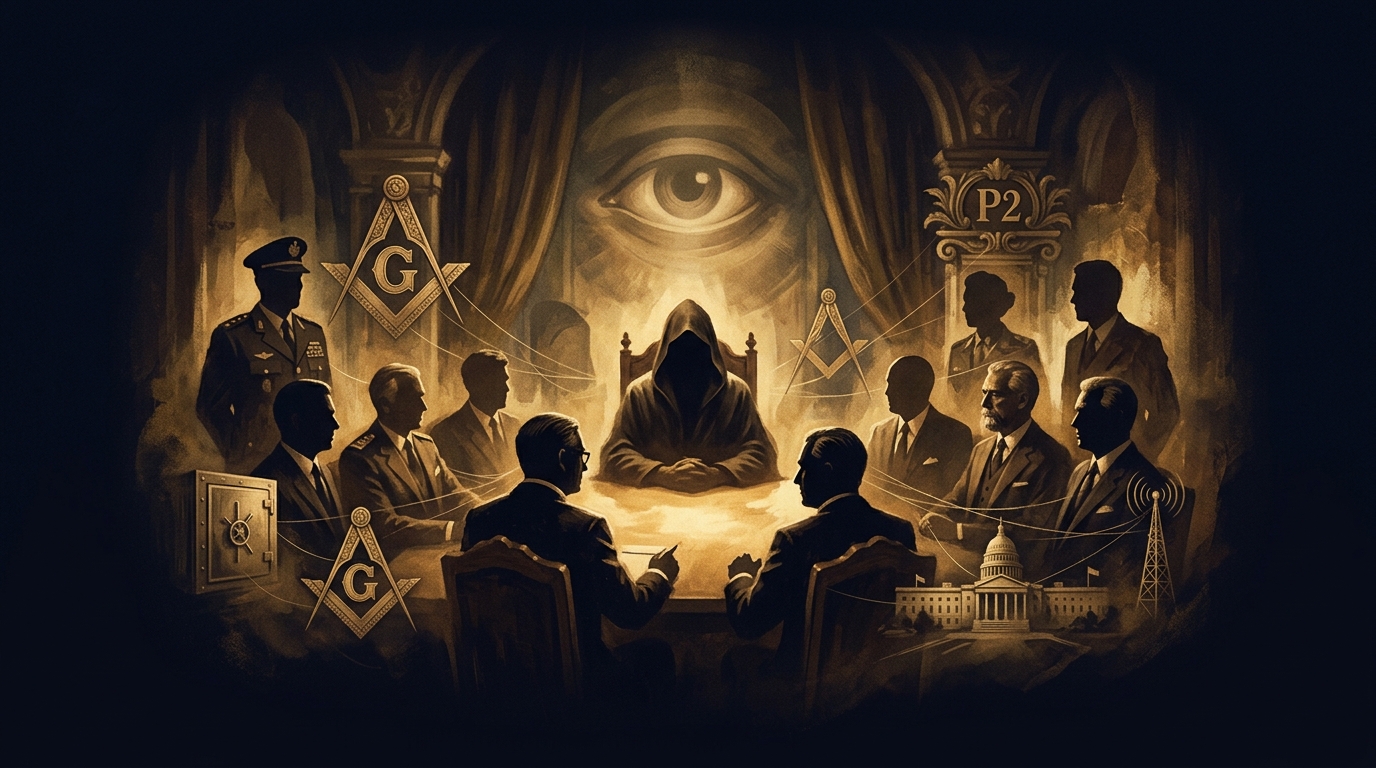
Propaganda Due — the P2 Masonic lodge operating in Italy from the 1960s through the early 1980s — was not merely a fraternal body but a clandestine network of military officers, intelligence chiefs, judges, politicians, and financiers whose exposure in 1981 revealed a documented shadow infrastructure embedded within the Italian state itself.
Overview
In the spring of 1981, magistrates investigating a financial fraud case raided the Arezzo villa of Licio Gelli, the Venerable Master of the Propaganda Due lodge. What they discovered was a membership list of 962 individuals — a cross-section of Italian institutional power encompassing three cabinet ministers, forty members of Parliament, forty-three generals, eight admirals, heads of the intelligence services, senior magistrates, and prominent figures from banking and media. The document was not a theoretical roster; parliamentary commissions subsequently confirmed its authenticity, and the resulting scandal forced the resignation of Prime Minister Arnaldo Forlani's government within weeks. The P2 affair stands as one of the most thoroughly documented cases of a secret society's direct penetration of a democratic state apparatus in the twentieth century.
The lodge's origins trace to the regular Masonic structure of the Grand Orient of Italy, from which a special lodge called Propaganda Massonica was historically reserved for members requiring anonymity — aristocrats, public officials, and others for whom open lodge membership carried social risk. Licio Gelli, a man with documented wartime connections to both Italian Fascism and later the Allied occupation, assumed control of the lodge in 1967 and quietly transformed it. Successive investigations established that P2 ceased to function as a conventional Masonic body and operated instead as a parallel network — what the parliamentary commission chaired by Tina Anselmi formally described in 1984 as an 'association pursuing political ends through reserved and secret methods.' The Grand Orient of Italy itself expelled the lodge in 1976, a fact sometimes overlooked in popular treatments.
The geopolitical dimension of P2 cannot be disentangled from the broader architecture of Cold War Italy. Investigators and subsequent scholars — including historian Daniele Ganser in his documented research on NATO's stay-behind programs — noted significant overlap between P2 membership and the Italian components of Operation Gladio, the NATO-sponsored clandestine network designed to operate behind Soviet lines in the event of invasion. Whether the two structures were formally coordinated or merely overlapped through shared personnel remains debated, but the factual convergence of names is documented. The lodge's trajectory intersects with several of the defining catastrophes of Italy's 'Years of Lead': the collapse of Banco Ambrosiano under Roberto Calvi, the suspicious death of Calvi himself in London in 1982 (found hanging beneath Blackfriars Bridge), and alleged connections to the Vatican's Institute for Religious Works, whose finances were implicated in the banking scandal. The precise degree of P2's institutional culpability in each of these events remains a matter of ongoing judicial and historical dispute.
What makes P2 genuinely significant for any serious archive of hidden power is not the lurid overlay of conspiracy theory but the documented parliamentary record. The Anselmi Commission's final report, submitted to the Italian Parliament in 1984, concluded that P2 represented a threat to Italian constitutional order — not a speculative claim but a formal legislative finding. Gelli himself was convicted of political espionage and banking fraud, though he evaded some charges through statute of limitations and legal maneuvering before his death in 2015. The lodge's internal document — reportedly titled 'Piano di Rinascita Democratica' (Plan for Democratic Rebirth) — outlined a systematic strategy for penetrating media, political parties, and financial institutions to redirect Italian public life. Whether that plan was ever operationalized in full remains disputed, but its existence and discovery are documented historical facts, not speculation.
Key Claims
Timeline
Evidence
Multiple Perspectives
Biblical Lens
Scripture Threads
Sources & Further Study
Questions to Explore
Go Deeper Path
Follow the Thread
Continue the Investigation
You’ve reached the Full Archive portion of this Case File.
Ask the Archivist
about this fileSign in to ask the Archivist
Create a free account to ask the Archivist 1 grounded question each day, cited straight from the CODEX case files.
Discussion
0Share findings, questions, and evidence with fellow Seekers. Be respectful and cite sources where you can.
No comments yet. Be the first to open this thread.