
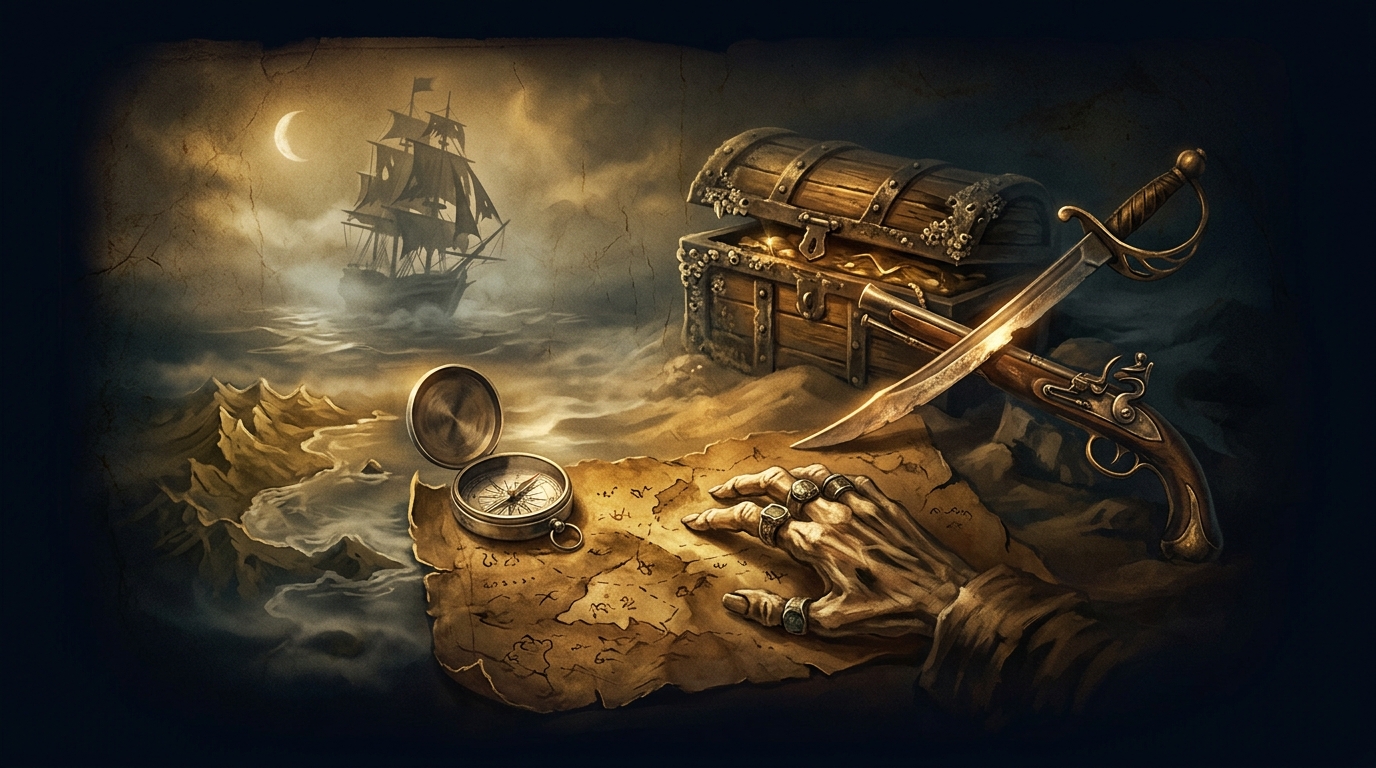
 Codex Illustration
Pirate Legends and Lost Treasure
For centuries, the Golden Age of Piracy has generated a mythology of buried treasure, coded maps, and sunken hoards that blends documented historical fact with romantic embellishment — some caches genuinely lost to history, others almost certainly invented by the legends themselves.
Overview
The Golden Age of Piracy, spanning roughly 1650 to 1730, produced a cohort of maritime raiders whose exploits became so thoroughly mythologized that separating documented history from accumulated legend is itself a scholarly discipline. Pirates such as Edward Teach (Blackbeard), Henry Every, Bartholomew Roberts, and the historically complex figure of Henry Morgan operated within a documented legal and criminal framework — privateering commissions, admiralty court records, colonial governance disputes — that researchers can trace in British, Spanish, and Dutch archives. The treasure narrative, however, belongs to a more ambiguous register: real plunder certainly existed, but the romantic notion of buried chests on remote islands owes more to literary imagination, particularly Robert Louis Stevenson's 1883 novel Treasure Island, than to any documented pirate practice. Scholars of the period note that pirates, as a rule, spent their plunder rapidly in port rather than burying it for later retrieval — a sensible economic behavior for men with uncertain life expectancies.
Yet certain cases resist easy dismissal. The treasure of Samuel Bellamy's Whydah Gally, which sank off Cape Cod in 1717, was partially recovered by marine archaeologist Barry Clifford beginning in 1984 and remains the only fully authenticated pirate shipwreck ever excavated — demonstrating that genuine hauls of documented size did exist and can, under the right circumstances, be found. The alleged fortune of Captain William Kidd, hanged for piracy in 1701 after a trial whose fairness remains contested by historians, has generated three centuries of treasure hunting across the Caribbean, Madagascar, and even the waters off coastal Connecticut. Kidd himself claimed before his execution that he knew where a great treasure was hidden, a statement some historians read as a desperate bargaining chip rather than literal geography. A cache reportedly connected to Kidd was announced in 2015 off the coast of Madagascar — the find attracted significant press coverage before independent analysts questioned the provenance of the recovered silver bar.
The Oak Island Mystery, located off the coast of Nova Scotia, represents perhaps the most durable and financially costly treasure legend in the Western world. Since the late eighteenth century, successive generations of investors and excavators — including, reportedly, Franklin D. Roosevelt as a young man — have spent enormous sums pursuing a theorized underground repository sometimes attributed to pirates, sometimes to the Knights Templar, sometimes to Francis Bacon's manuscripts, and occasionally to more esoteric frameworks entirely. No authenticated treasure has ever been recovered, though genuine pre-modern artifacts have surfaced in the course of excavation; the site's stratigraphy remains contested, and some geologists argue that the famous 'Money Pit' may be a natural sinkhole formation rather than an engineered shaft. The legend's persistence illustrates how treasure mythology operates culturally: each inconclusive excavation season sustains rather than diminishes the narrative.
The historiography of pirate treasure intersects with broader questions about how societies construct and perpetuate myths of hidden wealth. Scholars such as Marcus Rediker, in Villains of All Nations (2004), and David Cordingly, in Under the Black Flag (1995), have done much to distinguish the social and economic realities of piracy from its romanticized afterlife in popular culture. The treasure myth specifically may encode a deeper cultural fantasy — that enormous, unearned wealth lies just beneath the surface of the ordinary world, accessible to the sufficiently daring or clever. This fantasy has a long genealogy that predates pirates entirely, connecting to traditions of fairy gold, alchemical transformation, and the universal human conviction, documented across cultures, that the truly extraordinary is always tantalizingly close and perpetually just out of reach.
Key Claims
Timeline
Evidence
Multiple Perspectives
Biblical Lens
Scripture Threads
Sources & Further Study
Questions to Explore
Go Deeper Path
Follow the Thread
Continue the Investigation
You’ve reached the Full Archive portion of this Case File.
Ask the Archivist
about this fileSign in to ask the Archivist
Create a free account to ask the Archivist 1 grounded question each day, cited straight from the CODEX case files.
Discussion
0Share findings, questions, and evidence with fellow Seekers. Be respectful and cite sources where you can.
No comments yet. Be the first to open this thread.