
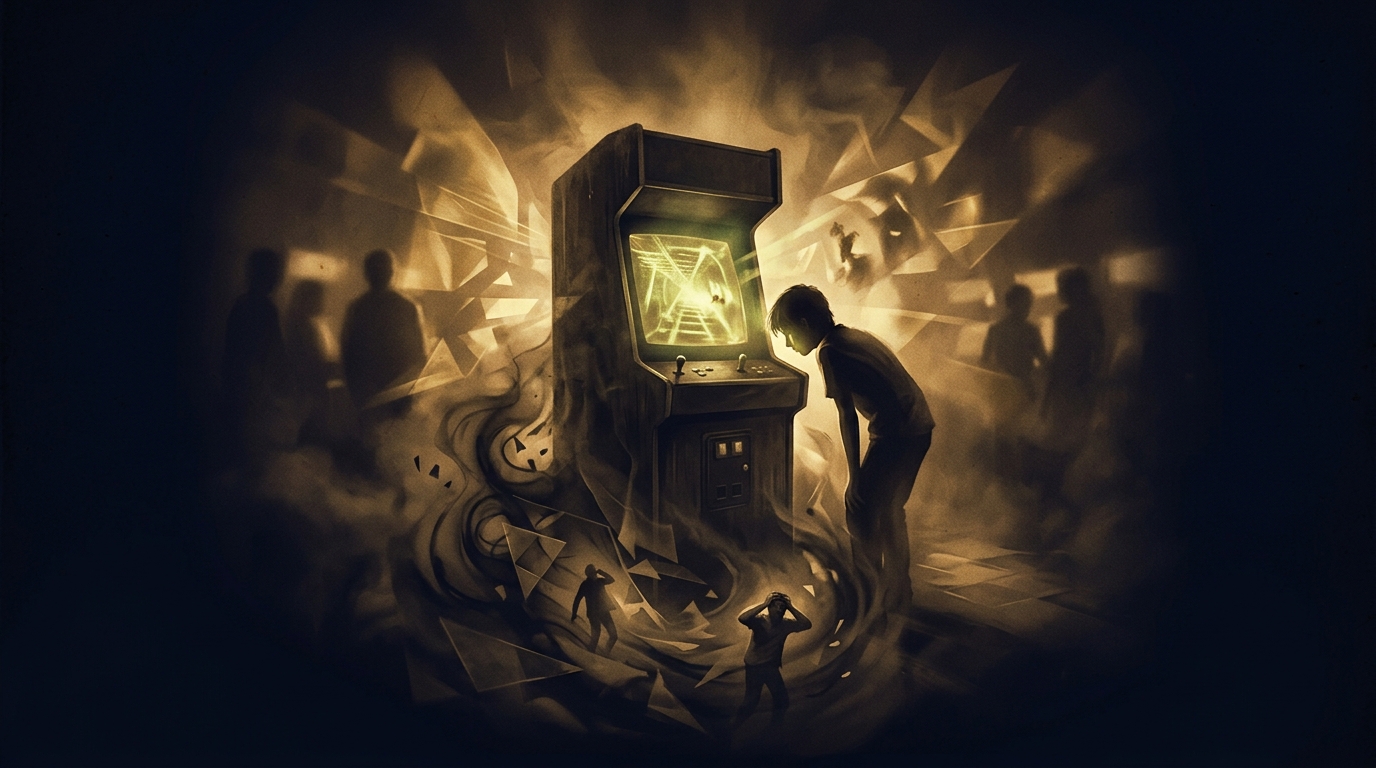
 Codex Illustration
Polybius Arcade Legend
Polybius is an alleged 1981 arcade cabinet said to have appeared briefly in Portland, Oregon, inducing seizures, amnesia, and psychological disturbance in players — a legend with no verifiable physical evidence that has nonetheless become one of the internet era's most enduring and symbolically rich pieces of digital folklore.
Overview
The Polybius legend, as most people encounter it, claims that in the autumn of 1981 a mysterious arcade game appeared without explanation in several Portland, Oregon, arcades. Players reportedly experienced hallucinations, amnesia, night terrors, and seizures. Men in dark suits — sometimes described as government agents — were said to visit the cabinets periodically to collect data from them. Within weeks, the machines allegedly vanished as quietly as they had arrived, leaving no trace and no manufacturer record. The story carries all the hallmarks of a classic Cold War anxiety narrative: faceless authority, involuntary experimentation, the complicity of consumer technology, and the vulnerability of ordinary citizens in public spaces.
The legend's documented origin is almost certainly the internet. The earliest traceable appearance of the Polybius story is a brief entry on the website coinop.org, posted by a user in 2000 under disputed circumstances. No arcade industry records from 1981, no contemporary newspaper accounts, no police or medical reports, and no surviving cabinet have ever surfaced. Researchers including Brian Dunning of the Skeptoid podcast, who investigated the claim rigorously, found zero corroborating documentation from the period in question. The name itself is borrowed from the ancient Greek historian Polybius, who wrote on the science of secret codes — a detail that feels too knowing for an authentic 1980s arcade title, suggesting the legend was assembled rather than remembered.
Despite its almost certain fictional origin, the Polybius legend invites serious analysis as a cultural artifact. It crystallized anxieties already present in 1980s America regarding arcade games — a moral panic that was quite real. Congressional hearings on the social dangers of video arcades occurred in the early 1980s; surgeon general C. Everett Koop made widely reported statements in 1982 warning of the addictive and potentially harmful effects of video games. Project MKUltra, the CIA's documented mind-control program, had only been publicly revealed through congressional hearings in 1977, leaving a vivid template in the cultural imagination for covert human experimentation. The Polybius legend, whether consciously or not, synthesizes these genuine anxieties into a single, elegant myth.
The story has grown considerably since its internet debut. It has been featured in an episode of The Simpsons, incorporated into the video game Seum, and inspired a 2017 virtual reality game by Jeff Minter that bears the Polybius name. Documentaries and investigative YouTube channels have revisited the claim repeatedly, each cycle amplifying its reach. Folklorists and media scholars have noted that Polybius functions less as a hoax and more as what Jan Harold Brunvand would call a 'contemporary legend' — a story that gains traction not because it is verifiably true but because it articulates something people already fear or suspect about the world. In this sense, the legend is a genuine cultural document, even if the arcade cabinet itself almost certainly never existed.
Key Claims
Timeline
Evidence
Multiple Perspectives
Biblical Lens
Scripture Threads
Sources & Further Study
Questions to Explore
Go Deeper Path
Follow the Thread
Continue the Investigation
You’ve reached the Full Archive portion of this Case File.
Ask the Archivist
about this fileSign in to ask the Archivist
Create a free account to ask the Archivist 1 grounded question each day, cited straight from the CODEX case files.
Discussion
0Share findings, questions, and evidence with fellow Seekers. Be respectful and cite sources where you can.
No comments yet. Be the first to open this thread.