
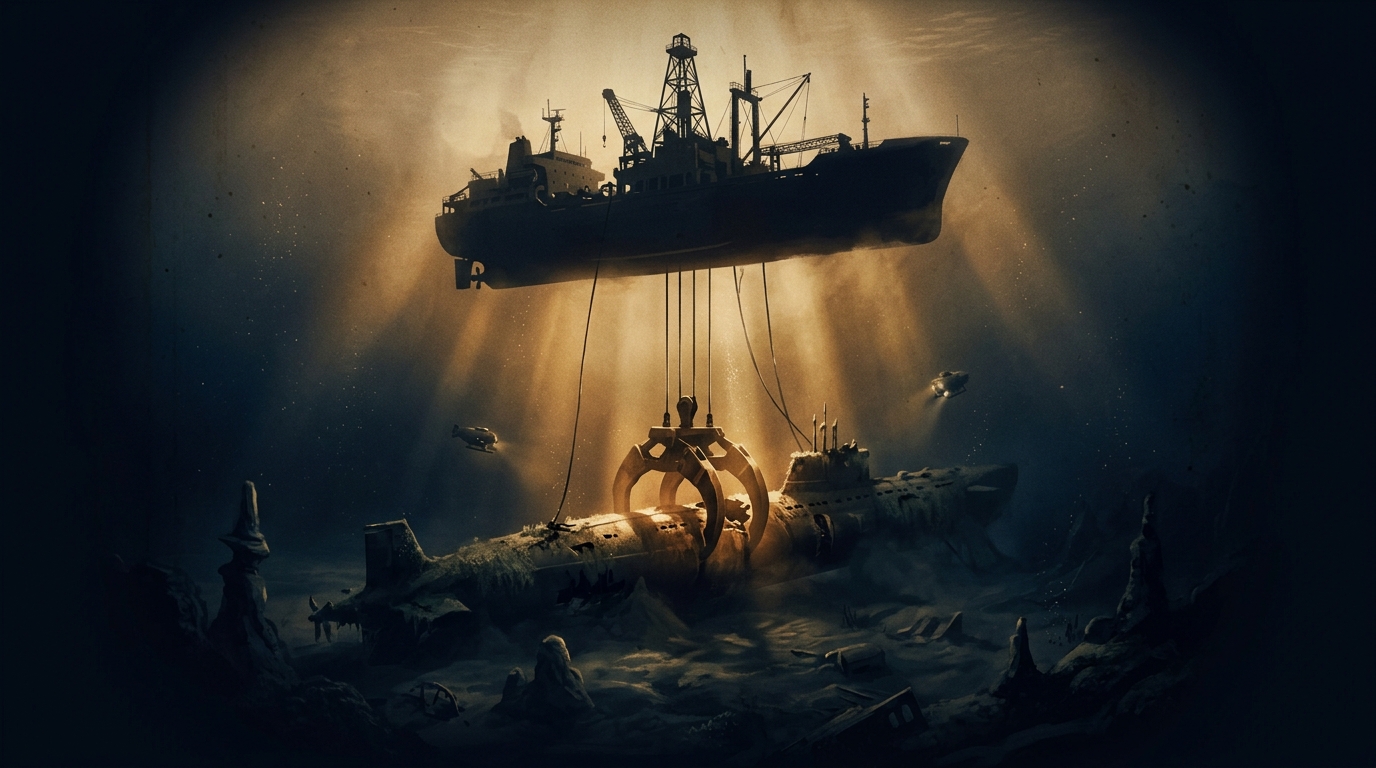
 Codex Illustration
Project Azorian
In 1974, the CIA orchestrated one of the most audacious covert operations in the history of American intelligence: the secret retrieval of a sunken Soviet nuclear submarine from the floor of the Pacific Ocean, three miles beneath the surface, using a purpose-built ship disguised as a commercial deep-sea mining venture. The operation was real, its details were classified for decades, and what the agency actually recovered remains, in part, a matter of official silence.
Overview
On April 11, 1968, the Soviet Golf II-class submarine K-129 sank in the North Pacific, approximately 1,560 miles northwest of Hawaii, under circumstances that remain incompletely explained. The vessel carried nuclear-tipped ballistic missiles, cryptographic equipment, and code books of immeasurable intelligence value. The Soviet Navy conducted an extensive search and failed to locate the wreck. The United States Navy, using its then-classified SOSUS hydroacoustic network, found it. What followed was one of the most carefully constructed deceptions of the Cold War era — a program that would eventually be known as Project Azorian, though for years it circulated under the informal name 'Project Jennifer,' a designation that the CIA has since clarified was used by the press rather than the agency itself.
To retrieve the K-129 from a depth of approximately 16,500 feet, the CIA partnered with Howard Hughes — a billionaire whose eccentric public persona and existing deep-sea interests provided ideal cover — and a consortium of defense contractors including Global Marine. A custom-built vessel, the Hughes Glomar Explorer, was constructed between 1972 and 1973 under the cover story of a commercial manganese nodule mining operation. The ship featured an enormous internal well called the 'moon pool,' through which a massive claw-like capture vehicle, designated the Clementine, could be lowered to the seabed. The operation was presented to the maritime world as a genuine mining enterprise, and the cover held with remarkable tenacity, aided in part by the secrecy agreements and compartmentalization that characterized CIA tradecraft at its most refined.
The actual recovery attempt took place in the summer of 1974. Publicly declassified accounts, confirmed by the CIA's own released documents (some heavily redacted), indicate that the Clementine successfully reached the wreck and engaged it, but that the submarine's hull fractured during ascent, causing a significant portion of the target section to fall back to the seabed. The CIA has stated that the forward section of the submarine — containing some crew remains, two nuclear torpedoes, and certain materials of intelligence value — was successfully brought aboard. The recovered Soviet sailors were given a burial at sea, with a ceremony reportedly filmed by the CIA; a portion of that footage was later shared with Russian officials after the Cold War. What specific intelligence materials — code books, missile guidance systems, nuclear warheads — were actually recovered, and in what condition, remains classified or disputed, with official statements carefully hedged.
Project Azorian was partially exposed in February 1975 when journalist Seymour Hersh learned of the program and the Los Angeles Times published a story, forcing the CIA to acknowledge the existence of the Glomar Explorer while declining to confirm operational details. The incident also produced a lasting legacy in American law and information policy: the phrase 'Glomar response' — in which a government agency neither confirms nor denies the existence of records — derives directly from the CIA's legal strategy when FOIA requests for Project Azorian files were submitted. The Glomar Explorer itself was eventually sold, repurposed as a commercial drilling vessel, and finally scrapped in 2015. The operation stands as a documented, partially declassified episode that illuminates the extraordinary lengths to which Cold War superpowers went to gain intelligence advantage, and the institutional machinery — legal, technological, financial, and psychological — that covert action required.
Key Claims
Timeline
Evidence
Multiple Perspectives
Biblical Lens
Scripture Threads
Sources & Further Study
Questions to Explore
Go Deeper Path
Follow the Thread
Continue the Investigation
You’ve reached the Full Archive portion of this Case File.
Ask the Archivist
about this fileSign in to ask the Archivist
Create a free account to ask the Archivist 1 grounded question each day, cited straight from the CODEX case files.
Discussion
0Share findings, questions, and evidence with fellow Seekers. Be respectful and cite sources where you can.
No comments yet. Be the first to open this thread.