
 Codex Illustration
Project Looking Glass
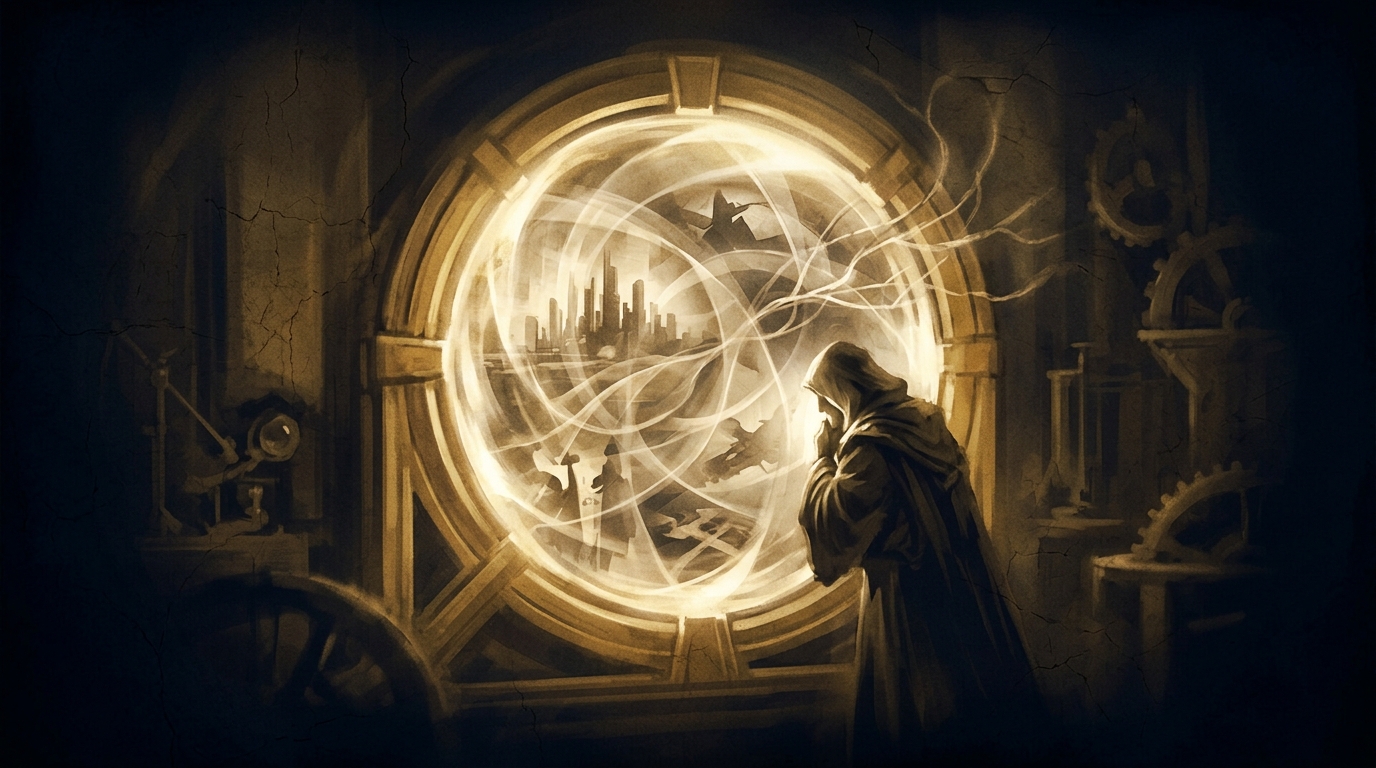
Project Looking Glass is an alleged classified U.S. government program purportedly designed to view probable future events using exotic technology — a claim that circulates widely in conspiracy and UFO disclosure communities but lacks any verified documentary foundation.
Overview
The term 'Project Looking Glass' entered broad public consciousness through the testimonies of self-described government insiders and whistleblowers, most notably in the context of the broader UFO disclosure movement of the late 1990s and early 2000s. The core claim is that American intelligence and defense agencies — operating in black-budget secrecy — developed or reverse-engineered technology capable of observing future timelines or probability streams. Proponents assert this device functioned by bending or warping spacetime in a localized field, allegedly using either captured extraterrestrial technology or principles derived from advanced theoretical physics. These claims were amplified dramatically by the anonymous internet figure known as 'Q' during 2017–2021, who referenced Looking Glass repeatedly as evidence that certain actors possessed foreknowledge of future geopolitical events. It is essential to note that none of these assertions has been substantiated by declassified documents, peer-reviewed research, or credible whistleblower testimony meeting journalistic standards of verification.
The most frequently cited primary witness is physicist and self-described former government contractor Dan Burisch (born Dan Crain), who claimed in interviews during the early 2000s to have worked directly with extraterrestrial beings and to have had access to Looking Glass technology at classified facilities in Nevada. Burisch alleged the device used a rotating ring of water or plasma to create a viewing aperture into probable futures, and that operators could steer the field to observe different timeline branches. A secondary figure, Bill Hamilton, compiled and disseminated Burisch's testimony through early internet forums. Separately, Robert Lazar — whose claims about Area 51 and reverse-engineered craft predate the Looking Glass narrative — is sometimes loosely associated with the broader ecosystem of exotic-technology allegations, though Lazar himself has not claimed direct knowledge of a time-viewing device. The evidentiary status of all these testimonies remains at the anecdotal level, and serious investigative journalists and government researchers have not been able to corroborate the core claims.
From the standpoint of physics, the concept of observing future events encounters profound theoretical obstacles. General relativity permits certain exotic solutions — closed timelike curves, wormholes, and the like — that have been explored mathematically by physicists including Kip Thorne and others working in theoretical frameworks. However, the leap from mathematical possibility to operational hardware is enormous and, in the current state of physics, unbridged. The energy requirements for even nanoscale spacetime manipulation would be extraordinary, and no known technology approaches such capability. The 'probability stream' framing found in Looking Glass narratives draws loosely on many-worlds interpretations of quantum mechanics, but conflates popular misreadings of quantum indeterminacy with macroscopic, navigable timelines in ways that professional physicists do not endorse. The language is evocative of real science while departing substantially from it.
What makes Project Looking Glass culturally interesting — and worth careful archival treatment — is precisely its function within contemporary mythology-making. It operates at the intersection of UFO disclosure culture, apocalyptic anxious about geopolitical control, and a deep human desire to believe that certain powerful actors can see what is coming. The narrative draws on ancient archetypes: the oracle, the prophetic device, the forbidden window into destiny. Its spread through QAnon networks after 2017 gave it a second life far beyond its origins in niche UFO forums, embedding it into a larger political eschatology in which shadowy forces battle over the timeline of civilization itself. Scholars of contemporary folklore and conspiracy theory, including researchers affiliated with institutions studying digital misinformation, have documented how such narratives serve as coherent meaning-making frameworks for communities experiencing acute uncertainty — a dynamic that warrants serious scholarly attention regardless of whether the underlying technological claims have any foundation.
Key Claims
Timeline
Evidence
Multiple Perspectives
Biblical Lens
Scripture Threads
Sources & Further Study
Questions to Explore
Go Deeper Path
Follow the Thread
Continue the Investigation
You’ve reached the Full Archive portion of this Case File.
Ask the Archivist
about this fileSign in to ask the Archivist
Create a free account to ask the Archivist 1 grounded question each day, cited straight from the CODEX case files.
Discussion
0Share findings, questions, and evidence with fellow Seekers. Be respectful and cite sources where you can.
No comments yet. Be the first to open this thread.