
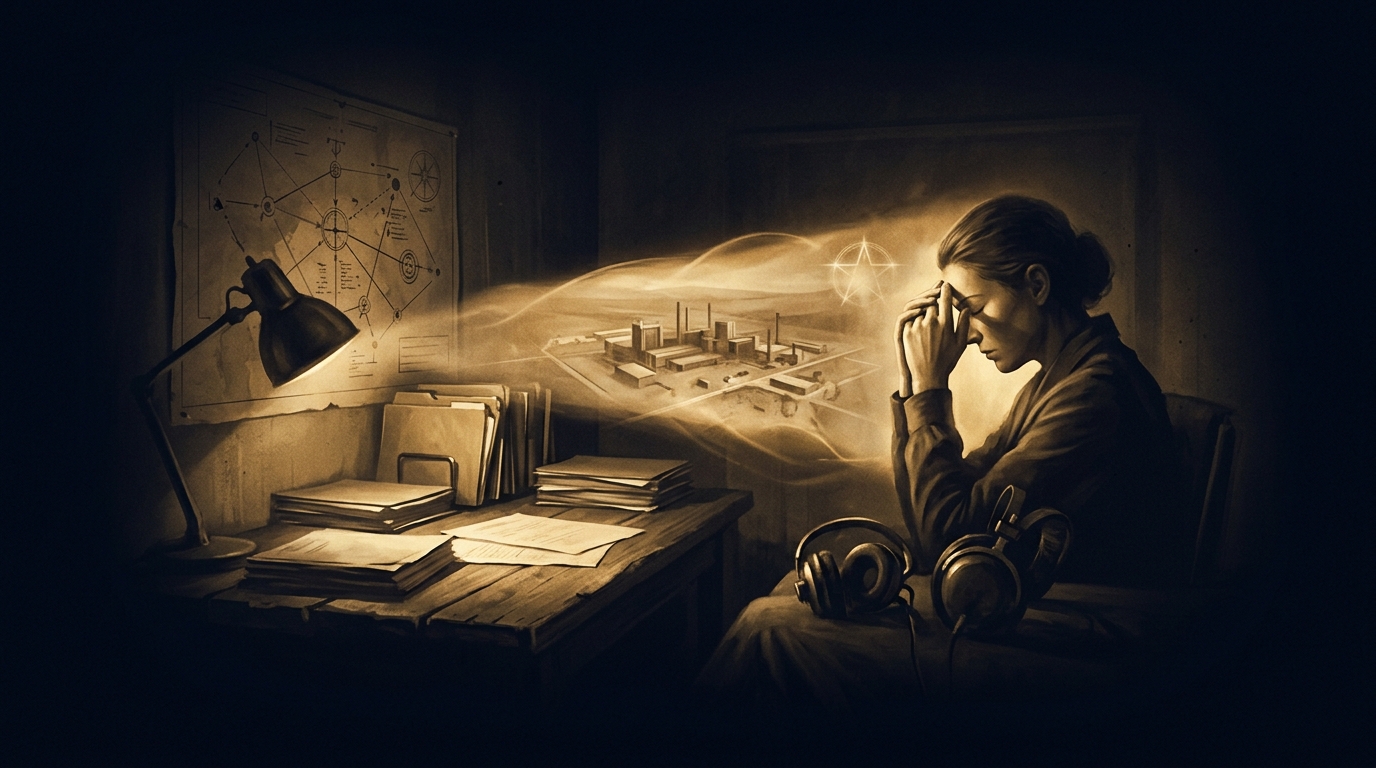
 Codex Illustration
Project Stargate
From 1972 to 1995, the United States government secretly funded a series of programs investigating whether trained individuals could perceive distant locations, objects, and events through non-sensory means — a phenomenon the researchers called 'remote viewing.' The declassified record is extensive, the results remain contested, and the questions it raises about the nature of human consciousness have never been fully resolved.
Overview
Project Stargate was not a single program but the culmination of a family of related covert research efforts that operated under successive code names — SCANATE, GONDOLA WISH, GRILL FLAME, CENTER LANE, SUN STREAK, and finally STARGATE — sponsored at various points by the CIA, the Defense Intelligence Agency (DIA), the Army, and other elements of the U.S. intelligence community. The core hypothesis under investigation was simple and radical: that certain human subjects, under controlled conditions, could describe physical locations, objects, or events at remote distances without any conventional sensory input, using only an apparent faculty the researchers termed 'anomalous cognition.' The program was formally initiated in the early 1970s at Stanford Research Institute (SRI) in Menlo Park, California, largely through the work of physicists Russell Targ and Harold Puthoff, and eventually migrated operational activities to Fort Meade, Maryland, where trained military and civilian remote viewers worked alongside intelligence analysts.
The documented history of Stargate is, by any reasonable standard, extraordinary in its institutional scope. For roughly two decades, elements of the American national security apparatus quietly devoted funding, personnel, and infrastructure to exploring what most academic scientists regarded as a fringe phenomenon. The impetus was partly competitive: credible intelligence reports suggested the Soviet Union was investing heavily in psychotronics research, and Cold War anxiety about a 'psi gap' was sufficient to keep the programs alive through multiple administrations and budget reviews. Among the most prominent operational remote viewers whose accounts are on record are Ingo Swann — a New York artist who became an early research subject and later a theorist of remote viewing methodology — and Army Chief Warrant Officer Joseph McMoneagle, who received the Legion of Merit partly in recognition of his remote viewing contributions. The program also produced Pat Price, whose reported sessions on Soviet facilities drew sustained intelligence interest, and Mel Riley, among others.
The scientific evaluation of Stargate's results is itself a matter of documented controversy. In 1995, the CIA commissioned an independent review by the American Institutes for Research (AIR), led by statistician Jessica Utts and skeptical psychologist Ray Hyman. Utts concluded that the statistical evidence for anomalous cognition in laboratory settings was robust and warranted serious scientific attention; Hyman, while acknowledging methodological improvements over earlier parapsychology research, argued that the evidence remained insufficient to establish a genuine phenomenon and that alternative explanations had not been fully ruled out. The AIR report was released publicly, and the program was terminated that same year — though the reasoning behind the termination combined both scientific ambiguity and perceived operational limitations. The full declassified archive of Stargate documents was released to the public via the Freedom of Information Act and is housed at the National Archives, making this one of the most thoroughly documented government parapsychology programs in history.
What Stargate ultimately demonstrates — beyond question — is that senior figures in the U.S. intelligence and defense establishment took the possibility of anomalous human cognition seriously enough to fund it for more than two decades. Whether the phenomenon itself is real, and if so what mechanisms might underlie it, remains an open question in consciousness research. The program's legacy extends into ongoing academic debates about the nature of perception, mind, and the physical limits of information transfer — debates that touch on quantum biology, neuroscience, and the philosophy of mind. It has also generated a rich secondary literature, a community of trained practitioners who continue to offer remote viewing services, and persistent interest from researchers attempting to replicate or build upon the SRI protocols in peer-reviewed settings.
Key Claims
Timeline
Evidence
Multiple Perspectives
Biblical Lens
Scripture Threads
Sources & Further Study
Questions to Explore
Go Deeper Path
Follow the Thread
Continue the Investigation
You’ve reached the Full Archive portion of this Case File.
Ask the Archivist
about this fileSign in to ask the Archivist
Create a free account to ask the Archivist 1 grounded question each day, cited straight from the CODEX case files.
Discussion
0Share findings, questions, and evidence with fellow Seekers. Be respectful and cite sources where you can.
No comments yet. Be the first to open this thread.