
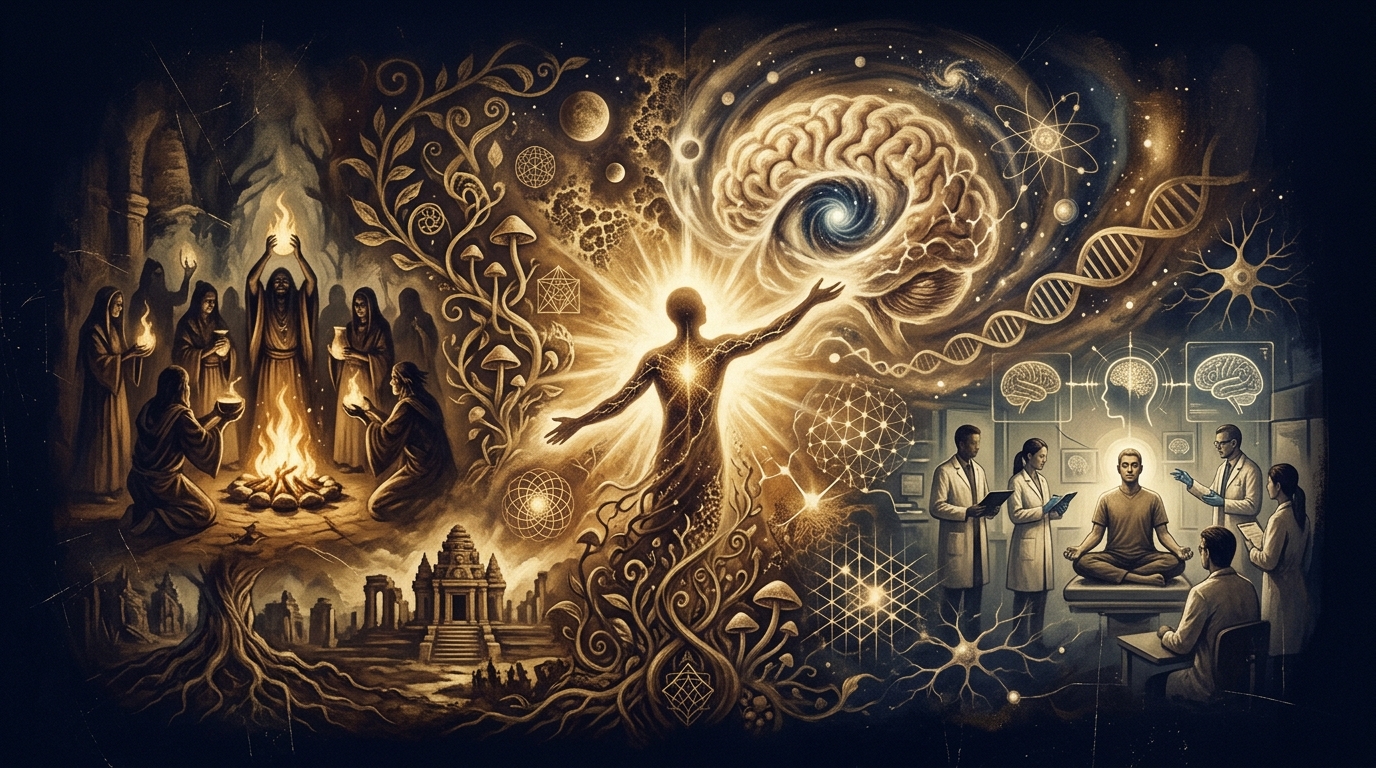
 Codex Illustration
Psychedelics and Consciousness
From ancient shamanic rituals to modern clinical trials, psychedelic substances have occupied a contested threshold between chemistry and the transcendent—raising profound questions about the nature of mind, the reality of spiritual experience, and what, if anything, lies beyond ordinary perception.
Overview
Psychedelic substances—principally psilocybin, DMT, LSD, mescaline, and ayahuasca—have been used in human ritual and healing contexts for millennia. Archaeological and ethnobotanical evidence suggests that indigenous cultures across the Americas, Africa, and Eurasia incorporated these compounds into ceremonial life, often within elaborate cosmological frameworks designed to mediate between the human and spirit worlds. The Huichol peyote pilgrimage, the Amazonian ayahuasca traditions, and the probable use of ergot-derived compounds in the Eleusinian Mysteries of ancient Greece all point to a cross-cultural intuition that certain plant medicines open a door—whether to the divine, to the unconscious, or to dimensions of reality inaccessible to ordinary waking consciousness.
The modern scientific engagement with psychedelics began in earnest in 1943 when Swiss chemist Albert Hofmann accidentally synthesized and self-administered LSD at Sandoz Laboratories. A period of intense, largely government-funded research followed through the 1950s and 1960s, culminating in more than a thousand clinical papers exploring applications in psychotherapy, addiction treatment, and the study of schizophrenia. This era was disrupted not by scientific failure but by political and cultural pressures: following widespread non-clinical use, LSD and related compounds were classified as Schedule I substances in the United States in 1970 under the Controlled Substances Act, effectively halting research for decades. The legacy of the CIA's Project MKUltra—which covertly administered LSD to unwitting subjects—further complicated public and institutional attitudes toward the field.
A renaissance of rigorous psychedelic science emerged in the early 2000s, anchored at institutions including Johns Hopkins University, New York University, and Imperial College London. Landmark studies on psilocybin demonstrated measurable reductions in anxiety and depression among terminal cancer patients, significant success in treating alcohol and tobacco addiction, and—perhaps most remarkably—that a majority of participants rated their psychedelic experience among the most meaningful of their lives, comparable to the birth of a child or the death of a parent. Neuroimaging research has mapped the disruption of the brain's Default Mode Network (DMN) during psychedelic states, offering a mechanistic account of ego dissolution that has been interpreted variously as pathological, therapeutic, or spiritually significant.
The deepest questions raised by psychedelics resist purely chemical reduction. Philosopher of mind David Chalmers' 'hard problem of consciousness'—why there is subjective experience at all—remains unsolved, and the phenomenology of psychedelic states (encounters with seemingly autonomous entities, life reviews, mystical unity) pushes that problem into sharp relief. Theologians, neuroscientists, and philosophers disagree fundamentally on whether such experiences constitute genuine contact with external reality, are artifacts of brain chemistry, or represent some third category not yet adequately theorized. This ambiguity makes psychedelics one of the most intellectually fertile—and spiritually consequential—frontiers at the intersection of science, philosophy, and religion.
Timeline
Evidence
Multiple Perspectives
Biblical Lens
Scripture Threads
Sources & Further Study
Questions to Explore
Follow the Thread
Continue the Investigation
You’ve reached the Full Archive portion of this Case File.
Ask the Archivist
about this fileSign in to ask the Archivist
Create a free account to ask the Archivist 1 grounded question each day, cited straight from the CODEX case files.
Discussion
0Share findings, questions, and evidence with fellow Seekers. Be respectful and cite sources where you can.
No comments yet. Be the first to open this thread.