
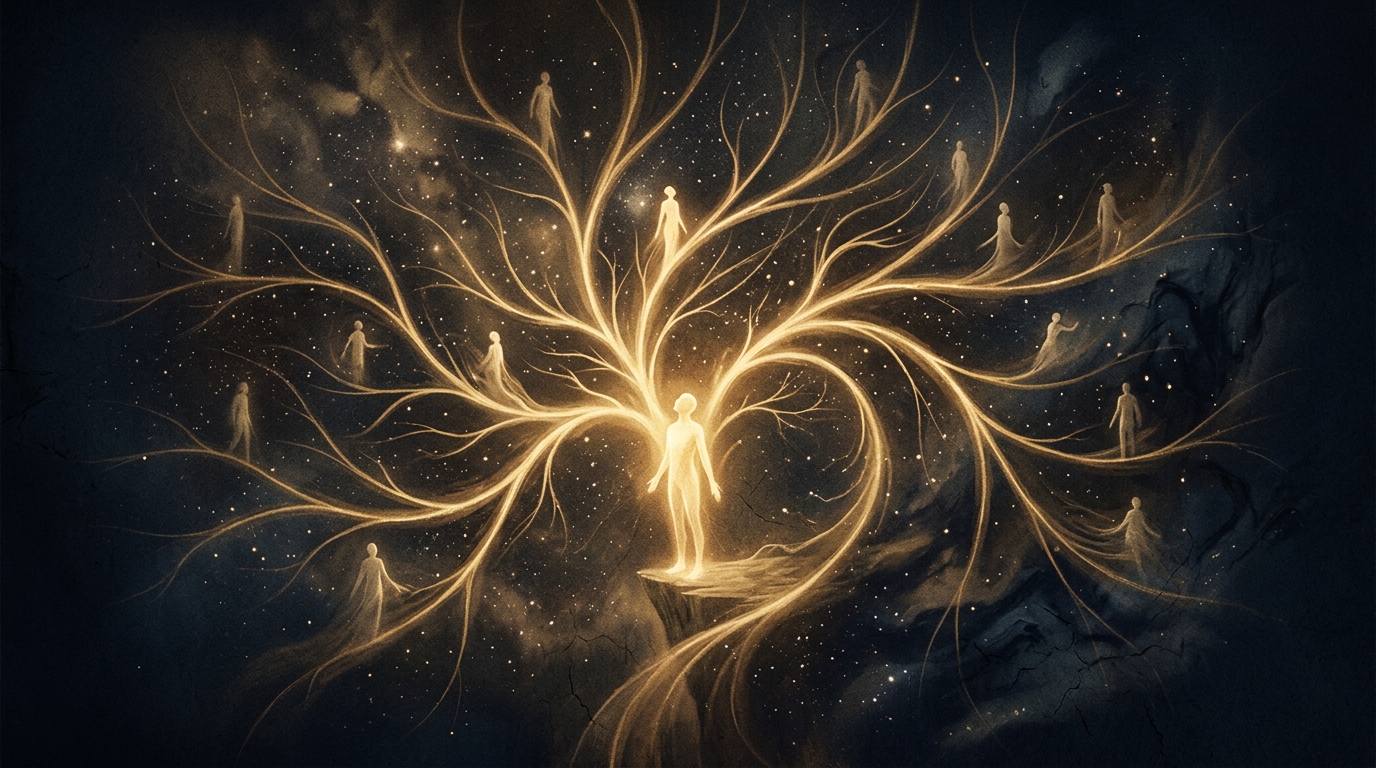
 Codex Illustration
Quantum Immortality
Quantum immortality is a thought experiment proposing that, within the many-worlds interpretation of quantum mechanics, an observer's subjective experience can never terminate — that consciousness perpetually branches into versions of itself that survive every fatal event. It is a seductive philosophical extension of serious physics, but one that nearly all physicists and philosophers regard as speculative, untestable, and potentially dangerous.
Overview
The thought experiment now called quantum immortality traces its formal lineage to Hugh Everett III's 1957 many-worlds interpretation (MWI) of quantum mechanics, later sharpened into a deliberately provocative scenario by physicist Max Tegmark in a 1998 paper. The core argument runs as follows: if the universe perpetually branches at every quantum event, then for any outcome that would kill an observer, there must exist at least one branch in which that observer survives. Because consciousness can only be experienced from the inside — by a living observer — the subjective thread of experience will always find itself in a surviving branch. On paper, this would mean that from the observer's own first-person perspective, death is never experienced. The argument is logically coherent only if MWI is correct and if consciousness supervenes exclusively on a continuous physical process — both of which remain contested.
It is essential to distinguish the legitimate science at this hypothesis's foundation from the speculative architecture built upon it. Hugh Everett's many-worlds interpretation is a serious, peer-reviewed position within the philosophy of physics, held by a minority but philosophically rigorous group of physicists including David Deutsch and Sean Carroll. The quantum suicide thought experiment — which quantum immortality extends — was used legitimately as a theoretical probe to distinguish MWI from Copenhagen-style collapse interpretations. In the Copenhagen framing, the observer would simply die; in MWI, some branch persists. Tegmark's original point was epistemological: the thought experiment reveals how different interpretations of quantum mechanics yield radically different predictions about observer experience, even if those predictions are practically indistinguishable from the outside. This is sober, careful physics philosophy — not a promise of literal immortality.
The popular and internet-mediated version of quantum immortality has, however, traveled far from Tegmark's careful caveats. In online communities and popular treatments, it is sometimes presented as an empirically grounded reason to believe one cannot die, or as a framework for understanding phenomena such as near-death experiences, miraculous survival accounts, or even reincarnation traditions. Some proponents conflate it with the Mandela Effect, simulation theory, or consciousness-uploading discourse, weaving a tapestry of interconnected claims that feel mutually reinforcing but share no common evidentiary thread. The leap from 'some branches contain a survivor' to 'I will subjectively experience immortality' requires assumptions about the nature of personal identity, the continuity of consciousness across branch splits, and the metaphysical weight of first-person experience that are nowhere established in quantum theory itself.
Philosophically, the hypothesis touches on some of the deepest unresolved questions in the study of mind: What constitutes personal identity across time? Is consciousness a physical process that can be meaningfully 'continued' across a quantum branching event? Derek Parfit's work on personal identity — particularly his arguments in Reasons and Persons (1984) — is frequently invoked here, as Parfit argued that identity is not what matters in survival; what persists through branching may not be 'you' in any meaningful sense. The hypothesis thus sits at the crossroads of quantum physics, philosophy of mind, and — when pressed to its existential limits — questions that religious and theological traditions have long claimed as their own domain: the nature of death, the persistence of the self, and what it means to be mortal.
Key Claims
Timeline
Evidence
Multiple Perspectives
Biblical Lens
Scripture Threads
Sources & Further Study
Questions to Explore
Go Deeper Path
Follow the Thread
Continue the Investigation
You’ve reached the Full Archive portion of this Case File.
Ask the Archivist
about this fileSign in to ask the Archivist
Create a free account to ask the Archivist 1 grounded question each day, cited straight from the CODEX case files.
Discussion
0Share findings, questions, and evidence with fellow Seekers. Be respectful and cite sources where you can.
No comments yet. Be the first to open this thread.