
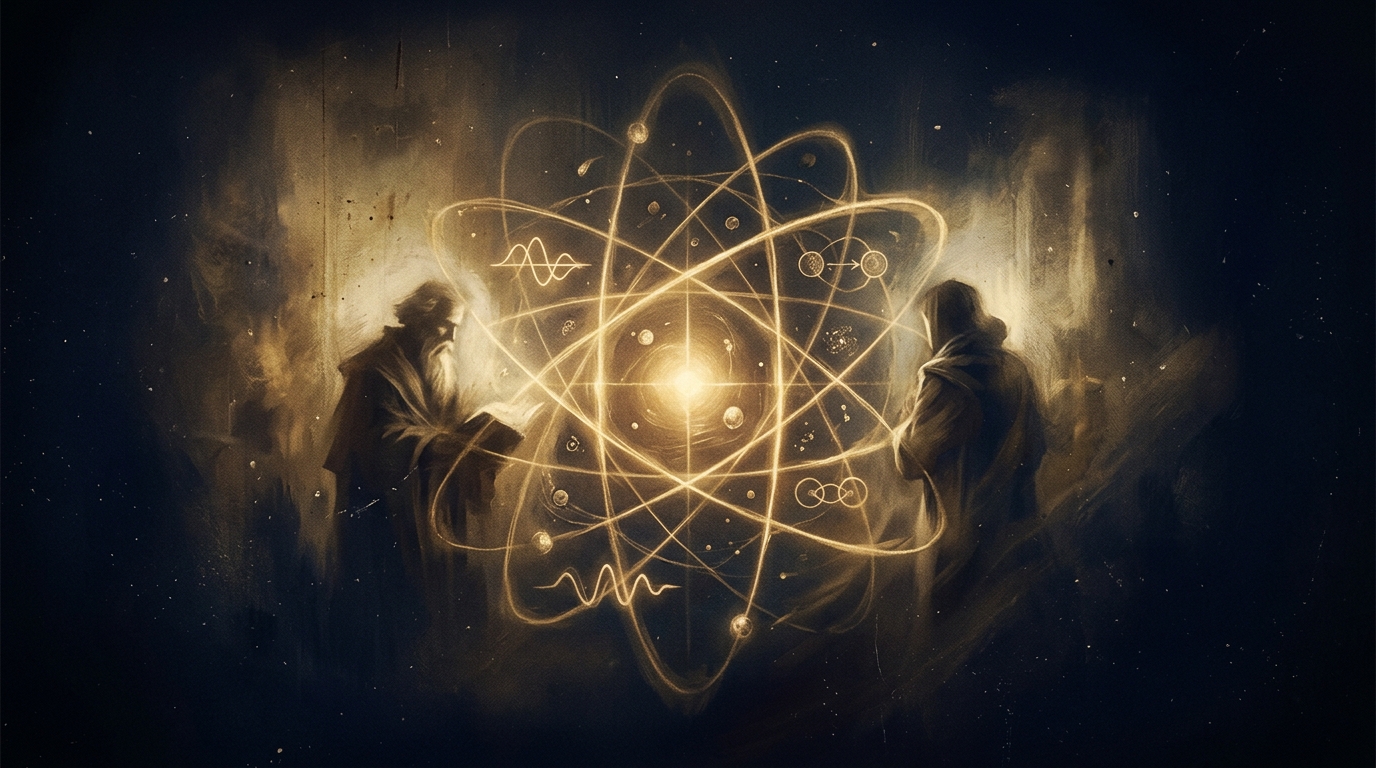
 Codex Illustration
Quantum Physics
Quantum physics, the science governing the behavior of matter and energy at the subatomic scale, has shattered classical intuitions about reality, determinism, and the nature of observation—raising profound questions that intersect with philosophy, consciousness studies, and even theology.
Overview
Quantum physics emerged in the early twentieth century as physicists confronted anomalies that Newtonian mechanics could not explain: the discrete energy levels of atomic spectra, the photoelectric effect, and the strange duality of light behaving as both wave and particle. Max Planck's 1900 hypothesis that energy is emitted in discrete packets called quanta, followed by Albert Einstein's explanation of the photoelectric effect and Niels Bohr's atomic model, laid the groundwork. By the late 1920s, Werner Heisenberg, Erwin Schrödinger, and Paul Dirac had formalized the mathematical framework now called quantum mechanics—a theory that remains the most precisely tested physical theory in history, with predictions confirmed to parts per billion.
The strangeness of quantum mechanics lies not in its mathematics, which are well-established, but in its interpretation. The Copenhagen interpretation, championed by Bohr and Heisenberg, holds that quantum systems exist in superpositions of states until measured, at which point the wave function 'collapses' into a definite outcome. Hugh Everett III's Many-Worlds Interpretation, by contrast, proposes that every quantum measurement causes a branching of the universe into all possible outcomes simultaneously—a view taken seriously by a significant minority of physicists. David Bohm's pilot-wave theory offers a deterministic alternative, while Carlo Rovelli's relational quantum mechanics reframes the entire edifice in terms of observer-dependent facts. No consensus exists on the correct interpretation; this is a live and contested philosophical frontier.
Perhaps the most philosophically charged phenomenon in quantum physics is entanglement—Einstein's 'spooky action at a distance.' When two particles become entangled, measuring one instantaneously determines the correlated property of the other, regardless of the distance separating them. John Bell's 1964 theorem and subsequent experimental tests by Alain Aspect and others have confirmed that no local hidden-variable theory can account for these correlations, meaning the universe is fundamentally non-local in some sense. This result earned Aspect, John Clauser, and Anton Zeilinger the 2022 Nobel Prize in Physics and remains one of the most profound empirical discoveries in science.
The frontier between quantum physics and other domains is extraordinarily active. Quantum field theory, which merges quantum mechanics with special relativity, underlies the Standard Model of particle physics and is explored experimentally at facilities such as CERN's Large Hadron Collider. Meanwhile, speculative but serious proposals—such as Roger Penrose and Stuart Hameroff's Orchestrated Objective Reduction (Orch-OR) hypothesis—suggest that quantum processes in neural microtubules may play a role in consciousness. Quantum physics also intersects with simulation theory, since certain interpretations imply that reality is inherently informational rather than material, and with cosmology, where quantum fluctuations in the very early universe are thought to have seeded the large-scale structure of the cosmos we observe today.
Timeline
Evidence
Multiple Perspectives
Biblical Lens
Scripture Threads
Sources & Further Study
Questions to Explore
Follow the Thread
Continue the Investigation
You’ve reached the Full Archive portion of this Case File.
Ask the Archivist
about this fileSign in to ask the Archivist
Create a free account to ask the Archivist 1 grounded question each day, cited straight from the CODEX case files.
Discussion
0Share findings, questions, and evidence with fellow Seekers. Be respectful and cite sources where you can.
No comments yet. Be the first to open this thread.