
 Codex Illustration
Reinhard Bonnke
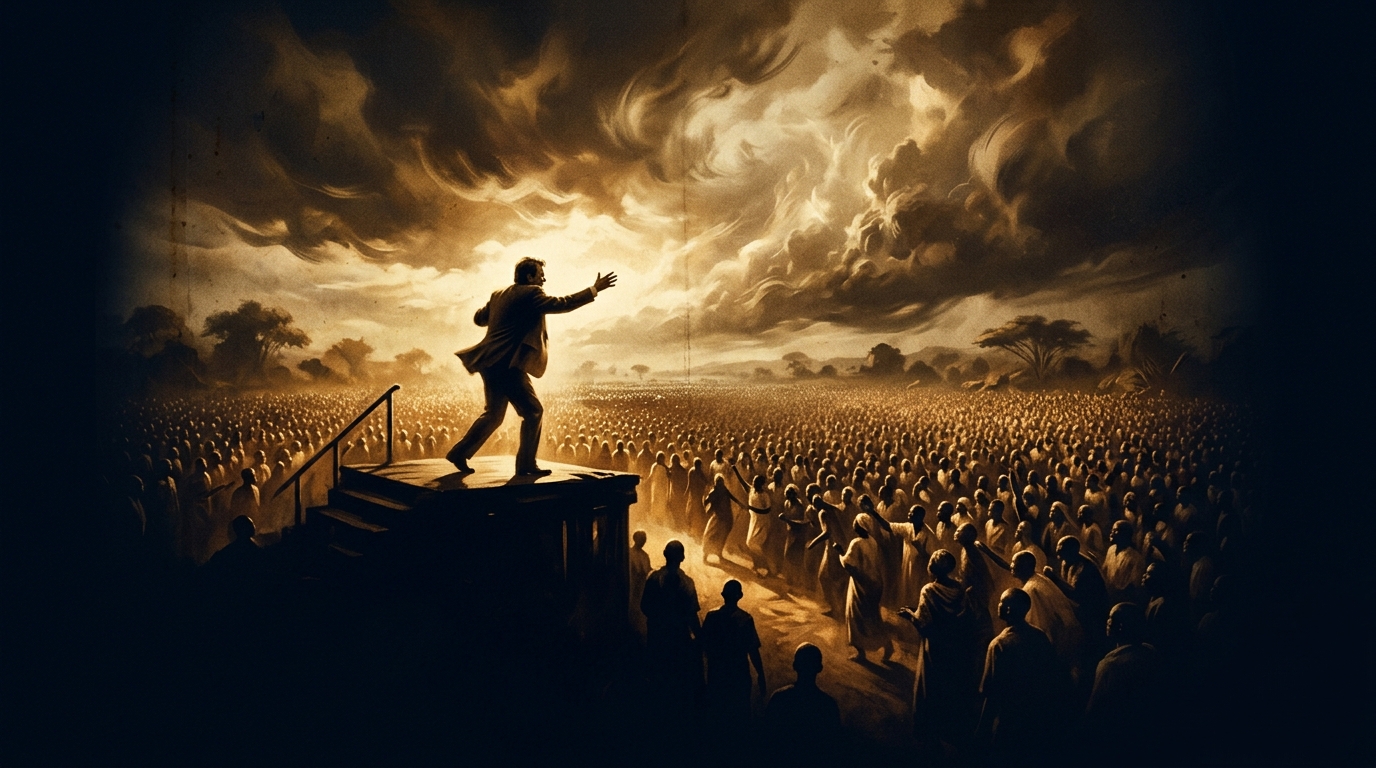
Reinhard Bonnke was a German Pentecostal evangelist whose Christ for all Nations crusades across sub-Saharan Africa drew some of the largest documented crowds in the history of Christian mission, with the organization recording more than eighty million documented decisions for faith across his lifetime of ministry.
Overview
Reinhard Bonnke was born on April 19, 1940, in Königsberg, East Prussia, into the home of a German Assemblies of God pastor. He would later describe a childhood encounter with the Holy Spirit at age nine as formative to his sense of calling, and by his own account he received what he understood as a specific prophetic mandate for Africa while still a teenager. After formal theological training at the Bible College of Wales in Swansea — itself a site associated with the Welsh Revival of 1904–1905 — Bonnke was ordained and appointed as a missionary to Lesotho in the mid-1960s. Early years were modest by any measure: small congregations, limited resources, and the grinding patience demanded of frontier mission work. Yet even then his organizational mind and evangelistic drive were forming the infrastructure that would eventually enable one of the most remarkable mass-mission enterprises in modern church history.
In 1974, Bonnke founded Christ for all Nations (CfaN), the ministry organization that would become the vehicle for his life's work. Through the 1980s and 1990s, CfaN evolved a distinctive methodology: city-by-city open-air crusades conducted on purpose-built tent or ground platforms, saturated with weeks of prior local church mobilization, coordinated intercessory prayer, and massive logistical preparation. Crowds at Lagos, Nigeria, in the late 1990s were independently estimated at several million per event by journalists and local authorities, making these among the largest single religious gatherings ever recorded anywhere on earth. African church growth scholars including David Barrett and Todd Johnson (World Christian Encyclopedia, Oxford University Press) have identified the West African Pentecostal belt as one of the most dramatic church-growth phenomena of the twentieth century, a shift in which mass crusade evangelism — of which Bonnke's ministry was a conspicuous part — played a documented role.
Central to the theological identity of Bonnke's ministry were two convictions: the universal efficacy of the blood of Jesus Christ as the ground of salvation, and the active, sign-accompanying work of the Holy Spirit in the present age. His phrase 'a blood-washed Africa' became a kind of shorthand for his eschatological vision of the continent — not merely converted in the statistical sense, but spiritually cleansed and reoriented toward Christ. Reported miraculous healings were a consistent feature of CfaN crusades; the ministry published testimonies of healings from blindness, deafness, paralysis, and disease, including several claims that drew significant media attention. Among the most widely circulated and contested is the account of Daniel Ekechukwu, a Nigerian pastor said to have been raised from documented clinical death in 2001, a claim publicized in a CfaN-produced documentary and circulated internationally. Critics, including medical professionals, questioned the clinical documentation, while supporters pointed to signed pastoral and hospital records. This episode remains the subject of ongoing theological and evidentiary debate.
Bonnke's legacy within global Christianity is substantial and largely undisputed in its broad outline, whatever one's theological commitments regarding the miraculous. He relocated CfaN's base of operations to Orlando, Florida, in later years, continuing to write, preach, and mentor. His designated successor, Daniel Kolenda, assumed leadership of CfaN and continued the crusade model. Bonnke died on December 7, 2019, in Orlando, having preached across more than sixty nations. Missiologists have noted that his career arc mirrors a broader twentieth-century narrative: the geographic southward shift of world Christianity, the explosive growth of Pentecostalism in the Global South, and the recentering of Christian mission energy away from the historic Western heartlands. Whatever ultimate theological assessment one reaches about the reported miracles, the sociological and historical weight of his ministry's documented scale places Bonnke among the most consequential figures in modern Christian history.
Key Claims
Timeline
Evidence
Multiple Perspectives
Biblical Lens
Scripture Threads
Sources & Further Study
Questions to Explore
Go Deeper Path
Follow the Thread
Continue the Investigation
You’ve reached the Full Archive portion of this Case File.
Ask the Archivist
about this fileSign in to ask the Archivist
Create a free account to ask the Archivist 1 grounded question each day, cited straight from the CODEX case files.
Discussion
0Share findings, questions, and evidence with fellow Seekers. Be respectful and cite sources where you can.
No comments yet. Be the first to open this thread.