
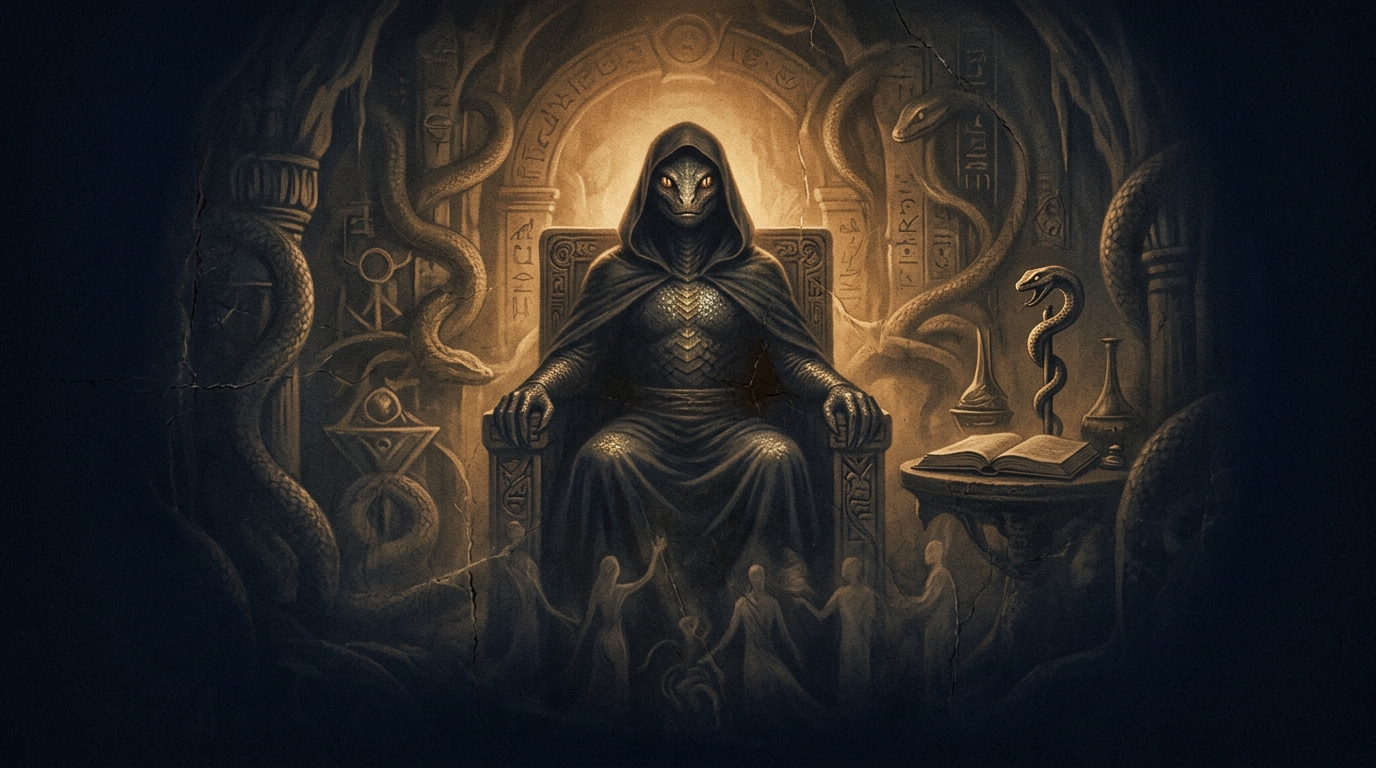
 Codex Illustration
Reptilians
The reptilian conspiracy — the claim that a race of shape-shifting, cold-blooded humanoid beings secretly governs human civilization — ranks among the most durable and culturally revealing conspiracy theories of the modern era, blending ancient serpent mythology, ufological abduction literature, and apocalyptic politics into a single, endlessly adaptable narrative.
Overview
The contemporary reptilian hypothesis, most visibly promoted by British author David Icke beginning in the early 1990s, asserts that a hidden lineage of extraterrestrial or interdimensional reptilian entities has infiltrated human elites — royal families, political dynasties, financial institutions — and that these beings sustain themselves through control, fear, and, in the most extreme versions of the claim, ritual. Icke's synthesis drew from an eclectic range of materials: Barbara Marciniak's channeled 'Pleiadian' texts, Zecharia Sitchin's contested readings of Sumerian cuneiform, John Keel's ultraterrestrial hypothesis, and older conspiratorial traditions running through Theosophy and Nag Hammadi Gnosticism. The theory entered mainstream cultural consciousness through Icke's prolific publishing output and, later, through the viral architecture of early internet forums, where it hybridized with New World Order narratives, anti-Semitic canards (a dimension noted by critical scholars including the Anti-Defamation League), and extraterrestrial disclosure communities. It is worth noting plainly: no credible physical, genetic, or institutional evidence supports the existence of shape-shifting reptilian rulers.
The mythological substrate of the reptilian idea, however, is genuinely ancient and cross-cultural — and that is where the scholarly conversation becomes more interesting. Serpent beings appear in the cosmogonies of ancient Sumer (the Anunnaki traditions, Tiamat), in Egyptian iconography (Apep, the serpentine chaos-force opposing Ra), in Vedic texts (the Nagas, semi-divine serpent people), in Mesoamerican tradition (Quetzalcoatl, the feathered serpent), and pervasively in Canaanite and Israelite literature. Whether this convergence reflects a shared primordial memory, a universal cognitive archetype rooted in evolutionary predator-detection (as scholars such as Lynne Isbell have proposed in her 'snake detection hypothesis'), or simply the independent narrative power of reptilian imagery, remains an open and genuinely interesting scholarly question. Comparative mythologists including Joseph Campbell observed that the serpent is among the most universal of all mythological symbols, embodying both wisdom and danger, order and chaos simultaneously.
Within ufological literature, the reptilian motif acquired a distinct character in the 1980s through contactee and abduction accounts. John Lear, William Cooper, and later the anonymous 'John Rhodes' popularized claims of underground reptilian civilizations — Dulce Base narratives, in particular, described cooperative and conflicted relationships between 'Greys,' reptilian beings, and human military personnel beneath New Mexico. These accounts blended with earlier science fiction tropes (notably the television series 'V,' which premiered in 1983 and depicted reptilian aliens in human disguise) in a feedback loop that makes source-tracing genuinely difficult. Researchers of UFO folklore including Jerome Clark and Jacques Vallée have noted that such narratives tend to absorb the cultural anxieties of their moment, functioning less as literal reports than as modern mythological productions.
From a scholarly standpoint, the reptilian conspiracy is most productively studied as a sociological and psychological phenomenon. Academic researchers including Michael Barkun (author of 'A Culture of Conspiracy,' 2003) and Robert Brotherton (author of 'Suspicious Minds,' 2015) situate it within the broader taxonomy of stigmatized knowledge — claims rejected by mainstream institutions but maintained by dedicated subcultures. Barkun's framework of 'improvisational millennialism' helps explain how the reptilian narrative functions as a secularized apocalyptic system: a hidden evil power, an elect who perceive the deception, and an imminent unmasking. The narrative's resilience owes much to its structural elegance — it provides a totalizing explanation for felt injustice, concentrated power, and moral disorder in human societies, which is precisely what makes it both appealing and dangerous when it shades into ethnic or political scapegoating.
Key Claims
Timeline
Evidence
Multiple Perspectives
Biblical Lens
Scripture Threads
Sources & Further Study
Questions to Explore
Go Deeper Path
Follow the Thread
Continue the Investigation
You’ve reached the Full Archive portion of this Case File.
Ask the Archivist
about this fileSign in to ask the Archivist
Create a free account to ask the Archivist 1 grounded question each day, cited straight from the CODEX case files.
Discussion
0Share findings, questions, and evidence with fellow Seekers. Be respectful and cite sources where you can.
No comments yet. Be the first to open this thread.