 Codex Illustration
The Rosicrucians
In the early seventeenth century, three anonymous German pamphlets announced a secret brotherhood of learned Christian mystics — the Fraternity of the Rose Cross — sending European intellectual society into ferment; whether that brotherhood ever truly existed remains one of history's most elegant unsolved questions.
Overview
Between 1614 and 1617, three extraordinary documents emerged from the German-speaking world: the Fama Fraternitatis (1614), the Confessio Fraternitatis (1615), and The Chymical Wedding of Christian Rosenkreutz (1616). Together they described a hidden fraternity founded by a mythical German pilgrim named Christian Rosenkreutz, who had allegedly traveled to the Near East and North Africa in the early fifteenth century, absorbed ancient wisdom from Arab sages, and returned to establish a brotherhood of healers and illuminated scholars. The Fama claimed that Rosenkreutz's perfectly preserved tomb had recently been rediscovered — sealed for 120 years — and that the brotherhood was now inviting worthy men to make contact. No address was given. Europe's philosophers, alchemists, theologians, and proto-scientists responded with hundreds of pamphlets and letters, either pleading for admission or denouncing the fraternity as a hoax or a diabolical snare. The remarkable irony documented by historians is that, despite this enormous response, no one ever demonstrably received a reply from the brotherhood itself.
Scholarly consensus today holds that the Rosicrucian manifestos were literary and theological provocations, almost certainly authored within a small Protestant humanist circle in Tübingen. The Chymical Wedding is now attributed with strong scholarly confidence to the Lutheran theologian Johann Valentin Andreae, who later described it as a youthful ludibrium — a literary jest or playful fiction — though he acknowledged the broader manifesto project with some ambivalence. The Fama and Confessio are frequently attributed to a collaborative circle that included Andreae, Christoph Besold, and Tobias Hess, though definitive proof of authorship remains elusive. The documents blended Lutheran piety, Christian Kabbalah, Paracelsan medicine, and Hermetic philosophy into a visionary programme for the reform of arts, sciences, and religion — anticipating, in remarkable ways, the intellectual ideals later associated with the Royal Society and the Enlightenment. Frances Yates, in her landmark 1972 study The Rosicrucian Enlightenment, argued influentially that a 'Rosicrucian moment' — a short-lived but consequential current — helped shape the climate in which early modern science emerged, though subsequent historians have debated the directness of this connection.
The historical relationship between Rosicrucianism and Freemasonry is genuinely complex and contested. Some degrees within eighteenth-century Masonic systems — notably the Rosicrucian degree of the Ancient and Accepted Scottish Rite — drew explicitly on Rosicrucian symbolism and legend. Scholars including David Stevenson and Christopher McIntosh have traced lines of cultural influence, while noting that no organizational succession from the seventeenth-century manifestos to Masonic bodies can be proved. The broader occult revival of the nineteenth century saw numerous orders claim Rosicrucian lineage, including the Societas Rosicruciana in Anglia (founded 1865) and the Hermetic Order of the Golden Dawn, whose members included W.B. Yeats and Aleister Crowley. In the twentieth century, Harvey Spencer Lewis founded the Ancient Mystical Order Rosae Crucis (AMORC) in the United States in 1915, building a large correspondence-course organization headquartered in San Jose, California, home of the notable Rosicrucian Egyptian Museum. AMORC's claims to ancient unbroken lineage are widely regarded by historians as mythological rather than historical, though the organization itself and its museum represent a genuine and well-documented modern institutional presence.
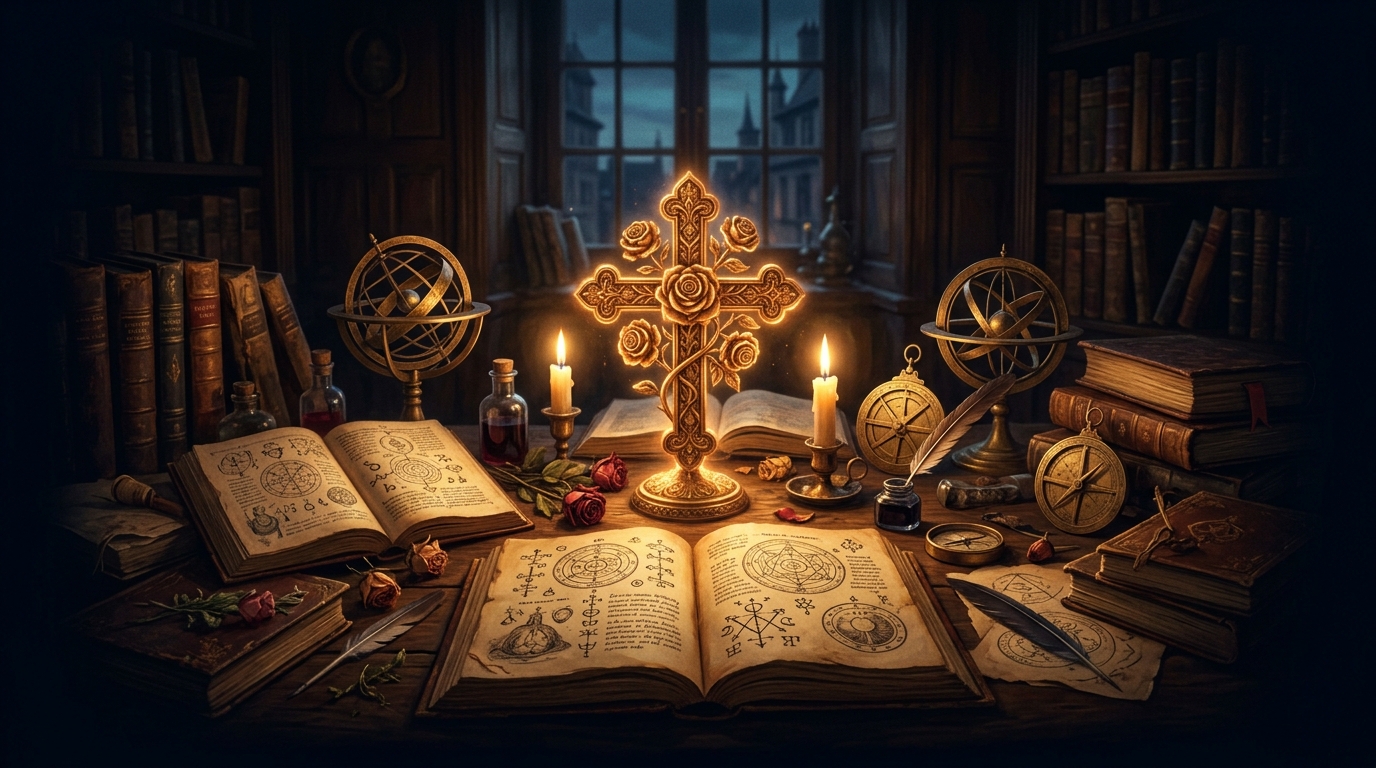
The enduring fascination of Rosicrucianism lies partly in its structural genius: an order that may never have existed generated centuries of seekers, imitators, and genuine philosophical creativity. The Rosy Cross — a rose blooming at the intersection of a cross — became one of Western esotericism's most potent symbols, fusing Christian redemption imagery with alchemical and natural philosophical themes. Historians of esotericism such as Wouter Hanegraaff and Antoine Faivre situate Rosicrucianism within the broader stream of Western esotericism as a genuine intellectual tradition worthy of serious scholarly study, distinct from both orthodox Christianity and modern popular occultism. Whether one reads the manifestos as Protestant reform literature, alchemical allegory, early science fiction, or the founding charter of a real invisible college, they remain among the most mysterious and consequential anonymous texts in European intellectual history.
Key Claims
Timeline
Evidence
Multiple Perspectives
Biblical Lens
Scripture Threads
Sources & Further Study
Questions to Explore
Go Deeper Path
Follow the Thread
Continue the Investigation
You’ve reached the Full Archive portion of this Case File.
Ask the Archivist
about this fileSign in to ask the Archivist
Create a free account to ask the Archivist 1 grounded question each day, cited straight from the CODEX case files.
Discussion
0Share findings, questions, and evidence with fellow Seekers. Be respectful and cite sources where you can.
No comments yet. Be the first to open this thread.