
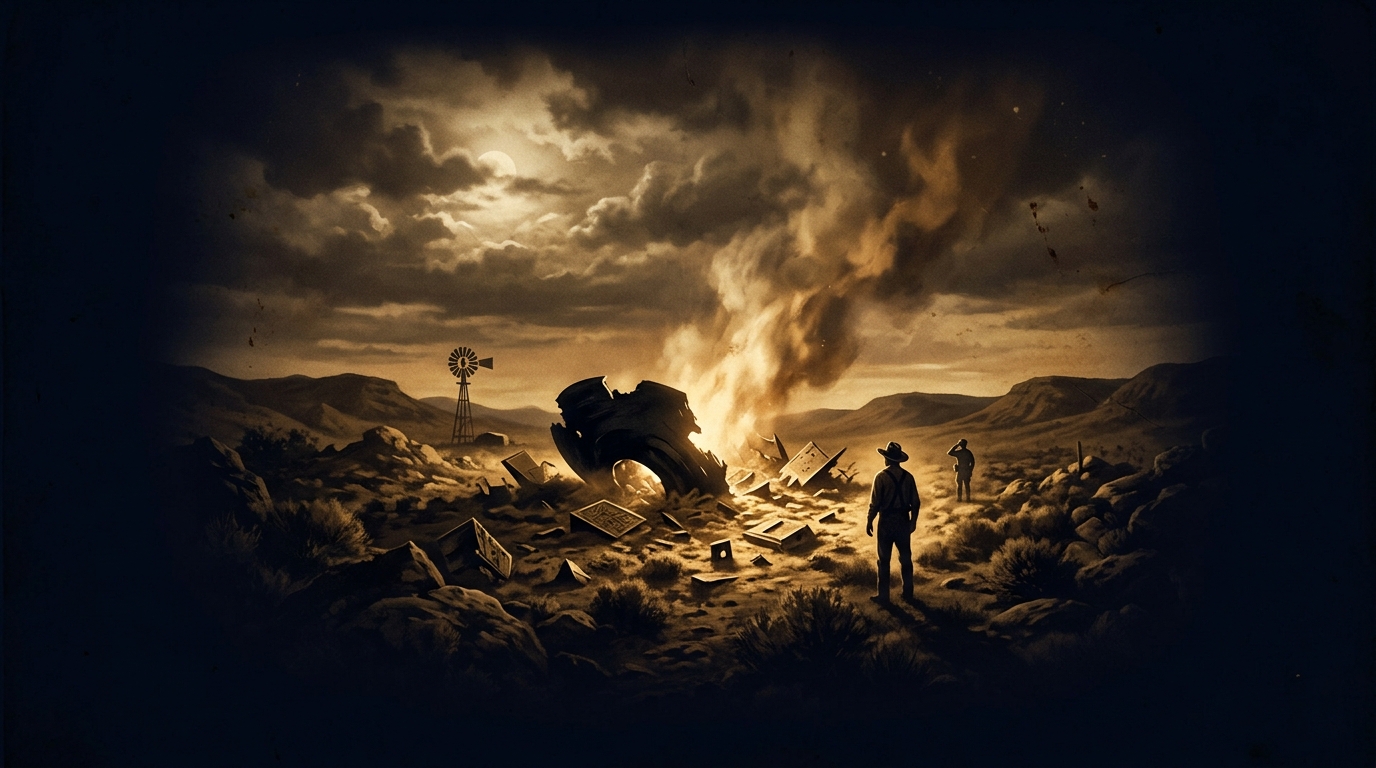
 Codex Illustration
The Roswell Incident
In the summer of 1947, something crashed on a remote ranch outside Roswell, New Mexico — triggering a government press release announcing a 'flying disc,' a rapid retraction, and seven decades of controversy that transformed UFO phenomena into a cultural and political obsession.
Overview
On or around July 2–4, 1947, rancher W.W. 'Mac' Brazel discovered an unusual debris field on the Foster Ranch approximately 75 miles north of Roswell, New Mexico. After contacting local authorities, the matter was escalated to Roswell Army Air Field (RAAF), whose public information officer Walter Haut issued a press release on July 8 stating that personnel had recovered a 'flying disc.' Within hours, commanding General Roger Ramey issued a correction attributing the debris to a conventional weather balloon. The rapid reversal was seized upon by UFO researchers as evidence of a cover-up, and the Roswell incident became the foundational myth of modern UFO culture.
The U.S. government's subsequent explanations have themselves evolved over decades, from weather balloon (1947) to a classified high-altitude surveillance balloon from Project Mogul (1994 Air Force report) to a more elaborate 1997 Air Force report addressing witness claims of recovered bodies, attributing these to anthropomorphic test dummies used in high-altitude parachute experiments. Critically, the Mogul explanation is considered mainstream and well-documented by most historians and skeptical investigators. The physical debris recovered — described variously as balsa wood, foil, and unusual porous material — is consistent with the classified Mogul balloon train, designed to monitor Soviet nuclear tests, which would explain both the initial secrecy and the scrambled official response.
Nevertheless, persistent testimony from individuals claiming firsthand or secondhand knowledge of non-human bodies, exotic materials, and covert transportation of wreckage has kept Roswell at the center of UAP discourse. Key witnesses include Glenn Dennis, a Roswell mortician who claimed he received unusual calls about small bodies; Jesse Marcel Sr., the intelligence officer who handled the debris and later expressed doubt about the weather balloon explanation; and Frank Kaufmann, whose detailed accounts of recovered craft and bodies were largely discredited after his death when fabricated documents were discovered in his possession. The evidentiary chain is thus deeply compromised: credible anomaly exists alongside demonstrably fabricated testimony, making clean historical reconstruction difficult.
Roswell's cultural legacy arguably eclipses its evidentiary value. It catalyzed the modern UFO movement, shaped government transparency debates, inspired the congressional hearings of the 1990s, and prefigured the contemporary UAP disclosure push that produced the 2021 ODNI Preliminary Assessment and subsequent congressional legislation mandating UAP reporting. Scholars of religion, folklore, and cultural anthropology have examined Roswell as a modern myth-making event — a story that fills psychological and quasi-religious needs for contact with higher intelligences, government accountability, and cosmic significance. Whether the incident represents a genuine unexplained phenomenon, a misidentified classified program, or a culturally amplified rumor, its historical importance as a pivot point in American consciousness is beyond dispute.
Timeline
Evidence
Multiple Perspectives
Biblical Lens
Scripture Threads
Sources & Further Study
Questions to Explore
Follow the Thread
Continue the Investigation
You’ve reached the Full Archive portion of this Case File.
Ask the Archivist
about this fileSign in to ask the Archivist
Create a free account to ask the Archivist 1 grounded question each day, cited straight from the CODEX case files.
Discussion
0Share findings, questions, and evidence with fellow Seekers. Be respectful and cite sources where you can.
No comments yet. Be the first to open this thread.