
 Codex Illustration
Seances
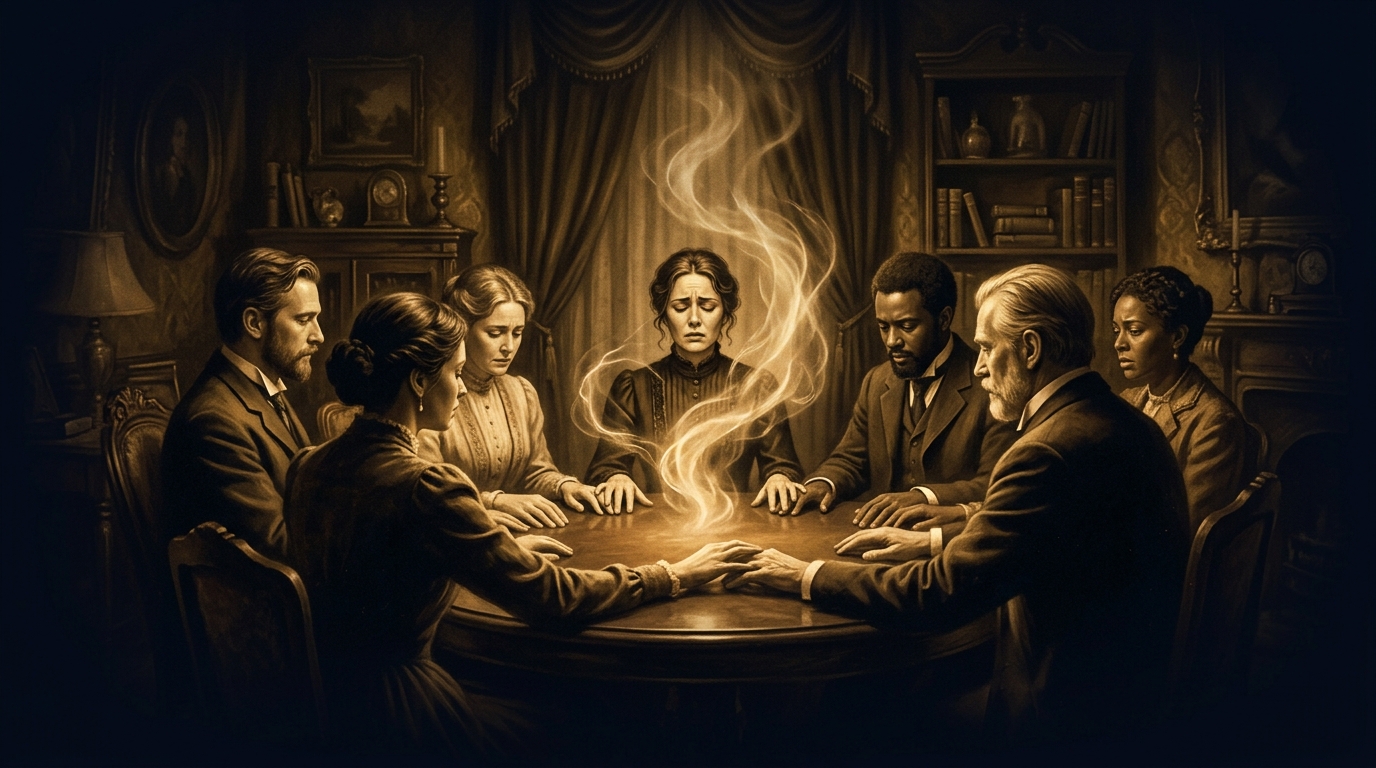
For roughly a century beginning in the 1840s, the séance — a structured ritual of communal spirit-contact — swept through Western parlors, royal courts, and scientific laboratories alike, blurring the boundary between grief, entertainment, religion, and outright fraud in ways that remain historically instructive and theologically provocative.
Overview
The modern séance emerged from a deceptively mundane event: in March 1848, in a modest farmhouse in Hydesville, New York, two young sisters — Kate and Margaretta Fox — reported mysterious rappings they claimed to interpret as communications from a deceased peddler buried beneath their home. Whether genuine, self-deluding, or confabulated, the incident ignited a social movement of extraordinary velocity. Within a decade, Spiritualism — the religious-cultural framework built around the belief that the living could communicate with the dead — claimed millions of adherents across the United States and Britain. The séance was its central liturgy: a darkened room, a circle of hands, a medium in altered or trance-like states, and phenomena ranging from table-tilting and automatic writing to full-bodied apparitions and spoken messages attributed to departed souls.
The historical record is a complex mixture of documented cultural fact and disputed phenomenology. What is unambiguously documented is the sociological reality of the Spiritualist movement: it attracted figures as prominent as Arthur Conan Doyle, William James, Mary Todd Lincoln, and Queen Victoria, who reportedly held private séances at Windsor Castle following the death of Prince Albert. What is deeply contested is whether any of the phenomena produced at séances reflected genuine contact with discarnate entities, or whether they were uniformly the product of grief-driven credulity, voluntary self-deception, cold reading, and deliberate theatrical fraud. Harry Houdini, himself deeply motivated by a desire to contact his deceased mother, spent the latter years of his life systematically exposing fraudulent mediums, and his work — alongside that of contemporaneous investigators — left an extensive documented record of physical trickery. The Fox sisters themselves, in a public confession in 1888 (later partially retracted by Margaretta), admitted that the famous rappings had been produced by joint cracking.
Yet the historical picture resists simple dismissal. The Society for Psychical Research (SPR), founded in London in 1882 by a distinguished group of Cambridge scholars including Frederic W. H. Myers, Edmund Gurney, and Henry Sidgwick, undertook systematic, methodologically serious investigations of mediumship and related phenomena. Some of their findings — particularly surrounding the medium Leonora Piper, who was studied extensively by William James and later by Richard Hodgson — could not be easily reduced to fraud or normal information transfer. The SPR's archives constitute a substantial body of primary material that serious scholars continue to evaluate. Mainstream parapsychology has not established the reality of séance phenomena to the satisfaction of the broader scientific community, but neither has a comprehensive normal-process explanation been offered for every documented case. The honest intellectual position acknowledges a spectrum: from the patently fraudulent, through the genuinely puzzling, to the irreducibly ambiguous.
The séance's cultural afterlife has been equally significant. What began as a quasi-religious practice became embedded in Victorian popular culture, shaped early cinema, influenced the development of psychology (Frederic Myers coined the term 'subliminal self,' a precursor to the unconscious), and left permanent marks on literary and artistic modernism. The practice also raised, with unusual urgency, questions that philosophy and theology have never resolved: the nature of personal identity after death, the reliability of grief as an epistemological instrument, the ethics of exploiting the bereaved, and the human compulsion to pierce what the Book of Job calls the boundary of the dead. These questions animate not only the archives of psychical research but also broader inquiries into consciousness, the afterlife, and the limits of scientific materialism.
Key Claims
Timeline
Evidence
Multiple Perspectives
Biblical Lens
Scripture Threads
Sources & Further Study
Questions to Explore
Go Deeper Path
Follow the Thread
Continue the Investigation
You’ve reached the Full Archive portion of this Case File.
Ask the Archivist
about this fileSign in to ask the Archivist
Create a free account to ask the Archivist 1 grounded question each day, cited straight from the CODEX case files.
Discussion
0Share findings, questions, and evidence with fellow Seekers. Be respectful and cite sources where you can.
No comments yet. Be the first to open this thread.