
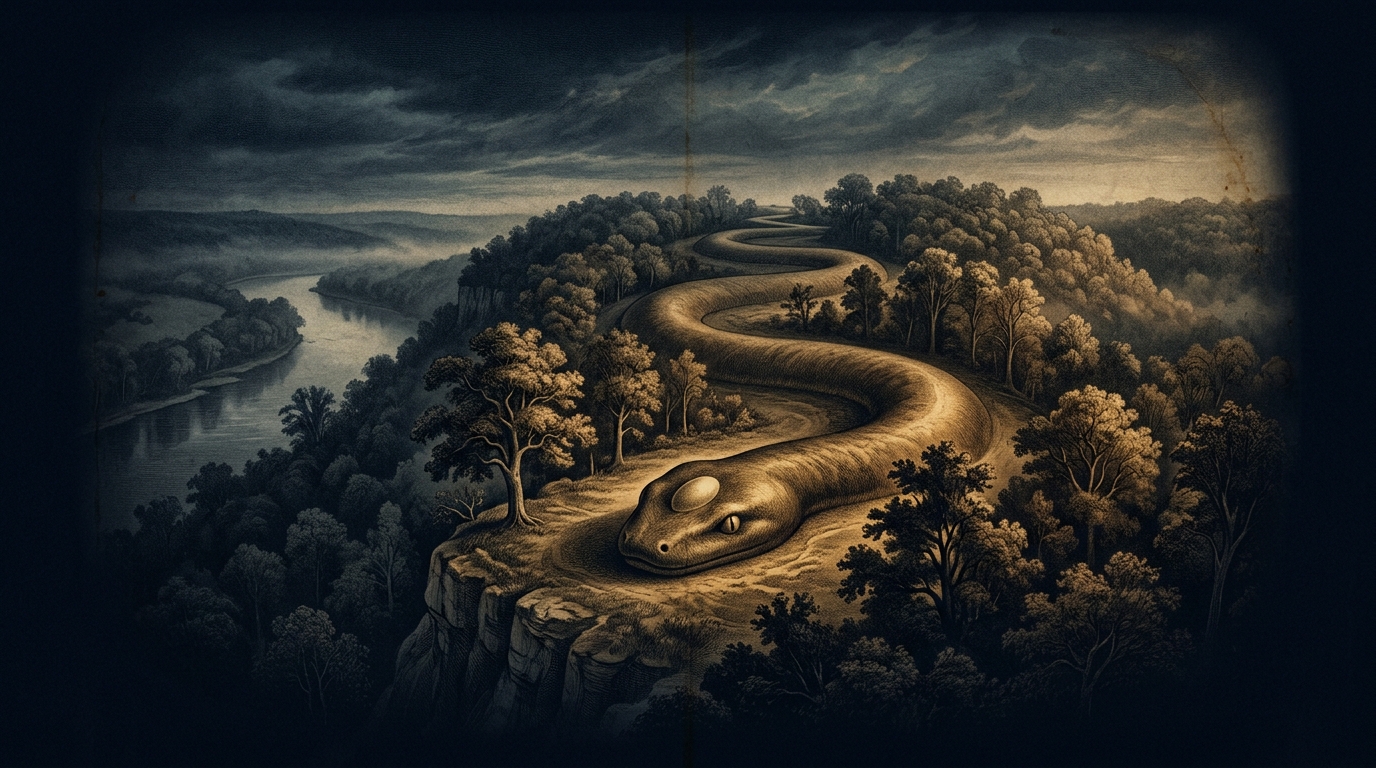
 Codex Illustration
Serpent Mound
Coiling nearly a quarter mile across the bluffs of southern Ohio, Serpent Mound is the largest known effigy mound in the world — a monumental earthwork whose builders, precise age, and intended meaning remain subjects of serious scholarly debate.
Overview
Serpent Mound stretches approximately 1,348 feet along a glacial plateau above Brush Creek in Adams County, Ohio, depicting an undulating serpent apparently in the act of swallowing or disgorging an oval form at its head. First systematically described to the wider academic world by Ephraim George Squier and Edwin Hamilton Davis in their landmark 1848 survey, Ancient Monuments of the Mississippi Valley, the mound reaches an average height of roughly three feet and has been the subject of intermittent excavation, restoration, and scholarly reanalysis ever since. No burials have been found within the effigy itself, distinguishing it functionally from the mortuary mounds of the region and deepening the mystery of its purpose.
The question of who built Serpent Mound is genuinely contested. For much of the late nineteenth and twentieth centuries, archaeologists attributed it to the Adena culture, which flourished in the Ohio Valley roughly from 800 BC to AD 100. However, radiocarbon dating conducted by researchers including Bradley Lepper and colleagues in the 1990s on charcoal samples from the mound's interior suggested a much later construction date — possibly around AD 1070 — pointing instead to the Fort Ancient culture. A subsequent 2014 study by researchers at the University of Toledo, led by William Romain, further complicated matters by yielding dates in the Adena range, suggesting either multiple construction phases or methodological challenges with the samples themselves. The scholarly consensus, if one can be said to exist, acknowledges genuine uncertainty about both the builders and the chronology.
Among the most frequently cited features of Serpent Mound are its apparent astronomical alignments. Several researchers, most notably William F. Romain in his book Mysteries of the Hopewell (2000) and subsequent studies, have argued that the mound's curves and orientation correspond meaningfully to solstice and equinox sunrises and sunsets, as well as to certain lunar standstill events. The head of the serpent appears oriented toward the summer solstice sunset when viewed from a specific vantage point, and the tail coils in a manner some interpret as mirroring astronomical cycles. These alignments are taken seriously by a number of archaeoastronomers, though others caution that the number of possible alignments at any ancient site makes coincidental correlation statistically plausible without intentional design being provable.
The site sits atop a cryptoexplosion structure — a roughly four-mile-wide geological formation caused either by a meteor impact or by an internal geological explosion of uncertain origin, a detail that has fueled considerable popular speculation. Whether the ancient builders were aware of this anomalous geology, and whether it influenced their choice of location, is unknown but intriguing. Serpent Mound is today a State Memorial managed by the Ohio History Connection, and it was inscribed on the World Monuments Fund's watch list in the past, underscoring both its fragility and its recognized cultural significance. The mound endures as one of the most evocative and genuinely mysterious monuments in North America — a work of deliberate, communal human effort whose full meaning has not yet been recovered.
Key Claims
Timeline
Evidence
Multiple Perspectives
Biblical Lens
Scripture Threads
Sources & Further Study
Questions to Explore
Go Deeper Path
Follow the Thread
Continue the Investigation
You’ve reached the Full Archive portion of this Case File.
Ask the Archivist
about this fileSign in to ask the Archivist
Create a free account to ask the Archivist 1 grounded question each day, cited straight from the CODEX case files.
Discussion
0Share findings, questions, and evidence with fellow Seekers. Be respectful and cite sources where you can.
No comments yet. Be the first to open this thread.