
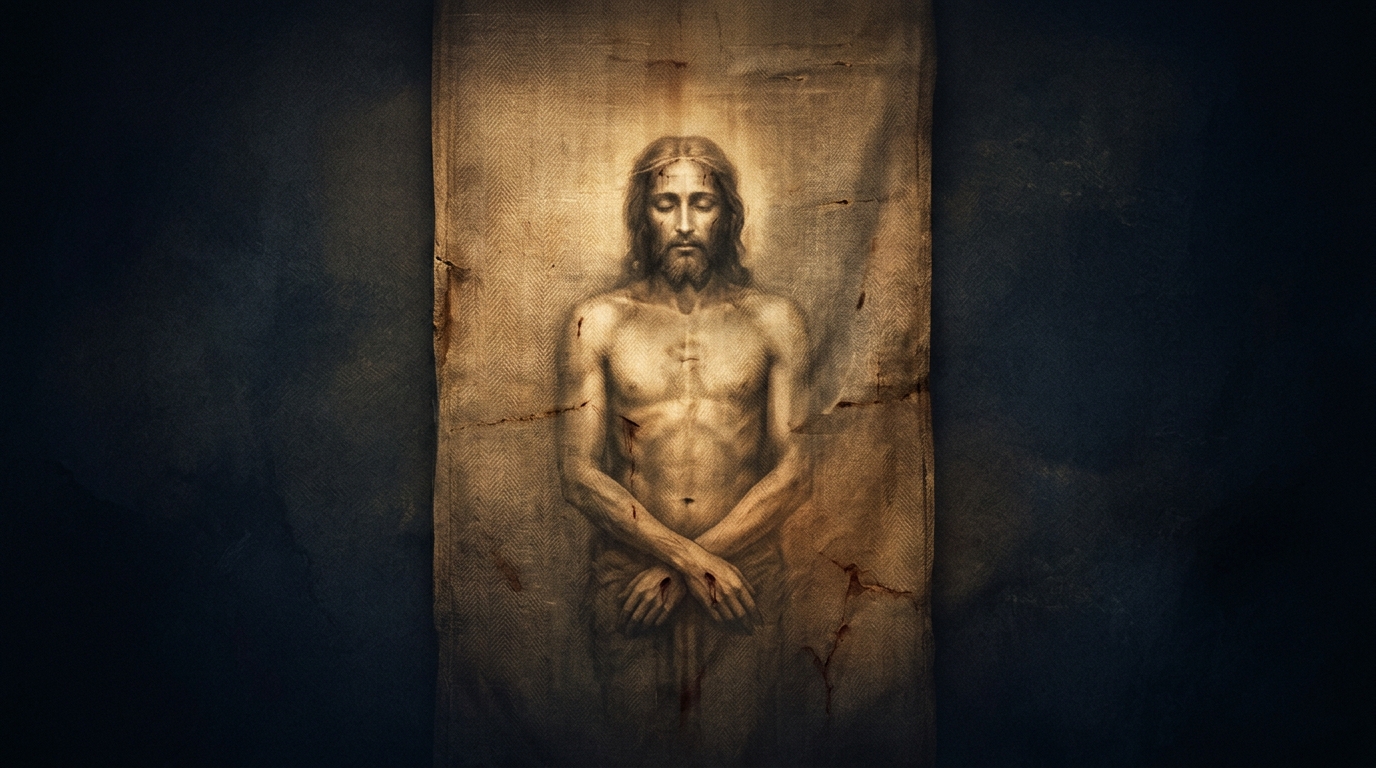
 Codex Illustration
Shroud of Turin
A linen cloth bearing the faint, photographic-negative image of a crucified man, the Shroud of Turin has resisted definitive explanation for centuries — its wounds, chemistry, and encoded three-dimensional data placing it at the intersection of forensic science, medieval history, and the most consequential resurrection claim in human history.
Overview
Housed in the Cathedral of Saint John the Baptist in Turin, Italy, the Shroud is a fourteen-foot length of herringbone-twill linen bearing a double, head-to-head, front-and-back imprint of a tall man who shows forensically detailed wounds consistent with Roman crucifixion: scourge marks consistent with a flagrum's lead-tipped thongs across the back and legs, puncture wounds at the wrists and feet, a large elliptical wound in the right side consistent with a Roman lancea, and a scalp lacerated by a circular crown of sharp objects rather than a theatrical wreath. What arrested twentieth-century science was not the wounds themselves but the image's physical character: in 1898, amateur photographer Secondo Pia discovered that the cloth's image behaves as a photographic negative — the negative of a negative producing a startlingly lifelike positive. In 1976, physicist John Jackson and aerospace engineer Eric Jumper fed the image into a VP-8 Image Analyzer, a NASA-developed tool for encoding topographical relief, and found that the image contained accurate three-dimensional distance information — a property no known painting, dye process, or contact-transfer technique naturally produces.
The Shroud of Turin Research Project (STURP), a multidisciplinary team of American scientists granted direct physical access in 1978, conducted 120 hours of intensive testing. Their 1981 peer-reviewed summary concluded that the image is a superficial, straw-yellow discoloration of the topmost fibrils of the linen — not paint, not dye, not any applied substance they could identify — with a resolution so fine it affects individual fibers rather than threads, and a penetration depth of roughly 200 nanometers. STURP's Alan Adler and John Heller independently confirmed the bloodstains as genuine human blood — type AB, containing hemoglobin, bilirubin, and albumin consistent with severe physical trauma — and noted the serum halos surrounding the clots, a detail consistent with actual wound drainage rather than artistic invention. The anatomical precision of the wounds aligns closely with Roman crucifixion practice as understood from both literary sources and the 1968 discovery of Yehohanan, the only confirmed archaeologically-recovered crucifixion victim.
The most contested chapter in Shroud scholarship arrived in 1988, when laboratories at Oxford, Zurich, and the University of Arizona conducted radiocarbon dating on a sample taken from one corner of the cloth and announced a medieval date range of 1260–1390 AD, appearing to resolve the authenticity question decisively. Yet that conclusion has since been substantially complicated. In 2005, chemist Raymond Rogers — a STURP veteran and skeptic of authenticity — published a peer-reviewed paper in the journal Thermochimica Acta demonstrating that the 1988 sample corner contained cotton fibers, a different weave character, and vanillin levels inconsistent with the rest of the cloth, strongly suggesting the sample was taken from a later medieval repair patch rather than original linen. In 2022, a team led by Liberato De Caro at the Italian CNR published a Wide-Angle X-ray Scattering (WAXS) study in the journal Heritage, analyzing the natural degradation of cellulose crystallinity in the linen and arriving at a date of approximately 55–74 AD ± 250 years — broadly consistent with a first-century origin. Additional circumstantial evidence includes pollen grains identified by Swiss criminologist Max Frei-Sulzer consistent with species native to the Jerusalem region and Anatolia, and aragonite limestone dust in the heel and knee regions chemically matching limestone found in Jerusalem's first-century tombs — though both findings have faced methodological criticism.
The Sudarium of Oviedo — a cloth venerated in Spain since at least the seventh century, historically claimed to be the face cloth of Jesus mentioned in John 20:7 — shares blood type AB and wound-pattern geometry with the Shroud in ways that have been judged consistent by researchers including Mark Guscin and Giulio Fanti. Whether the two cloths contacted the same individual remains a subject of serious scholarly debate rather than established consensus. What the cumulative record shows — cautiously but honestly — is that the Shroud is a genuinely anomalous artifact: its image-formation mechanism remains unexplained by any reproducible natural or artistic process; its bloodstains are forensically real; its environmental traces gesture toward the Levant; and the radiocarbon result, once considered decisive, now stands as one contested data point among many. The question of its identity remains, as it has always been, genuinely open.
Key Claims
Timeline
Evidence
Multiple Perspectives
Biblical Lens
Scripture Threads
Sources & Further Study
Questions to Explore
Go Deeper Path
Follow the Thread
Continue the Investigation
You’ve reached the Full Archive portion of this Case File.
Ask the Archivist
about this fileSign in to ask the Archivist
Create a free account to ask the Archivist 1 grounded question each day, cited straight from the CODEX case files.
Discussion
0Share findings, questions, and evidence with fellow Seekers. Be respectful and cite sources where you can.
No comments yet. Be the first to open this thread.