
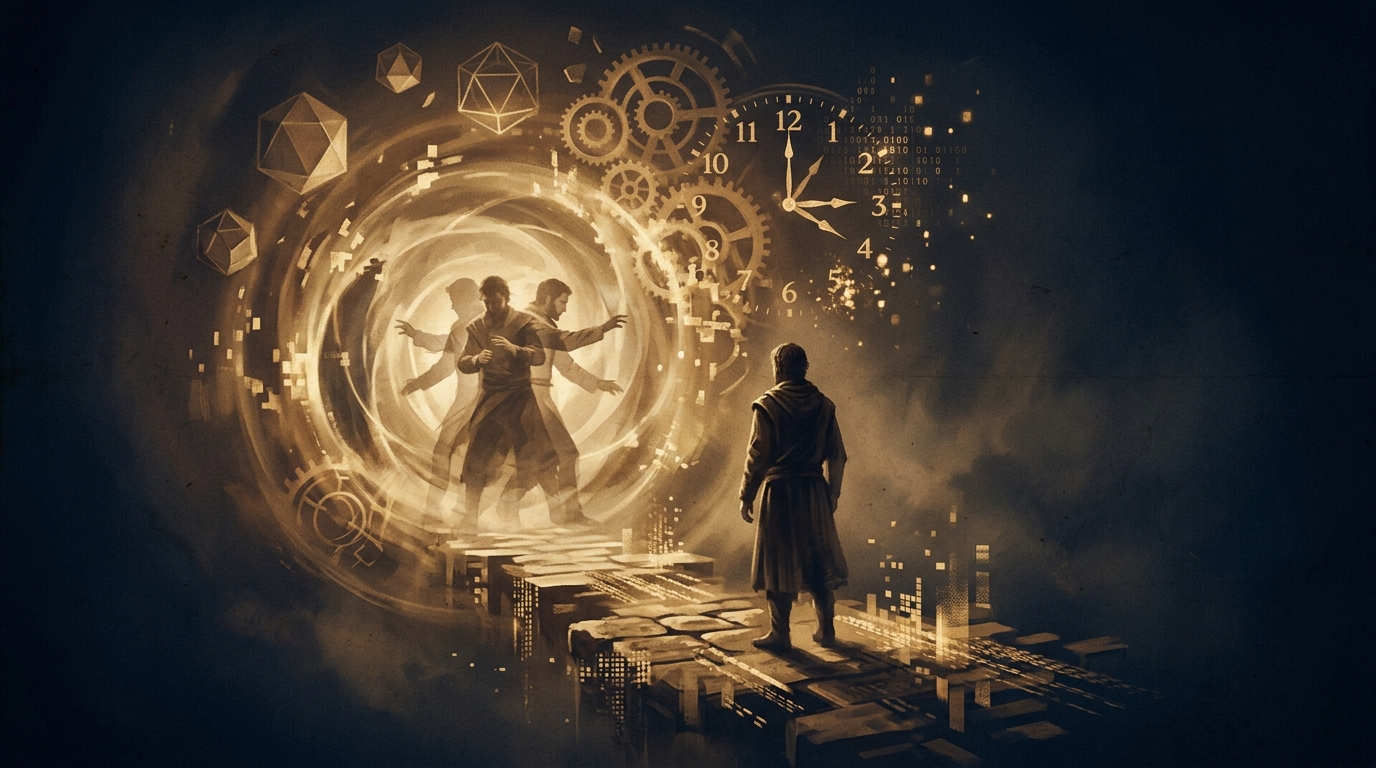
 Codex Illustration
Simulation Glitches
A growing cultural and philosophical conversation holds that certain anomalous experiences — déjà vu, the Mandela Effect, and statistically improbable coincidences — may be detectable 'errors' in a computationally generated reality, offering ordinary people glimpses behind the curtain of existence itself.
Overview
The phrase 'simulation glitch' entered popular consciousness largely through the internet age, but its intellectual roots are considerably older. The idea that perceived reality may be a constructed or illusory layer over a deeper truth appears in Plato's Allegory of the Cave, in Descartes' meditations on the deceiving demon, and in various strands of Hindu and Buddhist thought concerning maya — the veil of illusion. What distinguishes the modern 'glitch' hypothesis from these ancient predecessors is its specifically computational framing: the suggestion that anomalous perceptual events are not merely philosophical puzzles but diagnostic symptoms, analogous to a bug or rendering artifact in software, implying that the substrate of reality is information-theoretic rather than material. This framing was given serious academic scaffolding by philosopher Nick Bostrom's 2003 paper 'Are You Living in a Computer Simulation?' published in the Philosophical Quarterly, which argued probabilistically that advanced civilizations would likely run vast numbers of ancestor simulations, making it statistically probable that any given conscious entity inhabits such a simulation rather than base reality.
The three phenomena most commonly cited as candidate 'glitches' are déjà vu, the Mandela Effect, and improbable coincidences. Déjà vu — the uncanny sense of having already lived through a present moment — is a well-documented neurological phenomenon studied extensively by researchers including Chris Moulin and Akira O'Connor, who have linked it to transient misfirings in familiarity-recognition circuits in the temporal and frontal lobes. The scientific literature does not support a simulation interpretation; the cognitive neuroscience explanation is robust and falsifiable. The Mandela Effect — a term coined by blogger and self-described paranormal researcher Fiona Broome around 2009, referring to large groups of people sharing the same false memory — has been studied from a cognitive psychology standpoint as a manifestation of memory conformity, social reinforcement, and the malleability of semantic memory. Neither phenomenon, in mainstream scientific evaluation, requires the postulation of external computational interference. Yet the experiential quality of these events — the visceral sense of wrongness, of reality momentarily showing its seams — continues to resist easy dismissal for those who undergo them.
Improbable coincidences occupy a particularly slippery position in this discourse. Mathematician and philosopher David Hand, in his 2014 book 'The Improbability Principle,' argues rigorously that extremely unlikely events are, in aggregate, inevitable given the vast number of trials the universe conducts every moment. The feeling that a coincidence is cosmically significant is a well-characterized cognitive bias — the clustering illusion and the law of truly large numbers together account for the overwhelming majority of experiences people label miraculous or anomalous. Nevertheless, a subset of researchers — including those working at the intersection of quantum mechanics and consciousness, such as proponents of the Orchestrated Objective Reduction hypothesis advanced by Roger Penrose and Stuart Hameroff — suggest that quantum-level indeterminacy introduces genuine ontological openness into physical processes, potentially complicating simple materialist explanations of conscious experience without, it must be said, lending any direct support to simulation theory.
What makes the 'simulation glitch' framework culturally durable is not its scientific credibility — which is, at present, essentially nil as a testable hypothesis — but its narrative power. It transforms mundane cognitive malfunctions into potentially meaningful signals, recasting the ordinary human experience of uncertainty and strangeness as evidence of a hidden architecture. Philosophers such as David Chalmers, in 'Reality+' (2022), take simulation scenarios seriously as metaphysical possibilities while carefully declining to assert them as established facts. Chalmers notes that even if we inhabit a simulation, the objects and experiences within it would be 'real' in all functionally meaningful senses — a point that substantially deflates the dramatic implications of the glitch narrative. The phenomenon thus sits at a productive and unresolved intersection of neuroscience, philosophy of mind, information theory, cultural mythology, and the very human impulse to find pattern and meaning in a world that frequently declines to provide either.
Key Claims
Timeline
Evidence
Multiple Perspectives
Biblical Lens
Scripture Threads
Sources & Further Study
Questions to Explore
Go Deeper Path
Follow the Thread
Continue the Investigation
You’ve reached the Full Archive portion of this Case File.
Ask the Archivist
about this fileSign in to ask the Archivist
Create a free account to ask the Archivist 1 grounded question each day, cited straight from the CODEX case files.
Discussion
0Share findings, questions, and evidence with fellow Seekers. Be respectful and cite sources where you can.
No comments yet. Be the first to open this thread.