
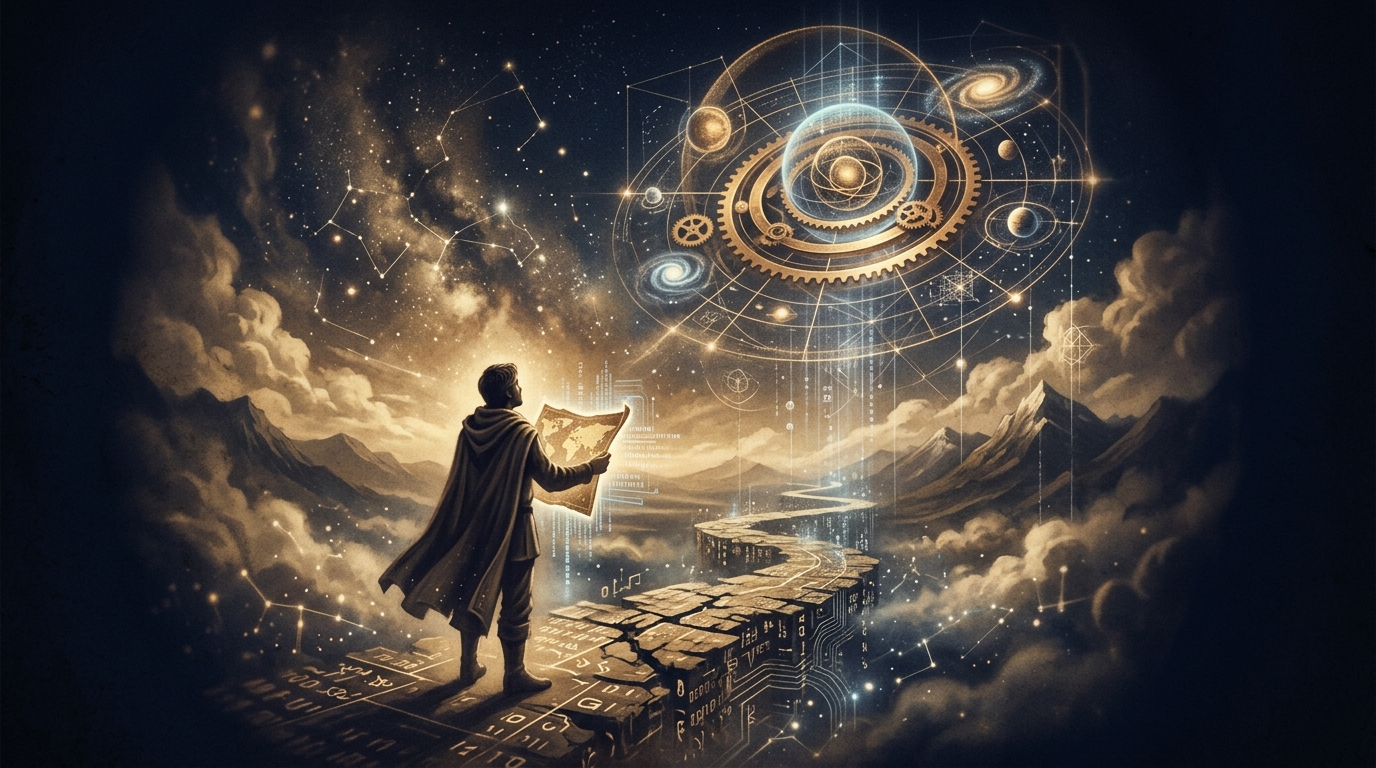
 Codex Illustration
Simulation Theory
Simulation Theory proposes that what we experience as physical reality may be a computational construct generated by a vastly more advanced intelligence—raising profound questions about the nature of existence, consciousness, and the boundaries between creator and creation. Far from a fringe curiosity, it has attracted serious engagement from physicists, philosophers, and theologians alike.
Overview
Simulation Theory in its modern philosophical form was most rigorously articulated by Swedish philosopher Nick Bostrom in his 2003 paper 'Are You Living in a Computer Simulation?' published in the journal Philosophical Quarterly. Bostrom's trilemma argues that at least one of three propositions must be true: civilizations almost universally go extinct before developing the computational capacity to simulate consciousness; technologically mature civilizations have no interest in running such simulations; or we are almost certainly already living inside one. The argument is formally probabilistic rather than theological, drawing on straightforward extrapolations of computing power and the logic of large numbers. Its reception in academic philosophy was serious enough to prompt sustained peer responses, and it has since become a fixture of analytic philosophy of mind and cosmology.
The idea itself, however, predates Bostrom by millennia in all but name. Plato's Allegory of the Cave in the Republic imagines prisoners who mistake shadow-projections on a cave wall for ultimate reality, never perceiving the true forms behind them. René Descartes' Meditations on First Philosophy entertained the possibility of a malicious demon who might construct an entirely false experiential world. In the twentieth century, philosopher Hilary Putnam's 'Brain in a Vat' thought experiment and Robert Nozick's 'experience machine' scenario both probed the epistemic and ethical dimensions of artificially constructed realities. The Matrix film trilogy (1999–2003) brought these themes into popular consciousness, though serious philosophers note that cinema tends to dissolve the argument's rigor into action-film metaphor.
On the scientific front, the theory has attracted attention from physicists including Max Tegmark, who argues in his Mathematical Universe Hypothesis that mathematical structures are not merely descriptions of reality but are reality itself—a position that dovetails suggestively with simulation arguments. Separately, researchers such as Silas Beane and colleagues at the University of Bonn published a 2012 paper in the European Physical Journal A proposing that if our universe were a lattice-based simulation, it might leave detectable signatures in the energy spectrum of cosmic rays. The theoretical physicist James Gates Jr. discovered what appear to be error-correcting codes embedded in the equations of supersymmetry—a finding he has discussed publicly, though its interpretive implications remain deeply contested among physicists. Elon Musk and Neil deGrasse Tyson have made popular public statements endorsing the probability of simulation, though neither claim carries the weight of peer-reviewed argument.
Theologically, simulation theory intersects with ancient questions about the nature of divine creation, the relationship between creator and creature, and the ontological status of matter. Christian theologians have noted both the provocations and the limits of the analogy: if a simulator is itself a created, finite, fallible intelligence, it bears little resemblance to the omnipotent, omniscient God of classical theism. Gnostic cosmologies—which posited that the material world was fashioned by a lesser, flawed demiurge rather than the true ultimate God—have been widely cited as the closest ancient structural parallel, though scholars caution that similarity in metaphor does not imply equivalence in meaning or truth-content. The theory also intersects meaningfully with debates in consciousness studies, particularly regarding whether subjective experience could in principle be computationally replicated—a question that remains unresolved.
Timeline
Evidence
Multiple Perspectives
Biblical Lens
Scripture Threads
Sources & Further Study
Questions to Explore
Follow the Thread
Continue the Investigation
You’ve reached the Full Archive portion of this Case File.
Ask the Archivist
about this fileSign in to ask the Archivist
Create a free account to ask the Archivist 1 grounded question each day, cited straight from the CODEX case files.
Discussion
0Share findings, questions, and evidence with fellow Seekers. Be respectful and cite sources where you can.
No comments yet. Be the first to open this thread.